|
UPS Knowledge Series · Part 2 of 6
UPS Topologies — Offline, Line-Interactive and Online UPS Compared
VFD, VI and VFI per IEC 62040-3: how they work, pros/cons and buying decision
Standby UPS · Line-Interactive · Double Conversion · AVR · Bypass · Transfer time
|
IEC 62040-3: The Standard Behind UPS Topology Names
International standard IEC 62040-3 defines three Performance Classes
for UPS systems. They describe how the UPS responds to power disturbances and how clean the
output voltage is under various conditions:
| IEC class |
Abbreviation |
Trade name |
Meaning |
| VFD |
Voltage and Frequency Dependent |
Offline, Standby |
Output depends on mains voltage and frequency |
| VI |
Voltage Independent |
Line-Interactive |
Output voltage stabilised, frequency mains-dependent |
| VFI |
Voltage and Frequency Independent |
Online, Double Conversion |
Output completely independent of mains |
Offline UPS / Standby UPS (VFD)
The Offline UPS (also: Standby UPS) is the simplest and most affordable
topology. During normal operation, mains current flows directly to the load — inverter
and battery are inactive. Only when a mains failure is detected does the UPS switch to battery
operation within a few milliseconds.
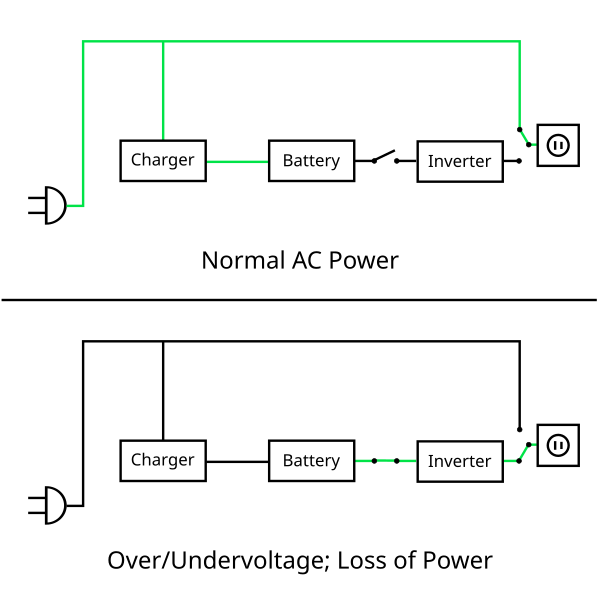
Standby/Offline UPS circuit diagram (VFD) — Source: Wikimedia Commons (CC BY-SA)
|
Advantages VFD
• Lowest purchase price
• High efficiency (> 99 %) in normal operation
• Low heat output
• Simple maintenance
|
|
Disadvantages VFD
• Transfer time 4–20 ms on mains failure
• No protection against voltage fluctuations during normal operation
• Output voltage mains-dependent
• Not suitable for sensitive loads
|
|
Typical use: Office PCs, simple network components, individual workstations.
Not recommended for servers or critical infrastructure. Power range: 300 VA – 2 kVA.
Line-Interactive UPS (VI)
The Line-Interactive UPS adds an AVR transformer (Automatic Voltage
Regulator) to the offline topology. This stabilises the output voltage even during
normal operation without drawing on the battery. Voltage sags and surges are compensated
by boosting or bucking. Transfer time on mains failure is 2–6 ms.
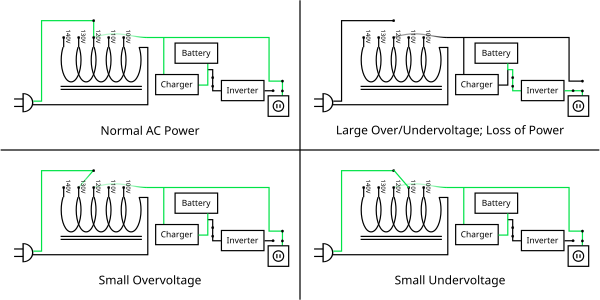
Line-Interactive UPS circuit diagram (VI) with AVR — Source: Wikimedia Commons (CC BY-SA)
|
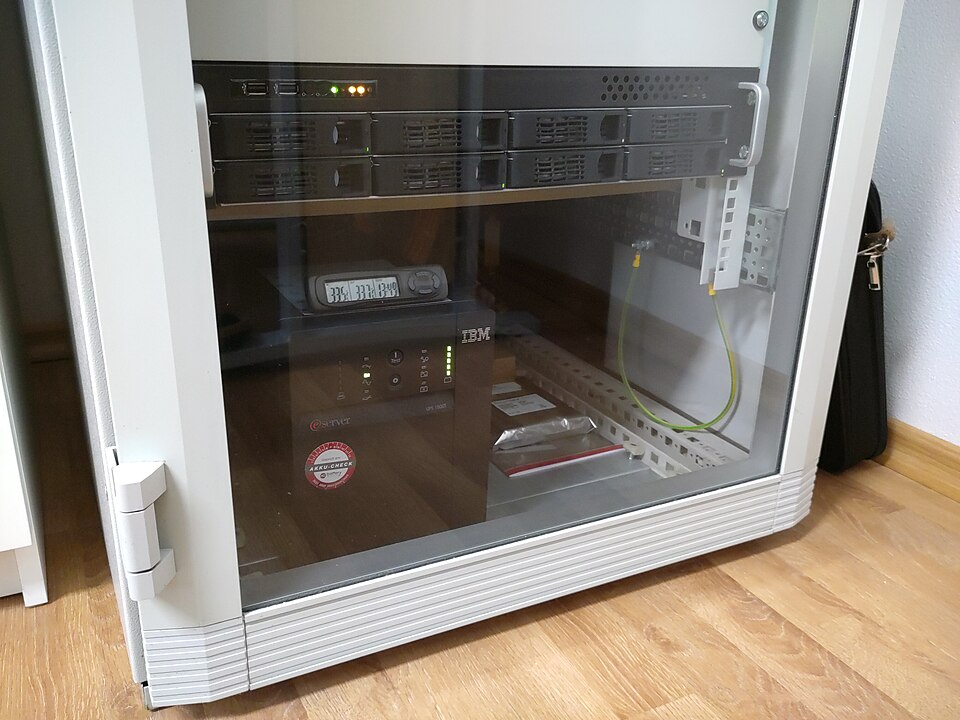
Line-Interactive UPS (bottom left) powering a server in 19-inch rack — Source: Wikimedia Commons (CC BY-SA)
|
Advantages VI
• Voltage stabilisation without battery drain
• Short transfer time (2–6 ms)
• Good price/performance ratio
• Efficiency 95–98 %
• Less battery stress (longer battery life)
|
|
Disadvantages VI
• Frequency still mains-dependent
• No filtering of harmonics
• Not suitable for generator operation
• Transfer time still measurable (not 0 ms)
|
|
Typical use: Small server rooms, network switches, NAS, PBX, SME servers.
The most commonly deployed class in the SME environment. Power range: 500 VA – 5 kVA.
Recommendation: UPS up to 3000VA.
Online UPS / Double Conversion (VFI)
The Online UPS (also: Double-Conversion UPS) is the highest-performance
topology. During normal operation, mains voltage is first converted to DC (AC/DC) and then
back to clean AC (DC/AC). The load always runs via the inverter — transfer time
on mains failure is 0 ms.
Because the output voltage is completely regenerated, harmonics, frequency deviations,
voltage spikes and sags are fully decoupled from the output. This topology meets the
requirements for critical IT, medical equipment and industrial control systems.
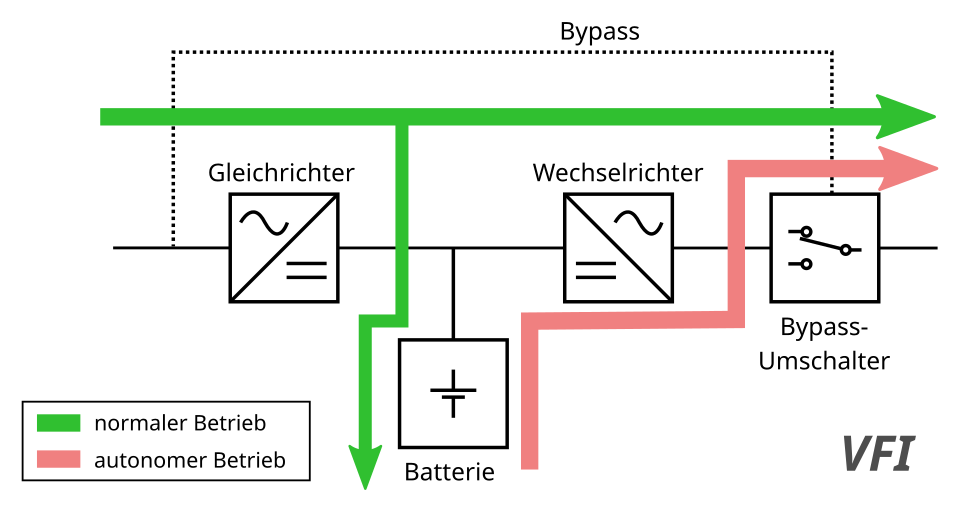
Online/Double-Conversion UPS circuit diagram (VFI) — Source: Wikimedia Commons (CC BY-SA)
|
Advantages VFI
• Transfer time 0 ms (true uninterruptibility)
• Complete galvanic isolation from mains
• Clean sine wave (THD < 3 %)
• Frequency stabilisation
• Suitable for generator operation
• Highest protection for sensitive loads
|
|
Disadvantages VFI
• Efficiency 92–96 % (energy loss from double conversion)
• Higher purchase cost
• More heat output
• Higher price per VA
|
|
Comparison Table: All Three UPS Topologies
| Feature |
VFD (Offline) |
VI (Line-Interactive) |
VFI (Online) |
| Transfer time |
4–20 ms |
2–6 ms |
0 ms |
| Voltage stabilisation |
No |
Yes (AVR) |
Yes (full) |
| Frequency stabilisation |
No |
No |
Yes |
| Harmonic filtering |
No |
Partial |
Yes (full) |
| Efficiency (normal operation) |
> 99 % |
95–98 % |
92–96 % |
| Generator compatibility |
No |
Limited |
Yes |
| Price level |
Low |
Medium |
High |
| Recommended for |
Office PCs |
SME server, NAS |
DC, critical IT |
Frequently Asked Questions on UPS Topologies
|
Is a Line-Interactive UPS sufficient for a server?
|
|
For small and medium servers in a stable grid: yes. Line-Interactive (VI) provides voltage
stabilisation and short transfer times adequate for modern server PSUs (ATX, redundant PSU).
For high-availability systems (> 99.99 % uptime) or industrial environments, VFI is recommended.
|
|
What does ECO mode mean on an online UPS?
|
|
In ECO mode, the load is fed directly through the passive bypass when mains quality is good
(similar to VFD). When a disturbance occurs, the UPS switches to the inverter within a few
milliseconds. Efficiency rises to up to 99 %, but protection is lower than in classic
VFI operation.
|
|
Which manufacturers offer online UPS for SMEs?
|
|
Leading vendors: Effekta (AX series, MH series), Eaton
(5PX, 9PX), APC by Schneider Electric (Smart-UPS On-Line, Symmetra),
Multimatik. For rack environments, see
Part 6: UPS Manufacturer Comparison.
|
|
More parts of the UPS Knowledge Series
|