|
UPS Knowledge Series · Part 4 of 6
UPS Batteries and Maintenance — VRLA, Lithium-Ion, Lifespan and Replacement
Battery technologies compared · Maintenance intervals · Hot-swap · Disposal
VRLA · AGM · Gel · Lithium-Ion · Temperature effect · Battery replacement
|
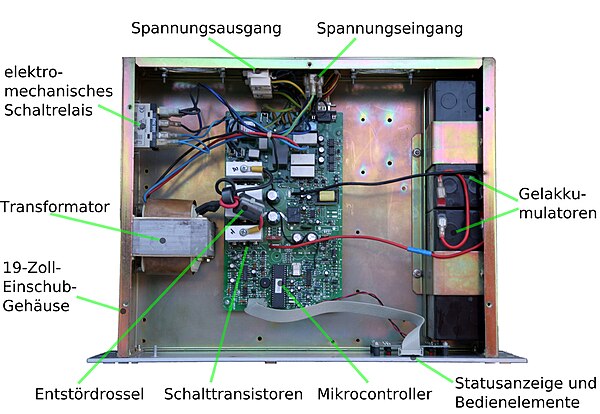
Inside view of a UPS with VRLA batteries and electronics — Source: Wikimedia Commons (CC BY-SA)
|
Battery Technologies: VRLA and Lithium-Ion Compared
| Feature |
VRLA Lead-Acid |
Lithium-Ion |
| Technology |
AGM or Gel (VRLA) |
LFP, NMC (model-dependent) |
| Lifespan (25 °C) |
3–5 years |
8–12 years |
| Weight |
Heavy |
60–70 % lighter |
| Energy density |
Low (30–50 Wh/kg) |
High (100–200 Wh/kg) |
| Charging speed |
6–8 hours |
1–3 hours |
| Deep discharge tolerance |
Low (harmful below 50 %) |
High (up to 80 % possible) |
| Purchase cost |
Low |
2–3× higher |
| TCO (Total Cost of Ownership) |
Higher (frequent replacement) |
Lower (rare replacement) |
Lifespan and Temperature Effects
Temperature is the most critical factor affecting VRLA battery lifespan.
The reference temperature is 25 °C. The rule of thumb: for every 10 °C
above 25 °C, lifespan halves.
| Ambient temperature |
Expected lifespan |
Assessment |
| 20–25 °C |
4–5 years |
Optimal — air-conditioned server room |
| 30 °C |
3–4 years |
Acceptable |
| 35 °C |
2–3 years |
Critical — shorten maintenance interval |
| 40 °C |
1.5–2 years |
Critical — annual testing required |
Maintenance Intervals and Testing
| Test / Action |
Interval |
Method |
| Check battery status indicator |
Daily / Automatic |
LCD display or SNMP monitoring |
| Trigger self-test |
Weekly / Automatic |
UPS internal self-test (standard feature) |
| Capacity test under load |
Annual |
Discharge test, UPS software or manual |
| Visual inspection (swelling, leakage) |
Annual |
Visual check after opening housing |
| Battery replacement |
Every 3–5 years |
Preventive or when capacity < 80 % |
Battery Replacement: Hot-Swap and Step by Step
Hot-Swap UPS
Battery can be replaced while the UPS is running without interrupting the load.
Standard on high-quality rack UPS (APC Smart-UPS, Eaton 5P/9PX, Effekta AX series).
Prerequisite: battery in separate compartment, UPS has bypass function.
|
|
Cold-Swap UPS
UPS must be fully switched off before battery replacement.
Standard on simple tower UPS. Plan maintenance windows.
Provide a bypass feed or backup UPS.
|
|
Replacement batteries for common UPS models (APC, Eaton, Effekta, Multimatik):
UPS batteries in the shop.
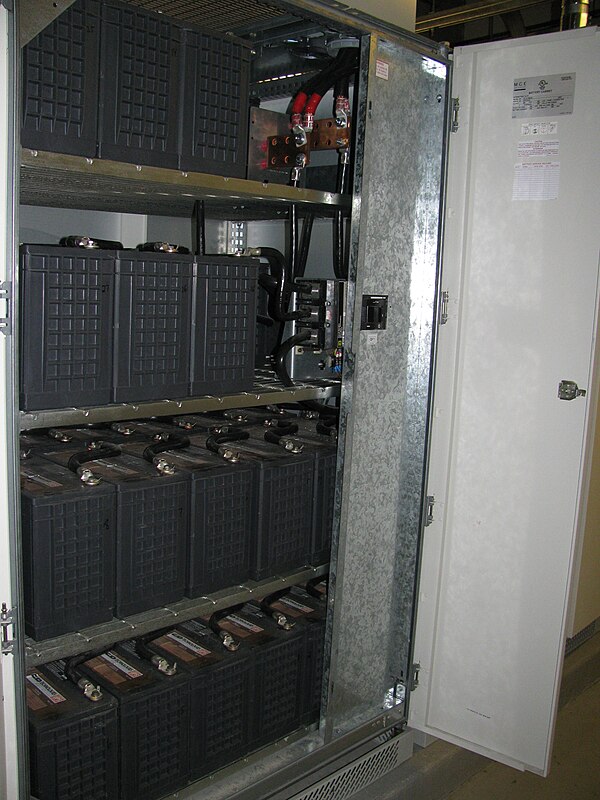
Battery extension cabinet for large UPS systems — Source: Wikimedia Commons (CC BY-SA)
|
Intelligent Battery Management: ABM, 3-Stage Charging and Real-Time Measurement
Modern UPS systems from leading manufacturers use advanced charging technologies far beyond
simple constant-current charging. The best-known system is
Eaton ABM® (Advanced Battery Management), which the manufacturer claims
can extend battery service life by up to 50 %.
| Phase |
Charging Method |
Goal |
Benefit |
Phase 1
Bulk charge |
Constant current (CC) |
Fast charge to ~80 % |
Rapid restoration of rated capacity |
Phase 2
Absorption charge |
Constant voltage (CV) |
Charge to 100 % without overcharging |
Protects electrodes, reduces gassing |
Phase 3
Float charge |
Pulse float charging |
Maintain capacity without constant stress |
Up to 50 % longer service life (Eaton ABM®) |
Similar systems are offered by APC (Smart-UPS charging technology) and Effekta
(automatic charge control in the AX/MH series). Common to all is real-time battery capacity
measurement — the UPS calculates actual remaining runtime dynamically rather than using
fixed lookup tables. Check for these datasheet values when purchasing:
| Datasheet Item |
Meaning |
Good Benchmark |
| Typical battery runtime |
Runtime at 50 % load (not 100 %) |
> 10 min at half load |
| Recharge time |
Time to 90 % capacity after full discharge |
< 4 hours |
| Battery design life |
Manufacturer spec at 20 °C (not actual service life) |
3–5 years (VRLA), 7–10 years (Li-Ion) |
| Hot-swap capable |
Battery replaceable without shutting down load |
Yes (mandatory for server environments) |
Disposal and Recycling
VRLA lead-acid batteries are subject to the EU Battery Regulation (EU 2023/1542).
They must not be disposed of in general waste. Correct disposal routes:
• Dealer take-back: When purchasing new batteries, we accept old ones back (legal obligation).
• Recycling centre: Municipal collection points for hazardous waste.
• Specialist disposal: Certified recyclers for large quantities.
• Transport regulations: Lead-acid (UN 2794) and Li-Ion (UN 3480/3481) batteries are dangerous goods (ADR/IATA).
Frequently Asked Questions on UPS Batteries
|
Can I install a battery of a different size?
|
|
No — the UPS charging circuit is designed for a specific battery capacity. A battery
that is too large will not be fully charged; one that is too small will be overcharged.
Always use the identical type (voltage, capacity in Ah, form factor).
|
|
How do I recognise a defective UPS battery?
|
|
Typical signs: alarm LED or buzzer on the UPS, significantly shorter runtime than normal,
battery no longer accepting charge, swollen or leaking housing, SNMP alert
"Battery needs replacement". On lithium-ion UPS, the BMS (Battery Management System)
reports cell errors.
|
|
Is a lithium-ion UPS worthwhile for SMEs?
|
|
Yes — for a service life exceeding 5 years, the TCO of a Li-Ion UPS is lower despite
the higher purchase price, as no battery replacement after 3–4 years is needed.
Additional benefits: faster charging, lower weight for rack environments, higher operating
temperature tolerance for non-air-conditioned rooms.
|
|
More parts of the UPS Knowledge Series
|