|
UPS Knowledge Series · Part 3 of 6
UPS Sizing — How to Calculate VA, Watts and Runtime Correctly
Apparent power vs. real power · Power factor · Runtime calculation · Redundancy
Practical examples · Formulas · Load assessment · N+1 redundancy
|
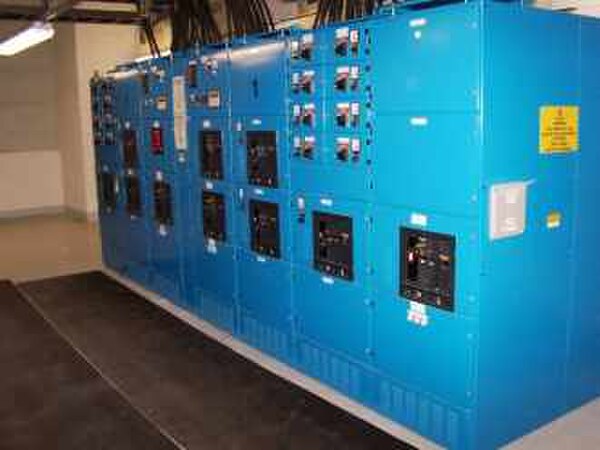
Online UPS installation in data centre — Source: Wikimedia Commons (CC BY-SA)
|
VA vs. Watts: Apparent Power and Real Power Explained
UPS capacity is stated in two units that often cause confusion:
VA (Volt-Ampere) and Watts (W). The relationship:
|
Real Power (W) = Apparent Power (VA) × Power Factor (cos φ)
|
| Device type |
cos φ |
Note |
| Modern servers, redundant PSU |
0.95–1.0 |
Active PFC |
| PC PSU (ATX), switches |
0.9–0.95 |
80-Plus certified |
| Older equipment, transformers |
0.6–0.8 |
Calculate conservatively |
| Motors, frequency inverters |
0.7–0.85 |
Inductive load |
Load Assessment: What Needs to Be Protected?
| Device type |
Typical consumption (W) |
Note |
| Tower server (1 CPU, 16 GB RAM) |
100–200 W |
Idle/load varies considerably |
| Rack server (1U, 2 CPU) |
200–500 W |
Up to 600 W under load |
| NAS (4–8 bay) |
30–80 W |
HDD spin-up can create peaks |
| 24-port switch (L2) |
15–40 W |
PoE switch considerably more |
| Firewall / router |
20–60 W |
|
Recommendation: Plan a 20–25 % safety buffer on
top of the assessed load. UPS units operate at their optimal efficiency at 50–80 %
load — not at 100 %.
Runtime Calculation: How Long Does the Battery Last?
Runtime (h) ≈ (Battery capacity Ah × Battery voltage V × Efficiency) ÷ Load (W)
Example: 12 V / 7 Ah battery, 300 W load:
Runtime ≈ (7 Ah × 12 V × 0.85) ÷ 300 ≈ 14 minutes
|
| Scenario |
Goal |
Recommendation |
| Orderly shutdown |
5–15 minutes |
Standard UPS with internal battery is sufficient |
| Bridge to generator |
10–30 minutes |
Add external battery modules (EBM) |
| Long-term operation |
> 1 hour |
Multiple EBM or large battery cabinet, UPS Batteries |
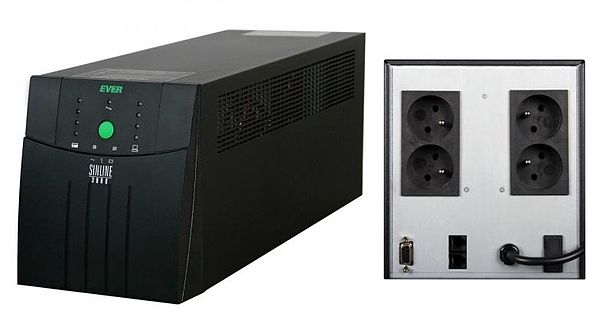
UPS units in tower and rack-mount configurations — Source: Wikimedia Commons (CC BY-SA)
|
Redundancy Concepts: N+1 and 2N
N+1 Redundancy
One additional UPS stands by and takes over if an active unit fails.
Example: 3 UPS units for a load requiring 2.
Cost-effective, uptime 99.9–99.99 %.
|
|
2N Redundancy
Two completely independent UPS systems feed the load via separate feeds.
Highest availability for Tier III/IV data centres.
Uptime up to 99.999 %.
|
|
Practical Example: Small Data Centre (SME)
| Device |
Qty |
Unit power (W) |
Total (W) |
| Rack server (2U, 2 CPU) |
4 |
350 W |
1,400 W |
| 48-port PoE switch |
2 |
120 W |
240 W |
| Enterprise firewall |
1 |
60 W |
60 W |
| NAS (8 bay) |
1 |
70 W |
70 W |
| Total load |
1,770 W |
| + 25 % buffer |
2,213 W |
| Recommended UPS size (cos φ=0.9) |
≈ 3,000 VA |
Frequently Asked Questions on UPS Sizing
|
Can I run a UPS at 100 % load?
|
|
Technically yes, economically no. In the optimal efficiency range (50–80 % load)
the UPS runs most efficiently and generates least heat. 100 % load shortens component
life and leaves no headroom for inrush currents. Rule of thumb: always plan 20–25 %
buffer.
|
|
How does temperature affect battery runtime?
|
|
Significantly. VRLA lead-acid batteries lose approximately 50 % capacity for every
10 °C above 25 °C. At 35 °C ambient temperature, a UPS will
run roughly half as long as the datasheet states (measured at 25 °C reference
temperature). Temperature also affects lifespan: see
Part 4: UPS Batteries & Maintenance.
|
|
What are external battery modules (EBM)?
|
|
External battery modules (EBM, also BP = Battery Pack) are separate units connected to
compatible UPS to multiply runtime. Compatibility is manufacturer-specific. Typical:
Effekta EBM, APC Smart-UPS SUA BPX, Eaton EBM.
UPS batteries and accessories in the shop.
|
|
More parts of the UPS Knowledge Series
|