|
UPS Knowledge Series · Part 1 of 6
UPS Basics — What Is an Uninterruptible Power Supply?
Protection goals, form factors and B2B applications at a glance
Voltage protection · Bridge time · Tower vs. Rack · Effekta · APC · Eaton
|
|
What Is a UPS?
An Uninterruptible Power Supply (UPS) — German: Unterbrechungsfreie
Stromversorgung (USV) — is a device that supplies connected electrical loads with
clean power during mains failures, voltage fluctuations and other power disturbances without
interruption. It sits between the public power grid and the equipment to be protected.
In the B2B environment, the UPS is a critical piece of equipment: servers, network
infrastructure, production systems, measuring systems and medical devices must continue
operating even during a power outage — or at least be able to shut down in an orderly
manner. Otherwise data loss, production downtime and hardware damage are the result.
The UPS fulfils three core functions:
| Function |
Description |
Protection goal |
| Buffering |
Bridging mains failure via internal battery |
Downtime = 0 |
| Conditioning |
Filtering voltage fluctuations, harmonics, voltage spikes |
Clean output voltage |
| Protecting |
Overvoltage protection, short-circuit protection, galvanic isolation (online UPS) |
Hardware protection |
Protection Goals and Power Disturbances
IEC 62040-3 and IEC 61000-4-xx define various power disturbance classes.
In the European grid (230 V / 50 Hz) the following events occur that a UPS
must protect against:
| Disturbance |
Description |
Typical duration |
UPS protection |
| Power failure |
Complete voltage loss |
ms to hours |
All UPS classes |
| Voltage sag |
Short-term drop (< 207 V) |
< 1 second |
Line-Interactive, Online |
| Overvoltage |
Sustained > 253 V |
Seconds to minutes |
Line-Interactive, Online |
| Voltage spike |
Transient voltage impulse (up to kV) |
< 2 ms |
All (AVR or bypass) |
| Harmonics |
Sine wave distortion from non-linear loads |
Continuous |
Online (double conversion) |
| Undervoltage (Brownout) |
Sustained low voltage (80–90 % of nominal), e.g. due to grid overload |
Minutes to hours |
Line-Interactive (AVR), Online |
| Frequency variation |
Deviation from 50 Hz (e.g. generator operation) |
Variable |
Online (decoupled) |
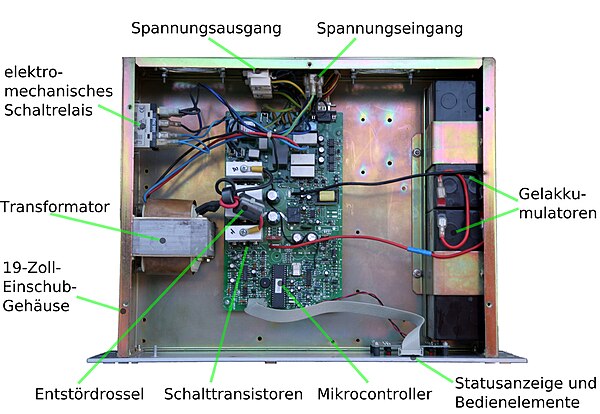
Inside view of a UPS: transformer, inverter and VRLA batteries — Source: Wikimedia Commons (CC BY-SA)
|
Form Factors: Tower, Rack, Modular
| Form factor |
Description |
Typical power |
Application |
| Tower |
Freestanding unit, upright or desktop |
300 VA – 3 kVA |
Single PCs, workstations, small servers |
| Rack (1U–4U) |
19" rack-mount, rack-optimised |
750 VA – 20 kVA |
Server rooms, data centres, network racks |
| Tower/Rack convertible |
Converts from tower to rack (with rails) |
1 kVA – 6 kVA |
Flexible environments |
| Modular |
Scalable via plug-in power modules |
from 10 kVA |
Large data centres, critical infrastructure |
| DIN-Rail UPS |
DIN-Rail mount for control panels |
100 W – 3 kW |
PLC, controls, field level |
B2B Applications
IT & Data Centres
Servers, storage, network components (switches, routers, firewalls), NAS systems.
Goal: uninterrupted operation and orderly shutdown on extended outages.
Recommendation: UPS up to 3000VA or UPS up to 5000VA.
|
|
Industry & Production
PLCs, frequency inverters, measurement technology, robotics.
Protection against harmonics and voltage spikes from machine operation.
Recommendation: Online UPS, DIN-Rail UPS.
|
|
Medical & Safety
Medical devices, surveillance cameras, alarm systems, emergency lighting.
Special requirements for reliability and EMC cleanliness.
Medical UPS: observe IEC 60601-1.
|
|
Frequently Asked Questions
|
How long does a UPS last during a power failure?
|
|
The bridge time depends on battery capacity and the connected load. Simple office UPS
provide 5–15 minutes at full load — sufficient for an orderly shutdown.
Extended-runtime UPS with additional battery modules can run for several hours.
Calculation: UPS Sizing.
|
|
What is the difference between VA and Watts in a UPS?
|
|
VA (Volt-Ampere) is apparent power; Watts is real (active) power. The ratio (power factor)
is 0.9–1.0 for modern IT loads, often lower for older equipment.
Rule of thumb: Watt requirement ÷ 0.8 = required VA.
Details: UPS Sizing.
|
|
Does a UPS require maintenance?
|
|
Yes — the battery is the most wear-prone component. VRLA lead-acid batteries must
be replaced every 3–5 years (depending on temperature and cycles).
Lithium-ion UPS reach 8–10 years. Full details:
UPS Batteries & Maintenance.
|
|
Which UPS topology is right for servers?
|
|
For servers and critical IT, the Online UPS (VFI) per IEC 62040-3
is recommended. It converts mains voltage completely (double conversion) and thus
delivers an absolutely clean, grid-independent output voltage.
Details: UPS Topologies.
|
|
More parts of the UPS Knowledge Series
|