



|
Technical Information — Networking Fibre vs. Copper: Benefits, Fibre Types and Where Each WinsOptical fibre is the backbone of modern networks — higher bandwidth, longer reach and full immunity to electromagnetic interference. Copper holds its ground for short links, simple device connections and PoE. Here is the factual comparison. |
Key Benefits of Optical Fibre
| Higher bandwidth 10/40/100 Gbit/s and beyond — with single-mode practically unlimited (400G in the backbone). |
Long reach Single-mode spans many kilometres without repeaters; copper ends at around 100 m. |
EMI immunity Optical transmission is immune to electromagnetic fields — ideal in industrial settings. |
| Tap resistance No radiating field; tapping requires major effort and causes measurable attenuation. |
Weight & space Thinner and lighter than copper of equal capacity — less tray occupancy. |
Future-proof Higher data rates often just need new transceivers — the installed fibre stays. |
Construction of an Optical Fibre
|
A fibre consists of a light-guiding core, an optically thinner cladding (guides the light by total internal reflection) and a protective coating. The core diameter distinguishes single-mode (approx. 9 µm) from multimode (50/62.5 µm). 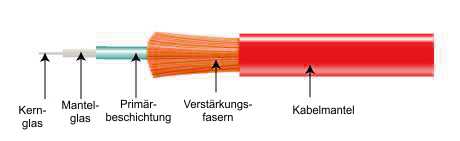
|
Fibre Types: Single-mode and Multimode
| Type | Core | Reach (10G) | Typical use |
|---|---|---|---|
| OS2 (single-mode) | ~9 µm | 10 km+ | Backbone, campus, WAN, FTTx |
| OM3 (multimode) | 50 µm | ~300 m | Data centre, buildings (EMB 2000 MHz·km) |
| OM4 (multimode) | 50 µm | ~400 m | Data centre (EMB 4700 MHz·km) |
| OM5 (multimode) | 50 µm | ~400 m | Wideband (SWDM), modern DC cabling |
Single-mode offers the highest bandwidth and reach; multimode is more economical on short links due to cheaper transceivers.
FTTx — How Far Does the Fibre Reach?
| FTTC | Fibre to the Curb/Cabinet — fibre to the cabinet, last stretch via copper. |
| FTTB | Fibre to the Building — fibre into the building, risers may be copper. |
| FTTH | Fibre to the Home — fibre into the flat, maximum bandwidth. |
When Copper Is Still the Right Choice
Copper (twisted pair) stays strong for the device connection: short links up to 100 m, inexpensive device ports and above all Power over Ethernet (PoE/PoE++) — a key argument for access points, IP cameras and VoIP phones. Modern categories such as Cat 6A (10G up to 100 m), Cat 7/7A and Cat 8 (25/40G at short DC range) keep copper relevant. Rule of thumb: fibre for backbone and distance, copper at the outlet.
|
Matching cabling in the B2B shop From the fibre run to the patch cord — a wide range, pre-assembled on request. » Fibre & components · Fibre installation cable · Fibre patch cords · Data cables · Fibre assembly Advice: +49 (0)7666 / 88499-0 · sales@industry-electronics.com |