



|
Technical Information — Lighting LED Technology: How It Works, Light Metrics and EfficiencyThe light-emitting diode (LED) has largely replaced classic light sources — at far lower energy consumption and with a long service life. This article explains the semiconductor principle, the key lighting metrics and socket compatibility. |
What is an LED?
|
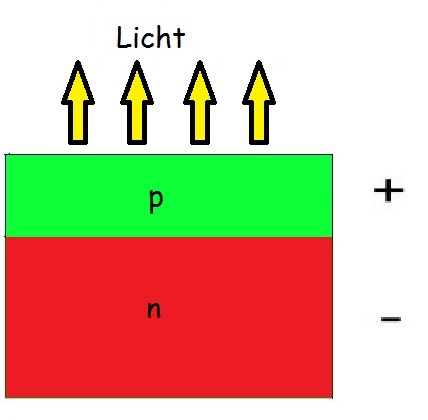
An LED (Light Emitting Diode) is an electronic semiconductor component from the diode family. It has a p-n junction and emits light of a specific wavelength when current flows in the forward direction — depending on the semiconductor material used. The first lecture on current conduction through crystals was given by Ferdinand Braun back in 1876: he pressed a metal tip onto a sulphur crystal, which conducted current well in one direction and poorly in the other. This rectifying effect did not fit the laws known at the time — it took almost 60 years to explain it physically. |
|
How does an LED work?
The starting point is a pure semiconductor crystal with equal numbers of free electrons and electron holes. Targeted doping (adding foreign atoms) increases the number of free charge carriers:
|
n-type (electron surplus) Adding pentavalent foreign atoms (donors, e.g. phosphorus) — they donate an extra electron. |
p-type (electron deficiency) Adding trivalent foreign atoms (acceptors, e.g. boron) — electron holes are created. |
When the n- and p-layers are joined and a forward voltage is applied, electrons move through the p-n junction and recombine with the holes. The energy released in this process is emitted as light.
LED in Comparison: Lumens Instead of Watts
Brightness is described not by power consumption (watts) but by luminous flux (lumens). The following reference values apply to high-quality LEDs — quality and origin make a clear difference:
| Incandescent | Light output | LED |
|---|---|---|
| 15 W | approx. 100 lumens | 1–2 W |
| 25 W | approx. 200 lumens | 3–4 W |
| 40 W | approx. 400 lumens | 5–6 W |
| 60 W | approx. 700 lumens | 7–8 W |
| 75 W | approx. 900 lumens | 9–10 W |
| 100 W | approx. 1400 lumens | 11–13 W |
Lighting Metrics at a Glance
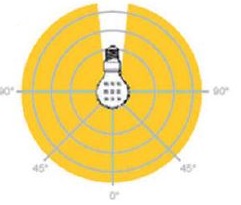
| Luminous flux — lumen [lm] | Total light power emitted by a light source. |
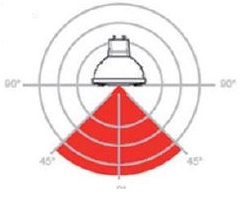
| Luminous intensity — candela [cd] | Luminous flux emitted into a given solid angle. |
| Illuminance — lux [lx] | Light falling onto a surface. |
| Light colour — kelvin [K] | Colour temperature: low value = warm, high value = cool. |
| Energy efficiency | New EU scale A–G since 2021 (replaces the former A++ to E scale). |
| Switching endurance | Number of switching cycles a lamp can withstand. |
| Start-up behaviour | Time to reach full brightness (virtually instant for LEDs). |
 Luminous flux in lumens |
 Luminous intensity in candela |
Choosing the Right Light Colour (Colour Temperature)
Light colour is given in kelvin — the lower the value, the warmer the light:
|
Warm white — 1500–3000 K Living and lounge areas, cosy atmosphere. |
Neutral white — 3000–5000 K Offices and workplaces, functional lighting. |
Daylight white — from 5000 K Factory and hall lighting, high concentration. |

|
Socket Compatibility
Many LED light sources are available as retrofits with common sockets: E27 (standard socket for 230 V incandescent lamps) and E14 (formerly standard up to 40 W). If the socket does not match, a socket adapter can often be used (e.g. G24 → E27). When switching from incandescent lamps to LED, a 2700 K version gives comparably warm light.
|
LED light sources in the B2B shop From retrofit lamps to LED strips — a wide selection for industry, trade and public institutions. Need advice? We are happy to help. » LED lamps · LED strips · Light sources · Advice: +49 (0)7666 / 88499-0 · sales@industry-electronics.com |