
TP-Link TG-3468 PCIe Network Card 10/100/1000MBit
Networks > Network Adaptors > PCIe Network Cards
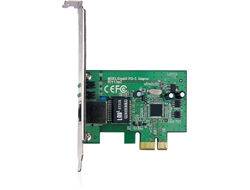
TP-Link TG-3468 PCIe Network Card 10/100/1000MBit
| Lieske Part No. | 161184 |
|---|---|
| Mfg Part No | TG-3468 |
| EAN-Code | 6935364001049 |
| Manufacturer | TP-Link |
| Here only | 10,06 EUR
11,97 EUR incl. VAT
|
Further information for TP-Link TG-3468 PCIe Network Card 10/100/1000MBit
| Design | |
| Component for | PC |
| Product colour | Green, Grey |
| LED indicators | Status |
| Certification | FCC, BSMI, VCCI |
| Internal | |
| Logistics data | |
| Harmonized System (HS) code | 85176990 |
| Network | |
| Maximum data transfer rate | 2000 Mbit/s |
| Networking standards | IEEE 802.1Q, IEEE 802.1p, IEEE 802.3, IEEE 802.3ab, IEEE 802.3u, IEEE 802.3x |
| Ethernet interface type | Gigabit Ethernet |
| Ethernet LAN data rates | 10,100,1000 Mbit/s |
| Cabling technology | 10/100/1000BaseT(X) |
| Maximum operating distance | 100 m |
| Ethernet LAN | |
| Wake-on-LAN ready | |
| Auto MDIX IEEE | |
| Full duplex | |
| Auto-negotiation | |
| Quality of Service (QoS) support | |
| VLAN tagging | |
| Operational conditions | |
| Operating temperature (T-T) | 0 - 40 °C |
| Storage temperature (T-T) | -40 - 70 °C |
| Operating relative humidity (H-H) | 10 - 90% |
| Storage relative humidity (H-H) | 5 - 90% |
| Other features | |
| Flow control support | |
| Packaging content | |
| Mounting brackets included | |
| Resource CD | |
| Quick installation guide | |
| Packaging data | |
| Package width | 160 mm |
| Package depth | 135 mm |
| Package height | 30 mm |
| Package weight | 100 g |
| Ports & interfaces | |
| Connectivity technology | Wired |
| Host interface | PCI Express |
| Interface | Ethernet |
| Ethernet LAN (RJ-45) ports | 1 |
| Sustainability | |
| Sustainability compliance | |
| System requirements | |
| Windows operating systems supported | Windows 10, Windows 10 Education, Windows 10 Education x64, Windows 10 Enterprise, Windows 10 Enterprise x64, Windows 10 Home, Windows 10 Home x64, Windows 10 IOT Core, Windows 10 IoT Enterprise, Windows 10 Pro, Windows 10 Pro x64, Windows 10 x64, Windows 7, Windows 7 Enterprise, Windows 7 Enterprise x64, Windows 7 Home Basic, Windows 7 Home Basic x64, Windows 7 Home Premium, Windows 7 Home Premium x64, Windows 7 Professional, Windows 7 Professional x64, Windows 7 Starter, Windows 7 Starter x64, |
| Technical details | |
| Compliance certificates | BSMI, CE, Federal Communications Commission (FCC), RoHS |
| Weight & dimensions | |
| Width | 78.5 mm |
| Depth | 120.8 mm |
| Height | 21.5 mm |
Applications
The adapter is designed for use in PCs equipped with a PCI Express bus. It is particularly suitable for systems requiring a Gigabit Ethernet connection where no such network interface is integrated into the motherboard. The card supports 10/100/1000BaseT(X), enabling flexible adaptation to various network environments. The maximum connection range is 100 meters over standard Ethernet cables (Cat5e or higher). The card is designed for indoor use, with an operating temperature of 0 to 40 °C and relative humidity of 10 to 90 % during operation.
Features and Specifications in Detail
The TP-Link TG-3468 features an RJ-45 connector for connection to a network cable. The card supports Auto-Negotiation, allowing the data transfer rate to be automatically adjusted to the network environment (10, 100, or 1000 Mbit/s). The Auto MDIX function enables automatic detection and adjustment of cable connections, eliminating the need for a special crossover cable. The card supports full-duplex transmission, enabling simultaneous bidirectional data transfer, and flow control (IEEE 802.3x) to prevent data loss during overload. Additionally, Wake-on-LAN (WOL) is integrated, allowing remote computer startup via the network – useful for remote administration and maintenance.
Technology Explained Simply
The card is based on the PCI Express x1 interface, which provides a direct connection to the computer’s system bus, ensuring high data transfer performance. The maximum data rate of 2000 Mbit/s (as stated in technical specifications) refers to the theoretical bandwidth of the PCIe interface, while the actual network transfer rate is 1000 Mbit/s. The card is fully compatible with the standards IEEE 802.3, IEEE 802.3u, IEEE 802.3ab, IEEE 802.1Q, IEEE 802.1p, and IEEE 802.3x. Support for VLAN tagging (IEEE 802.1Q) and Layer-2 priority coding (IEEE 802.1p) enables structured network management and prioritization of data traffic, for example for VoIP or video transmissions. The integrated LED indicator displays the connection status: “Solid On” indicates that the driver is installed and a connection is established.
Compatibility and Accessories
The adapter is certified for Windows 7, Windows 10 (including Home, Pro, Enterprise, Education, and IoT versions) as well as Linux and Novell NetWare. Drivers are available for the specified operating systems. The card is equipped with a Realtek RTL8168B chipset, providing a widely used and reliable hardware foundation. The card is designed for use in 32-bit PCIe systems and fits into any PCI Express x1 slot. The card’s color scheme is green and grey.
Installation and Mounting
Installation is performed by inserting the card into a free PCI Express x1 slot in the computer. The card is plug-and-play compatible, with driver installation possible via the included Resource CD or through the manufacturer’s download section. The quick installation guide supports installation and configuration. The card is installed internally and mounted inside the computer housing. Mounting is done using the included mounting brackets, designed for securing the card in the housing.
Operational Advantages
The TP-Link TG-3468 offers a cost-effective way to equip an existing system with Gigabit Ethernet capability. Support for Wake-on-LAN enables centralized network management and reduces energy consumption, as the computer is only activated when needed. Auto-Negotiation and Auto MDIX ensure simple and error-free setup without manual configuration. The card is certified to FCC, BSMI, VCCI, and CE, confirming compliance with applicable electromagnetic compatibility and safety standards. The card is designed for indoor use and meets requirements for sustainability compliance (RoHS).
Scope of Delivery
The delivery includes the TP-Link Gigabit PCI Express Network Adapter TG-3468, a Resource CD with drivers and documentation, and a quick installation guide. The mounting brackets are also included and are used to secure the card in the computer housing.
Certifications and Standards
The card complies with the standards IEEE 802.3, IEEE 802.3u, IEEE 802.3ab, IEEE 802.1Q, IEEE 802.1p, IEEE 802.3x. Certifications FCC, BSMI, VCCI, CE, and RoHS confirm compliance with applicable technical and ecological standards. The card is designed for indoor use and meets requirements for sustainability compliance.
Operating Conditions
The card is designed for an operating temperature of 0 to 40 °C. Relative humidity during operation is 10 to 90 %. For storage, temperatures of -40 to 70 °C and humidity of 5 to 90 % are permissible.
Design and Form Factor
The card is a plug-in card with dimensions of 78.5 mm (width) × 120.8 mm (depth) × 21.5 mm (height). The color scheme is green and grey. The card is installed internally and mounted inside the computer housing. The LED indicator serves to display the network connection status.
System Requirements
The card is compatible with Windows 7, Windows 10 (including Home, Pro, Enterprise, Education, IoT) as well as Linux and Novell NetWare. Drivers are available for these operating systems.

This is an offer of:
79279 Vörstetten
https://industry-electronics.com
Tel. 07666/88499-0
Fax. 07666/88499-111
Diesen Artikel finden Sie unter:
industry-electronics.com/artikel/161184

Lieske Elektronik e.K.
Reutener Str. 1079279 Vörstetten
https://industry-electronics.com
Tel. 07666/88499-0
Fax. 07666/88499-111
Diesen Artikel finden Sie unter:
industry-electronics.com/artikel/161184