
Eltako TLZ12-8 Stairlight Timer 1S
Installation > Modular devices / equipment installation > Staircase time switch / time relay
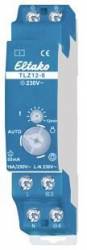
Eltako TLZ12-8 Stairlight Timer 1S
| Lieske Part No. | 366303 |
|---|---|
| Mfg Part No | 23100934 |
| EAN-Code | 4010312401637 |
| Manufacturer | Eltako |
| Here only | 39,27 EUR
46,73 EUR incl. VAT
|
Further information for Eltako TLZ12-8 Stairlight Timer 1S
| General | |
| Degree of protection | non-isolated |
| Operating voltage | 230 V |
| Switching voltage | 230 V |
| Control voltage | 230 V |
| Maximum load | 16 A |
| Maximum voltage | 250 V AC |
| Time setting | 0.2 to 12 minutes |
| Neon lamp current | up to 50 mA |
| Stand-by loss | 0,7 W |
| Mounting method | DIN-EN 60715 TH35 mounting rail |
| Switching type | At zero crossing |
| Pre-warning of switching-off | None |
| Double connectors | for pushbuttons and lamps |
| Wiring system | automatic detection of 3- and 4-wire |
| Compatibility | 230V-LED lamps, ESL up to 100W, incandescent lamps up to 2000W |
| Application | Stair lighting, hallway lighting, attic lighting |
| Noise generation | silent |
| Pitch unit | 1 TE (18 mm) |
Applications
The TLZ12-8 is specifically designed for use in residential and commercial buildings where automatic switching off of lighting after a preset time is required. Typical applications include stairwells, corridors, attics, or basements, where manual switching off is often forgotten. The device is suitable for 3- and 4-wire circuits and can be installed in series. With a 4-wire circuit, it can be used for attic lighting. The automatic detection of the circuit type ensures the device functions correctly without requiring manual adjustment.
Functions and Equipment in Detail
The device features dual terminals for switches and lamps, enabling flexible installation—either top and bottom or bottom only. This allows adaptable installation into existing circuits. The contact switching occurs at zero crossing, which increases contact lifespan and minimizes disturbances in the power network. There is no switching-off warning, meaning the lighting is switched off without prior notice. The standby power loss is only 0.7 W, ensuring energy-efficient operation. The electronics are silent, enabling disturbance-free operation, unlike mechanical synchronous motors with gearboxes.
Technology Explained Simply
The non-isolated closing contact means the switch is directly connected to the mains voltage and does not have galvanic isolation. This is sufficient for most applications in building electrical systems and allows direct control of the load. The time setting from 0.2 to 12 minutes can be adjusted according to requirements, for example, for short lighting in a corridor or longer lighting in an attic. The automatic detection of circuit type recognizes whether a 3- or 4-wire circuit is present and adapts accordingly, without requiring manual configuration. The dual terminals offer installation flexibility, especially when the circuit already includes existing switches or lamps.
Compatibility and Accessories
The device is suitable for use with 230V LED lamps, energy-saving lamps up to 100W, and incandescent lamps up to 2000W. It can be used in 3- and 4-wire circuits and is suitable for series installation. Compatibility with attic lighting in 4-wire circuits expands application possibilities.
Mounting and Installation
Mounting is on a support rail according to DIN-EN 60715 TH35. The device occupies a mounting unit of 18 mm width and 58 mm depth. Installation requires no special tools or additional components. The dual terminals allow flexible connection options, with wiring possible either top and bottom or bottom only. Switching occurs at zero crossing, ensuring clean and disturbance-free switching.
Operational Advantages
The TLZ12-8 offers energy-efficient operation with a standby power loss of only 0.7 W. The silent electronics ensure disturbance-free operation, especially in living spaces. Automatic detection of circuit type and dual terminals increase installation flexibility. The time setting from 0.2 to 12 minutes allows application-specific adjustment. Zero-crossing switching extends contact lifespan and reduces network disturbances. The device is suitable for a variety of lighting types, including LED, ESL, and incandescent lamps.
Neon Lamp Current
The neon lamp current is up to 50mA, with the exact value depending on the ignition voltage of the neon lamp used. This is relevant when the device is used in circuits with neon lamps serving as signal or operational indicators.
Functions Without Additional Components
The device includes an integrated permanent lighting switch, allowing the lighting to be switched on permanently without requiring additional switches or modules. The timer function and permanent lighting function are independently available.
No Switching-Off Warning
The lighting is switched off without prior notice, meaning no optical or acoustic warning is given before switching off. This is sufficient for many applications in residential and commercial buildings, as lighting is often only needed for a short time.
Switching Type and Operating Voltage
Switching occurs at zero crossing, ensuring clean and disturbance-free switching. The operating voltage is 230V, which corresponds to the standard voltage in Germany. The control, supply, and switching voltage are identical and also amount to 230V.

This is an offer of:
79279 Vörstetten
https://industry-electronics.com
Tel. 07666/88499-0
Fax. 07666/88499-111
Diesen Artikel finden Sie unter:
industry-electronics.com/artikel/366303

Lieske Elektronik e.K.
Reutener Str. 1079279 Vörstetten
https://industry-electronics.com
Tel. 07666/88499-0
Fax. 07666/88499-111
Diesen Artikel finden Sie unter:
industry-electronics.com/artikel/366303