
Eltako TLZ12-9 Stairlight Timer 1S
Installation > Modular devices / equipment installation > Staircase time switch / time relay
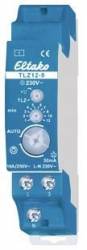
Eltako TLZ12-9 Stairlight Timer 1S
| Lieske Part No. | 366305 |
|---|---|
| Mfg Part No | 23100836 |
| EAN-Code | 4010312401620 |
| Manufacturer | Eltako |
| Here only | 58,10 EUR
69,14 EUR incl. VAT
|
Further information for Eltako TLZ12-9 Stairlight Timer 1S
| General | |
| Degree of protection | not specified |
| Switching power | 16 A |
| Switching voltage | 250 V AC |
| Operating voltage | 230 V |
| Time setting | 1 to 12 minutes |
| LED power | 600 W |
| ESL power | 200 W |
| Incandescent lamp power | 2300 W |
| Stand-by loss | 0,7 W |
| Neon lamp current | 50 mA |
| Mounting method | rack mounting on DIN rail DIN-EN 60715 TH35 |
| Switching type | non-isolated |
| Switching behavior | At zero crossing |
| Pre-warning of switching-off | Switchable |
| Relay type | Bistable |
| Power failure behavior | automatic re-energization if time period not yet expired |
Applications
The TLZ12-9 is suitable for controlling lighting in residential and commercial spaces, particularly in corridors, stairwells, and attics. It enables energy-saving operation, as the lighting is automatically switched off after the set time has elapsed. The maximum power consumption is 600W for 230V LED lamps, 200W for energy-saving lamps (ESL), and 2300W for incandescent lamps. The switching function is designed for an operating voltage of 230V, with control, supply, and switching voltage being identical.
Functions and Equipment in Detail
The device features a large rotary switch that serves as an independent permanent lighting switch and allows time setting from 1 to 12 minutes. The setting is adjusted in minute increments, enabling precise adaptation to the respective usage situation. The switch-off warning is optional and activates a flickering function: approximately 30 seconds before the end of the time interval, the lighting begins to flicker, three times in increasingly shorter intervals. This serves as a visual warning before the lighting is switched off. The contact switching occurs at zero crossing to extend the life of the contacts and the connected lamps.
Technology Explained Simply
The electronics of the TLZ12-9 are silent, in contrast to mechanical synchronous motors with gearboxes. The use of a bistable relay ensures that no coil power loss occurs in the switched-on state, thus avoiding unwanted heating. The standby power loss is only 0.7 watts, ensuring high energy efficiency. After installation, a short automatic synchronization is required, which must be waited for before connecting the consumer to the network. In the event of a power failure, the lighting is automatically switched back on, provided the time interval has not yet expired.
Compatibility and Accessories
The device is designed for 3-wire circuits and cannot be connected in series. It is exclusively intended for retrofitting existing installations. The maximum current consumption is 16A at 250V AC. The neon lamp current is up to 50mA, with the exact value depending on the ignition voltage of the neon lamp used.
Mounting and Installation
The TLZ12-9 is designed as a modular device and occupies a module width of 18mm and a depth of 58mm. Mounting is done on a DIN-EN 60715 TH35 support rail. Installation requires observing the automatic synchronization after installation before connecting the consumer.
Operational Advantages
The zero-crossing switching and the bistable relay increase the lifespan of the contacts and the connected lamps. The low standby power loss of 0.7 watts contributes to energy efficiency. The silent electronics ensure disturbance-free operation, especially in living spaces. The switch-off warning provides clear visual information before the lighting is switched off, which is particularly useful in stairwells or attics. The automatic reactivation after a power failure ensures continuous use, provided the time has not yet expired.

This is an offer of:
79279 Vörstetten
https://industry-electronics.com
Tel. 07666/88499-0
Fax. 07666/88499-111
Diesen Artikel finden Sie unter:
industry-electronics.com/artikel/366305

Lieske Elektronik e.K.
Reutener Str. 1079279 Vörstetten
https://industry-electronics.com
Tel. 07666/88499-0
Fax. 07666/88499-111
Diesen Artikel finden Sie unter:
industry-electronics.com/artikel/366305