
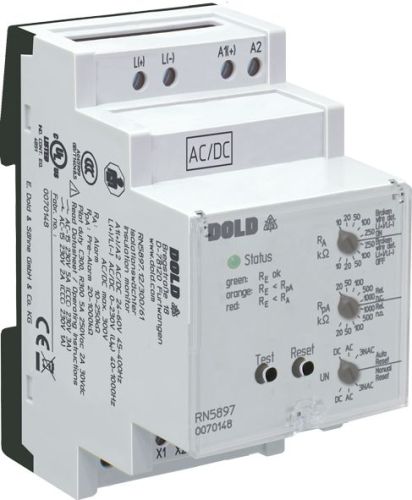
Dold 0070149 RN5897.12/300/61 insulation monitor AC/DC85-230V
Dold 0070149 RN5897.12/300/61 insulation monitor AC/DC85-230V
| Lieske Part No. | 1001683 |
|---|---|
| Mfg Part No | 0070149 |
| EAN-Code | 4030641701499 |
| Manufacturer | Dold |
| Here only | 459,13 EUR
546,36 EUR incl. VAT
|
Further information for Dold 0070149 RN5897.12/300/61 insulation monitor AC/DC85-230V
| Technical data | |
| Approvals | UL |
| Classification | For mobile power generators |
| Enclosure design | Distribution board |
| IMD type | AC, AC/DC, DC |
| Nominal voltage IT system | AC 0 - 230 V, DC 0 - 230 V |
| Response value | 10 - 250 kΩ |
| Response value type | Adjustable |
| Width | 52,5 mm |
| Type | RN 5897/300 |
| Earth fault indicator | |
| Variant | |
| Alarm value | 10 - 250 kOhm |
| Auxiliary voltage | AC/DC 85 - 230 V |
| Contact equipping | 2 x 1 changeover contact |
| Prewarning value | 20 kOhm - 1 MOhm |
| Approvals and Markings | UL-listed C/US, CCC |
Applications
The insulation monitor is universally applicable in various application areas, including UPS systems, networks with frequency converters, battery networks, DC drives, hybrid and battery-powered vehicles, as well as mobile power generators. It is designed for network capacitances up to 30 μF and also allows monitoring during de-energized networks, making it particularly suitable for systems with intermittent power supply.
Functions and Equipment in Detail
The device features two independently adjustable trigger thresholds: a pre-alarm threshold ranging from 20 kΩ to 1 MΩ and an alarm threshold from 10 kΩ to 250 kΩ. These settings enable differentiated responses to insulation degradation, with the pre-alarm triggering an early warning before the critical alarm threshold is reached. The output contacts consist of two individual changeover contacts—one for the pre-alarm and one for the alarm—which can be operated in either energized or de-energized mode depending on the application. A multicolored device status LED visualizes the operating state and allows for quick visual inspection of the device.
Technology Explained Simply
Insulation resistance measurement is performed between terminals L(+) and L(-) as well as PE1/PE2. An active test voltage pulse with alternating polarity is used to determine insulation quality. The connection monitoring for the measurement circuit L(+) / L(-) is switchable and generates a fault message if interrupted. The protective earth connection monitoring PE1/PE2 is non-switchable and ensures that a break in the protective conductor is also detected. After switching on the auxiliary voltage (AC/DC 85–230 V), the device performs an internal self-test lasting approximately 12 seconds. Afterward, continuous insulation measurement begins. An external control input (X1/X2) allows connection to a combined test/reset button.
Compatibility and Accessories
The device is designed for IT systems with rated voltages of AC 0–230 V and DC 0–230 V. It is suitable for use in AC, DC, and AC/DC networks. The auxiliary voltage can range from AC/DC 85–230 V, enabling flexible integration into existing power supplies. The width is 52.5 mm, allowing installation in standard installation distributors. Certifications include UL-listed C/US and CCC, enabling use in corresponding markets.
Mounting and Installation
Mounting is done in an installation distributor. Terminals L(+) and L(-) are connected directly to the network to be monitored, while PE1 and PE2 are connected to the protective conductor system via separate conductors. The auxiliary voltage is supplied via A1(+) and A2. The tamper-proof transparent cover protects the device against unauthorized manipulation and ensures safe operation.
Operational Advantages
The insulation monitor provides preventive fire and system protection through early detection of insulation faults. Alarm memory is selectable, so an alarm remains indicated even after the fault is resolved until manually reset. Simple operation via rotary switches and visual indication via the LED simplify maintenance and diagnostics. The device requires no additional pre-stage device, simplifying installation and reducing system costs.

This is an offer of:
79279 Vörstetten
https://industry-electronics.com
Tel. 07666/88499-0
Fax. 07666/88499-111
Diesen Artikel finden Sie unter:
industry-electronics.com/artikel/1001683

Lieske Elektronik e.K.
Reutener Str. 1079279 Vörstetten
https://industry-electronics.com
Tel. 07666/88499-0
Fax. 07666/88499-111
Diesen Artikel finden Sie unter:
industry-electronics.com/artikel/1001683