
Dold 0070014 RN5897.12/011/61 AC/DC24-60V insulation monitor 1K-2M
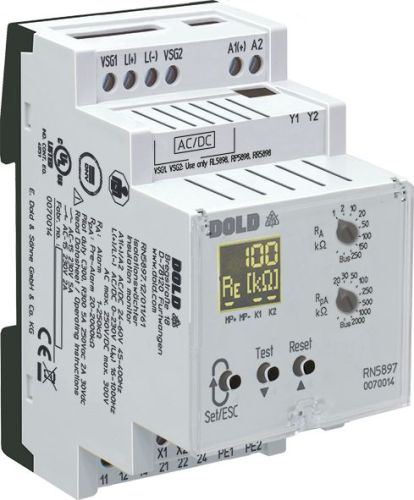
Dold 0070014 RN5897.12/011/61 AC/DC24-60V insulation monitor 1K-2M
| Lieske Part No. | 1001697 |
|---|---|
| Mfg Part No | 0070014 |
| EAN-Code | 4030641700140 |
| Manufacturer | Dold |
| Here only | 709,24 EUR
844,00 EUR incl. VAT
|
Further information for Dold 0070014 RN5897.12/011/61 AC/DC24-60V insulation monitor 1K-2M
| Technical data | |
| Approvals | DNV, UL |
| Bus interface | Modbus RTU |
| Enclosure design | Distribution board |
| IMD type | AC, AC/DC, DC |
| Nominal voltage IT system | AC 0 - 230 V, AC 0 - 1000 (Coupling device) V, DC 0 - 230 V, DC 0 - 1500 (Coupling device) V |
| Response value | 1 - 2000 kΩ |
| Response value type | Adjustable |
| Width | 52,5 mm |
| Type | RN 5897/011 |
| Earth fault indicator | |
| Variant | |
| Alarm value | 1 kOhm - 2 MOhm |
| Auxiliary voltage | AC/DC 24 - 60 V |
| Contact equipping | 2 x 1 changeover contact |
| Prewarning value | 1 kOhm - 2 MOhm |
| Approvals and Markings | UL-listed C/US, DNV |
Applications
The RN5897/011 is universally applicable in IT systems with rated voltages up to AC 250 V or DC 300 V. When used with an external pre-stage device (e.g. RL 5898, RP 5898 or RR 5898), the rated voltage can be extended up to AC 1000 V or DC 1500 V. The device is designed for network capacitances up to 1000 μF and offers an optimized response time at high capacitances. It also enables monitoring in de-energized networks, which is important for safety in stationary installations.
Functions and equipment in detail
The device features two independently adjustable threshold settings, which can be used for pre-alarm and alarm. The adjustment range for both values is between 1 kΩ and 2 MΩ. Adjustment is performed via two rotary switches on the front of the device, ensuring user-friendly parameterization. Additionally, parameterization can be done via a Modbus RTU interface, which is galvanically isolated. A multicolored display shows the current insulation resistance, device status, and other parameters. The earth fault indication is integrated.
Technology explained simply
The insulation monitor operates with a measurement circuit between L(+) / L(-) and PE1 / PE2. The measurement is performed using an auxiliary voltage in the range AC/DC 24–60 V, supplied via terminals A1(+) / A2. After switching on the auxiliary voltage, the device performs an internal self-test, which takes approximately 12 seconds. Afterward, continuous measurement of the insulation resistance begins. The response time is optimized based on the setting of the maximum network capacitance. Wire break monitoring in the measurement circuit (L(+)/L(-)) is switchable off, while protective conductor connection monitoring (PE1/PE2) is not switchable off. A trigger output allows connection to an insulation fault detection system.
Compatibility and accessories
The device is compatible with external pre-stage devices that extend the system's rated voltage. The pre-stage devices RL 5898, RP 5898, and RR 5898 enable operation at higher voltages. The Modbus RTU interface allows remote reading and parameterization of all measured values, statuses, and settings. Functions can also be operated via Modbus. An external control input allows connection of a combined test/reset button.
Mounting and installation
The insulation monitor is designed as an installation distributor with a width of 52.5 mm. Mounting is done in standard distributor boxes. The terminals are intended for connection cables, with the auxiliary voltage supplied via A1(+) / A2. The tamper-proof transparent cover protects the device against unauthorized manipulation.
Advantages in operation
The device provides preventive fire and plant protection through early detection of insulation faults. It detects both symmetrical and asymmetrical faults and enables fast fault localization through selective earth fault detection according to L+ and L-. The galvanically isolated contacts (2 x 1 changeover) ensure safe signal transmission. Alarm storage is selectable, and automatic and manual device self-tests ensure reliability. Adjustment of threshold values and parameters is simple via rotary switches or Modbus, simplifying maintenance and commissioning. The certifications UL-listed C/US and DNV confirm suitability for use in corresponding application areas.

This is an offer of:
79279 Vörstetten
https://industry-electronics.com
Tel. 07666/88499-0
Fax. 07666/88499-111
Diesen Artikel finden Sie unter:
industry-electronics.com/artikel/1001697

Lieske Elektronik e.K.
Reutener Str. 1079279 Vörstetten
https://industry-electronics.com
Tel. 07666/88499-0
Fax. 07666/88499-111
Diesen Artikel finden Sie unter:
industry-electronics.com/artikel/1001697