
Dold 0069400 RN5897.12/321/61 AC/DC100-230V insulation monitor 1k-500k
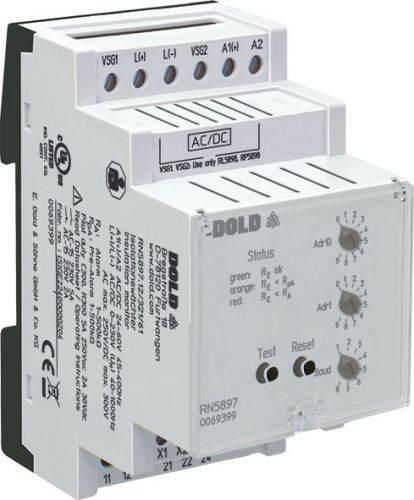
Dold 0069400 RN5897.12/321/61 AC/DC100-230V insulation monitor 1k-500k
| Lieske Part No. | 1001702 |
|---|---|
| Mfg Part No | 0069400 |
| EAN-Code | 4030641694005 |
| Manufacturer | Dold |
| Here only | 684,28 EUR
814,29 EUR incl. VAT
|
Further information for Dold 0069400 RN5897.12/321/61 AC/DC100-230V insulation monitor 1k-500k
| Technical data | |
| Approvals | UL |
| Bus interface | Modbus RTU |
| Classification | For DC charging stations |
| Enclosure design | Distribution board |
| IMD type | AC, AC/DC, DC |
| Nominal voltage IT system | AC 0 - 230 V, AC 0 - 690 (Coupling device) V, DC 0 - 230 V, DC 0 - 1000 (Coupling device) V |
| Response value | 1 - 500 kΩ |
| Response value type | Adjustable |
| Width | 52,5 mm |
| Type | RN 5897/321 |
| Earth fault indicator | |
| Variant | |
| Alarm value | 1 - 500 kOhm |
| Auxiliary voltage | AC/DC 100 - 230 V |
| Contact equipping | 2 x 1 changeover contact |
| Prewarning value | 1 - 500 kOhm |
| Approvals and Markings | UL-listed C/US |
Applications
The insulation monitor is intended for applications in modern IT systems, particularly in DC charging stations for electric vehicles with network voltages up to DC 1000 V. It is also suitable for UPS systems, networks with frequency converters, battery networks, DC drives, hybrid and battery-powered vehicles, as well as mobile power generators. The devices are designed for use in ungrounded networks, where the rated voltage of the IT system reaches up to AC 230 V or DC 230 V. When used with an external pre-stage device (RL 5898 or RP 5898), the rated voltage can be extended up to AC 690 V or DC 1000 V.
Functions and Equipment in Detail
The device features two independently adjustable trip thresholds, which can be used for pre-alarm and alarm functions. The adjustment range for both values is between 1 kΩ and 500 kΩ. Each trip threshold is signaled via a separate 1-changeover contact. The alarm relays can operate in either energized or de-energized mode, with the setting adjustable via Modbus. An automatic self-test is performed after each full hour of operation to ensure device functionality. Alarm memory is selectable, allowing alarm history to remain available even after a reset.
Technology Explained Simply
Insulation monitoring is performed in accordance with IEC/EN 61557-8. The device detects both symmetrical and asymmetrical insulation faults and can also monitor during de-energized network conditions. The measurement is optimized for network voltage fluctuations, utilizing network voltage for evaluation. The response time is maximum 1 second. Circuit monitoring for L(+) and L(-) detects wire breaks and is switchable off. Protective conductor connection monitoring for PE1 and PE2 is not switchable off. The auxiliary voltage can be operated in the range AC/DC 100–230 V. The width is 52.5 mm, enabling installation in standard installation distributors.
Compatibility and Accessories
The device can be combined with external pre-stage devices RL 5898 (for rated voltages up to AC 400 V / DC 500 V) or RP 5898 (for rated voltages up to AC 690 V / DC 1000 V) to monitor higher voltages. Communication is via Modbus RTU, allowing all measured values, device states, and parameters to be read and functions to be controlled. An external control input enables connection of a combined test/reset button, with additional capability to pause the measurement function.
Mounting and Installation
The insulation monitor is designed as an installation distributor and can be mounted in standard switchboards. Connections are clearly labeled: A1(+) and A2 for auxiliary voltage, L(+) and L(-) as well as VSG1 and VSG2 for the measurement circuit or pre-stage device, PE1 and PE2 for protective conductor, X1 and X2 for control input. The terminals are designed for secure connections. The tamper-proof transparent cover protects the device against unauthorized manipulation.
Advantages in Operation
The device provides preventive fire and system protection through early detection of insulation faults. Setting trip thresholds and parameters is simple via Modbus, enabling centralized control and monitoring. The operating temperature range extends from -40 °C to +70 °C, allowing use in demanding environments. The network capacitance can be up to 5 μF. The galvanic isolation of the Modbus interface increases safety and immunity to interference. The earth fault indication is integrated, enabling the operator to react directly to a fault.
Approvals
The device is UL-listed C/US and complies with the requirements of standard IEC/EN 61851-23:2014/AC:2016-06 for DC charging stations. Approvals and markings are documented in the datasheet and confirm suitability for use in corresponding installations.

This is an offer of:
79279 Vörstetten
https://industry-electronics.com
Tel. 07666/88499-0
Fax. 07666/88499-111
Diesen Artikel finden Sie unter:
industry-electronics.com/artikel/1001702

Lieske Elektronik e.K.
Reutener Str. 1079279 Vörstetten
https://industry-electronics.com
Tel. 07666/88499-0
Fax. 07666/88499-111
Diesen Artikel finden Sie unter:
industry-electronics.com/artikel/1001702