
Dold 0069298 insulation monitor 1k-250k DC24V
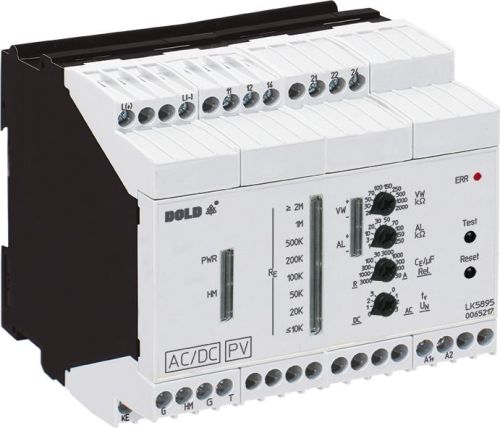
Dold 0069298 insulation monitor 1k-250k DC24V
| Lieske Part No. | 1001670 |
|---|---|
| Mfg Part No | 0069298 |
| EAN-Code | 4030641692988 |
| Manufacturer | Dold |
| Here only | 2.322,39 EUR
2.763,64 EUR incl. VAT
|
Further information for Dold 0069298 insulation monitor 1k-250k DC24V
| Technical data | |
| Approvals | UL |
| Classification | For photovoltaic systems |
| Enclosure design | Switch cabinet |
| IMD type | AC, AC/DC, DC |
| Nominal voltage IT system | AC 0 - 1000 V, DC 0 - 1000 V |
| Response value | 1 - 250 kΩ |
| Response value type | Adjustable |
| Width | 90 mm |
| Type | LK 5895 |
| Earth fault indicator | |
| Variant | |
| Alarm value | 1 - 250 kOhm |
| Auxiliary voltage | DC 24 V |
| Contact equipping | 2 x 1 changeover contact |
| Prewarning value | 1 - 250 kOhm |
| Approvals and Markings | UL-listed C/US, UKCA |
| Variant | With wire-break detection at L(+)/L(-). Analogue output with linear output function to indicate the insulation resistance value. With adapted measurement algorithm |
Applications
The insulation monitor is universally applicable in IT systems with a rated voltage up to 1000 V AC or DC. It is suitable for installations such as photovoltaic systems, UPS systems, networks with frequency converters, battery networks, and DC drives. Monitoring is also performed when the network is de-energized, making it suitable for applications with intermittent power supply. The maximum network capacitance is 3000 μF, allowing even systems with high capacitance to be monitored.
Functions and Equipment in Detail
The device features two 1-changeover contacts, one for pre-alarm and one for alarm. The trip values are adjustable: the alarm value ranges from 1 kΩ to 250 kΩ, and the pre-alarm value ranges from 20 kΩ to 2 MΩ. The current insulation resistance is displayed via an LED chain, visually indicating the status. Additionally, the operating status of the measuring circuit is indicated by a separate LED. Measuring circuit monitoring includes wire break detection at terminals L(+) and L(-), preventing false alarms due to broken conductors.
Technology Explained Simply
Insulation monitoring is performed according to standard IEC/EN 61557-8. The device detects both symmetrical and asymmetrical insulation faults. The measuring circuit can be deactivated via control terminals, for example, during network coupling. The output relays can operate in either energized or de-energized mode, with the setting adjusted via control terminals G and R. An automatic and manual device self-test ensures functional reliability. Alarm memory is selectable, and external test and reset buttons can be connected.
Compatibility and Accessories
The device is designed for IT systems with AC and DC voltages up to 1000 V. It is intended for use in enclosures, with a width of 90 mm. The auxiliary voltage is DC 24 V. Approvals include UL-listed C/US and UKCA. The terminal connections allow integration into existing control systems, with signals such as DC auxiliary voltage, measuring circuit connection, protective earth, and control inputs clearly labeled.
Mounting and Installation
Mounting is done in an enclosure. The terminal connections are clearly labeled, with the assignment of L(+), L(-), KE, PE, G, R, T, HM, and relay contacts (11-14 for alarm, 21-24 for pre-alarm) directly visible on the device. The trip value settings are adjusted using a screwdriver on the rotary switches on the front. The LED indicators allow for quick visual control of the operating status.
Advantages in Operation
The insulation monitor provides preventive fire and system protection through early detection of insulation faults. Selective earth fault detection according to L+ and L- enables fast fault localization. Optimized measurement times are typically shorter than with conventional methods. The integrated wire break detection and the ability to deactivate the measuring circuit via control terminals increase the reliability and flexibility of the device. No additional pre-stage device is required, simplifying installation.

This is an offer of:
79279 Vörstetten
https://industry-electronics.com
Tel. 07666/88499-0
Fax. 07666/88499-111
Diesen Artikel finden Sie unter:
industry-electronics.com/artikel/1001670

Lieske Elektronik e.K.
Reutener Str. 1079279 Vörstetten
https://industry-electronics.com
Tel. 07666/88499-0
Fax. 07666/88499-111
Diesen Artikel finden Sie unter:
industry-electronics.com/artikel/1001670