
Dold 0063176 current relay AC,5-5A AC/DC80-230V
Industrial Material > Industrial relays and contactors > Switching units / measuring, control relay
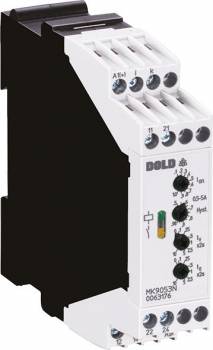
Dold 0063176 current relay AC,5-5A AC/DC80-230V
| Lieske Part No. | 1320395 |
|---|---|
| Mfg Part No | 0063176 |
| EAN-Code | 4030641631765 |
| Manufacturer | Dold |
| Here only | 291,36 EUR
346,72 EUR incl. VAT
|
Further information for Dold 0063176 current relay AC,5-5A AC/DC80-230V
| Technical data | |
| 1- / 3-phase | 1 |
| Enclosure design | Switch cabinet |
| Output contacts | 2 C/O contacts |
| Width | 22,5 mm |
| Type | MK 9053N |
| Operate delay | |
| Variant | |
| Auxiliary voltage | AC/DC 80 - 230 V |
| Contact equipping | 2 changeover contacts |
| Measuring range | AC 0,5 - 5 A |
| Start up delay | 0,1 - 20 s |
| Switching delay | 0 - 20 s |
| Terminal type | screw terminal fixed |
| Approvals and Markings | CCC |
| Variant | Overcurrent relay, energized on trip |
Applications
This relay is intended for monitoring the current consumption of electrical loads in industrial and railway applications. It is particularly suitable for systems where preventive maintenance and rapid fault localization are important to ensure productivity and operational safety. The galvanic isolation between auxiliary circuit and measurement circuit increases safety during installation and use.
Functions and Equipment in Detail
The device features two changeover contacts as output contacts, which can be used to control auxiliary circuits. The measurement ranges cover AC 0.5 to 5 A, where the measured current is arithmetically averaged and rectified. The devices are calibrated for sinusoidal AC currents in RMS value. The setting of the pickup value and hysteresis is adjusted via rotary switches on the front of the device. The start-up bypass allows short-term current peaks, such as those occurring during motor start-up, to be ignored, preventing unwanted trips. The switching delay ranges from 0 to 20 seconds and delays switching after exceeding the set threshold.
Technology Explained Simply
The relay's measurement frequency reaches up to 5 kHz, enabling precise monitoring even with high-frequency loads. The auxiliary voltage is supplied in the range of AC/DC 80 to 230 V, allowing flexible use in various network voltages. The connection terminals are designed as fixed screw terminals, ensuring a secure and durable connection. The LED indicators signal operational readiness (green LED) and activation of the output relay (yellow LED), enabling visual monitoring of the operating status.
Compatibility and Accessories
The relay is manufactured in accordance with standards IEC/EN 60255-1 and IEC/EN 60947-1, ensuring compliance with international standards for measuring and switching devices. It is designed for use in single-phase systems and can be used as either an overcurrent or undercurrent relay, with hysteresis dependent on the set pickup value. The CCC certification is specified for this variant. Optional variants with remote potentiometer for setting the pickup value or with plug-in connection blocks are available, but are not part of this specific configuration.
Mounting and Installation
Mounting is performed in enclosures, with the width of 22.5 mm ensuring compatibility with standard control panels. Terminal markings are assigned as A1/A2 for auxiliary voltage, i/k for current input, and 11/12/14 as well as 21/22/24 for the two changeover contacts. The connection terminals are designed for secure mechanical connections. When using a remote potentiometer, note that the measurement circuit and remote potentiometer are not galvanically isolated, so the remote potentiometer must be connected earth-free and potential-free.
Operational Advantages
The combination of precise measurement, adjustable delays, and visual indication enables reliable and low-maintenance operational monitoring. The ability to adjust start-up bypass and switching delay reduces unnecessary trips and increases the availability of the monitored system. The galvanic isolation between measurement and auxiliary circuit enhances safety during installation and use.

This is an offer of:
79279 Vörstetten
https://industry-electronics.com
Tel. 07666/88499-0
Fax. 07666/88499-111
Diesen Artikel finden Sie unter:
industry-electronics.com/artikel/1320395

Lieske Elektronik e.K.
Reutener Str. 1079279 Vörstetten
https://industry-electronics.com
Tel. 07666/88499-0
Fax. 07666/88499-111
Diesen Artikel finden Sie unter:
industry-electronics.com/artikel/1320395