
Dold 0062576 IK9144.11/200 DC24V 0,1-20S standstill monitor
Industrial Material > Industrial relays and contactors > Switching units / measuring, control relay
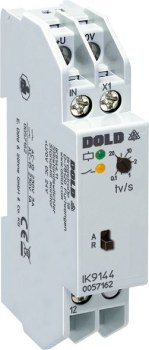
Dold 0062576 IK9144.11/200 DC24V 0,1-20S standstill monitor
| Lieske Part No. | 1321048 |
|---|---|
| Mfg Part No | 0062576 |
| EAN-Code | 4030641625764 |
| Manufacturer | Dold |
| Here only | 160,65 EUR
191,17 EUR incl. VAT
|
Further information for Dold 0062576 IK9144.11/200 DC24V 0,1-20S standstill monitor
| Technical data | |
| Classification | Stillstandsüberwachung |
| Enclosure design | Distribution board |
| Measuring range max. | 300000 IPM |
| Output contacts | 1 C/O contact |
| Width | 17,5 mm |
| Type | IK 9144 |
| Variant | |
| Auxiliary voltage | DC 24 V |
| Contact equipping | 1 changeover contact |
| Time range | 0,1 - 20 s |
| Variant | Input for NAMUR sensors |
Stillstand monitoring
The device is used for continuous monitoring of pulse sequences generated by mechanical or electronic sensors. It detects blockages, standstills, or pulse failure, for example, in conveyor belts, drive shafts, or flow meters. The function is based on evaluating the time between two consecutive pulses at input IN. If this time exceeds the set monitoring time range, the output contact is switched accordingly.
Functions and equipment in detail
The stillstand monitor features a universal input configurable for various sensor types, including PNP, NPN, 2-wire sensors, contacts, and voltage signals. A special variant allows connection to NAMUR sensors. The monitoring time is adjustable in the range of 0.1 to 20 seconds. The device supports two operating modes: operating current principle (slide switch in position A") and resting current principle (position "R), whereby the state of the output relay changes depending on the operating mode when pulses are missing. The LED indicators signal the presence of auxiliary voltage, detection of sensor pulses, and the position of the output relay.
Technology explained clearly
The pulse sequence is detected at input IN. In the operating current principle logic, the relay is de-energized at operating voltage (contacts open). If no pulse is detected within the set time tᵥ, the relay energizes (contacts close). With a new pulse, the relay de-energizes immediately, and time measurement restarts. In the resting current principle logic, the relay is normally energized (contacts closed). If pulses are missing within time tᵥ, the relay de-energizes (contacts open). A new pulse reactivates it. The maximum input frequency is 5 kHz, equivalent to 300,000 pulses per minute.
Compatibility and accessories
The device is suitable for connection to sensors specified according to IEC/EN 60947-5-2, including SKF sensor bearings. It is configured for use with NAMUR sensors. The auxiliary voltage is DC 24 V. The device module is designed in I-form, with a depth of 59 mm and bottom-mounted connection terminals, suitable for installation and industrial distributors according to DIN 43880. The width is 17.5 mm.
Mounting and installation
Mounting is done in installation distributors or industrial distributors according to DIN 43880. The connection terminals are located at the bottom. The devices are intended for use in enclosures, with the I-form designed for shallow distributors. Connection designations include supply voltage (U+, 0V), sensor connection (X1, IN), and changeover contact (11, 12, 14). The LED indicators support diagnosis and status monitoring during operation.
Advantages in operation
The simple operation and clear adjustment of the monitoring time enable quick commissioning. The universal input control increases flexibility when integrating various sensors. The LED indicators provide visual feedback on operating status, facilitating maintenance and troubleshooting. The device complies with the standard IEC/EN 60255-1 and is designed for use in industrial environments where reliability and fast response to faults are required.

This is an offer of:
79279 Vörstetten
https://industry-electronics.com
Tel. 07666/88499-0
Fax. 07666/88499-111
Diesen Artikel finden Sie unter:
industry-electronics.com/artikel/1321048

Lieske Elektronik e.K.
Reutener Str. 1079279 Vörstetten
https://industry-electronics.com
Tel. 07666/88499-0
Fax. 07666/88499-111
Diesen Artikel finden Sie unter:
industry-electronics.com/artikel/1321048