
Dold 0062412 overcurrent relay AC220-240V 7,5-75A
Industrial Material > Industrial relays and contactors > Switching units / measuring, control relay
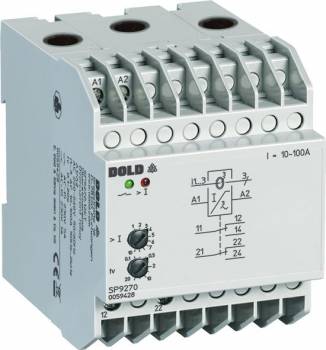
Dold 0062412 overcurrent relay AC220-240V 7,5-75A
| Lieske Part No. | 1320775 |
|---|---|
| Mfg Part No | 0062412 |
| EAN-Code | 4030641624125 |
| Manufacturer | Dold |
| Here only | 516,01 EUR
614,05 EUR incl. VAT
|
Further information for Dold 0062412 overcurrent relay AC220-240V 7,5-75A
| Technical data | |
| 1- / 3-phase | 3 |
| Enclosure design | Switch cabinet |
| Output contacts | 2 C/O contacts |
| Width | 70 mm |
| Type | SP 9270CT |
| Operate delay | |
| Variant | |
| Auxiliary voltage | AC 220 - 240 V |
| Contact equipping | 2 changeover contacts |
| Measuring range | 7,5 - 75 A |
| Time delay | 0,1 - 20 s |
| Variant | 3-phase current relay with built in CT. De-energized on trip |
Applications
This relay is suitable for use in industrial plants, such as in manufacturing automation, power supply systems, or machine control systems. It monitors current consumption in 3-phase networks and responds when the set switching point is exceeded. The galvanic isolation between the auxiliary circuit and the measurement circuit ensures high safety and prevents interference in the control circuit. The width of 70 mm and the enclosure-compatible design make it ideal for installation in standard control panels.
Functions and Features in Detail
The device features 2 changeover contacts as output contacts, which can be used to control auxiliary relays, signal indicators, or switching operations. The pickup value is adjustable, allowing the relay to be flexibly adapted to different loads. The hysteresis is fixed at approximately 4 %, ensuring stable switching behaviour even with minor current fluctuations. LED indicators signal the operating state: a green LED indicates that the current is within the specified limits, while a red LED indicates an overcurrent condition. The adjustable time delay allows for differentiated response to short-term load peaks.
Technology Explained Simply
The SP9270.12CT operates with an integrated current transformer, which draws the measurement current from the main circuit. Measurement is performed in the range of 7.5 to 75 A, with the pickup value adjusted via a bridge at terminals 11, 12, and 14. The auxiliary voltage is supplied via terminals A1 and A2. The output contacts (Rel. 1 and Rel. 2) are designed as changeover contacts and enable control of external switching devices. The zero-current principle means that the output relay is energized in the normal state and de-energized in the event of a fault (overcurrent), enabling clear state indication.
Compatibility and Accessories
The device is designed for use in enclosures and complies with the standard IEC/EN 60255-1. It is compatible with other devices from the SP- and IP-series, which are also used in 3-phase applications. The terminal markings and wiring diagrams in the datasheet allow for unambiguous wiring. The galvanic isolation between the measurement and auxiliary circuits is a key safety feature, especially when integrating into existing control systems.
Mounting and Installation
Mounting is carried out in enclosures using a mounting plate and cable duct. The connection terminals are located at the top, enabling easy wiring. Wiring is performed according to the diagrams in the datasheet, with terminals i1, i2, i3 used for current measurement and A1, A2 for auxiliary voltage.
Operational Advantages
The SP9270.12CT offers high reliability due to galvanic isolation and adjustable time delay. The LED indicators allow for quick visual state monitoring. The adjustable parameters (pickup value, time delay) make the device universally applicable. The enclosure-compatible design and width of 70 mm fit standard control panels. The zero-current principle ensures clear fault indication, as the relay is de-energized in the event of a fault.

This is an offer of:
79279 Vörstetten
https://industry-electronics.com
Tel. 07666/88499-0
Fax. 07666/88499-111
Diesen Artikel finden Sie unter:
industry-electronics.com/artikel/1320775

Lieske Elektronik e.K.
Reutener Str. 1079279 Vörstetten
https://industry-electronics.com
Tel. 07666/88499-0
Fax. 07666/88499-111
Diesen Artikel finden Sie unter:
industry-electronics.com/artikel/1320775