
Dold 0062074 SP9277.39CT AC220-240V 5-50A under-overcurrent relay
Industrial Material > Industrial relays and contactors > Switching units / measuring, control relay
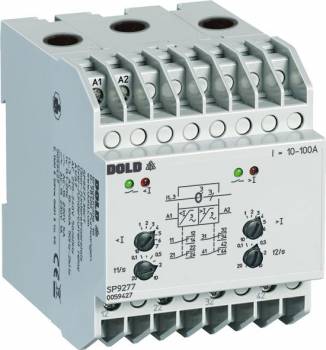
Dold 0062074 SP9277.39CT AC220-240V 5-50A under-overcurrent relay
| Lieske Part No. | 1319814 |
|---|---|
| Mfg Part No | 0062074 |
| EAN-Code | 4030641620745 |
| Manufacturer | Dold |
| Here only | 548,56 EUR
652,79 EUR incl. VAT
|
Further information for Dold 0062074 SP9277.39CT AC220-240V 5-50A under-overcurrent relay
| Technical data | |
| 1- / 3-phase | 3 |
| Enclosure design | Switch cabinet |
| Output contacts | 2 x 2 C/O contacts |
| Width | 70 mm |
| Type | SP 9277CT |
| Operate delay | |
| Variant | |
| Auxiliary voltage | AC 220 - 240 V |
| Contact equipping | 2 x 2 changeover contacts |
| Measuring range | 5 - 50 A |
| Time delay | 0,1 - 20 s |
| Variant | 3-phase current relay with built in CT. De-energized on trip |
Applications
This relay is designed for use in industrial and railway applications where reliable current monitoring is required. It is suitable for monitoring motors, transformer installations, lighting systems, and other electrical loads where sudden current increases or drops can be critical. The 3-phase design enables simultaneous monitoring of all phases in a three-phase system, which is important for the safety and stability of installations.
Functions and Equipment in Detail
The device features two independent output relays, each with 2 changeover contacts, intended for signaling over- and under-current conditions. The hysteresis is fixed at approximately 4% to prevent unwanted switching operations due to minor fluctuations. The time delay can be adjusted between 0.1 and 20 seconds to compensate for short-term current peaks or to ignore them if necessary.
Technology Explained Simply
The integrated current transformer allows measurement of the load current without direct connection to the main current circuit. The measurement circuit is galvanically separated from the auxiliary circuit, ensuring high safety and isolation. The LED indicators signal the operating status: a green LED indicates normal operation, a red LED for I max indicates over-current, and a red LED for I min indicates under-current. The indication is independent of the operating mode, allowing the status to be visually checked at any time.
Compatibility and Accessories
The relay is designed for mounting in enclosures and can be installed either on a DIN rail or via screw mounting. The width is 70 mm, making it suitable for standard enclosure designs. It is part of the VARIMETER series from Dold and can be combined with other devices in this series, particularly models from the IP and SP series, which are also 3-phase and equipped with an integrated current transformer. The measurement ranges are adjustable via bridges on terminals Z1/Z2, Z3/Z4, enabling flexible adaptation to different loads.
Mounting and Installation
Mounting is carried out in an enclosure, with the connection terminals located at the top. The auxiliary voltage is connected to terminals A1/A2, and the measurement circuit is connected via terminals i1/k1, i2/k2, i3/k3. The output relays are accessible via contact terminals 11–14, 21–24, 31–34, 41–44. The settings for the measurement range and time delay are adjusted via the corresponding bridges and rotary controls on the device. Installation requires no additional tools, as the connections are standardized.
Advantages in Operation
The SP9277.39CT offers high reliability through galvanic separation between the measurement and auxiliary circuits, as well as through the residual current principle. The separate output relays for over- and under-current enable precise response to different fault conditions. The LED indicators allow for quick visual fault detection. The adjustable time delay prevents false alarms due to short-term load fluctuations. The device complies with the standard IEC/EN 60255-1 and is therefore suitable for use in industrial environments.

This is an offer of:
79279 Vörstetten
https://industry-electronics.com
Tel. 07666/88499-0
Fax. 07666/88499-111
Diesen Artikel finden Sie unter:
industry-electronics.com/artikel/1319814

Lieske Elektronik e.K.
Reutener Str. 1079279 Vörstetten
https://industry-electronics.com
Tel. 07666/88499-0
Fax. 07666/88499-111
Diesen Artikel finden Sie unter:
industry-electronics.com/artikel/1319814