
Dold 0060495 SP9277.39CT under-overcurrent relay AC220-240V
Industrial Material > Industrial relays and contactors > Switching units / measuring, control relay
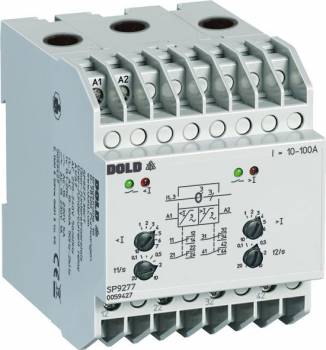
Dold 0060495 SP9277.39CT under-overcurrent relay AC220-240V
| Lieske Part No. | 1313057 |
|---|---|
| Mfg Part No | 0060495 |
| EAN-Code | 4030641604950 |
| Manufacturer | Dold |
| Here only | 548,56 EUR
652,79 EUR incl. VAT
|
Further information for Dold 0060495 SP9277.39CT under-overcurrent relay AC220-240V
| Technical data | |
| 1- / 3-phase | 3 |
| Enclosure design | Switch cabinet |
| Output contacts | 2 x 2 C/O contacts |
| Width | 70 mm |
| Type | SP 9277CT |
| Operate delay | |
| Variant | |
| Auxiliary voltage | AC 220 - 240 V |
| Contact equipping | 2 x 2 changeover contacts |
| Measuring range | 2,5 - 25 A |
| Time delay | 0,1 - 20 s |
| Variant | 3-phase current relay with built in CT. De-energized on trip |
Applications
This relay is suitable for continuous monitoring of electrical loads in industrial plants, such as in production lines, pump or ventilation systems. It can also be used in railway installations, where precise current monitoring is required for the safety and reliability of operational equipment. The 3-phase measurement enables simultaneous monitoring of all phases in a three-phase system, allowing detection of unbalanced loads or phase loss.
Functions and Equipment in Detail
The device includes an integrated current transformer, covering a measurement range of 2.5 to 25 A. Measurement is performed by passing the conductors through the transformer, ensuring galvanic isolation between the measurement circuit and the auxiliary circuit. The adjustable switching delay of 0.1 to 20 seconds allows adaptation to specific requirements, such as filtering out short-term current peaks. The hysteresis is fixed at approximately 4 %, ensuring stable switching behavior without oscillations at threshold values. The separate threshold setting for overcurrent and undercurrent enables differentiated monitoring, with the switching point adjustable between 0.1 and 1 times the rated current.
Technology Explained Simply
The relay operates on a zero-current principle, where the output relays are energized during normal operation and de-energized when a threshold value (overcurrent or undercurrent) is reached. This is particularly advantageous in systems where a shutdown in the event of a fault must ensure that no unintended activity occurs. The LED indicators signal the operating status: a green LED indicates normal operation, a red LED for I max indicates overcurrent, and a red LED for I min indicates undercurrent. This visual feedback simplifies diagnosis and maintenance.
Compatibility and Accessories
The device is designed for mounting in enclosures and can be installed either on DIN rails or by screws. The width is 70 mm, making it suitable for standard enclosure installations. The galvanic isolation between the auxiliary circuit and the measurement circuit increases safety and prevents interference in the control circuit. The relay is part of the VARIMETER series from Dold and can be combined with other devices in this series, particularly models that also support 3-phase measurement and similar output contacts.
Mounting and Installation
Mounting is performed in an enclosure, with connection terminals located at the top. Terminal designations are clearly defined: A1/A2 for auxiliary voltage, i1/k1, i2/k2, i3/k3 for measurement phases, and contacts 11–44 for output relays. The selection of the measurement range is done via jumpers on terminals Z1–Z4. Installation requires passing the conductors to be monitored through the integrated current transformer, ensuring correct phase assignment.
Operational Advantages
The SP9277.39CT provides reliable and precise current monitoring with clear signals via LED indicators. The adjustable time delay and separate threshold setting allow flexible adaptation to different applications. Galvanic isolation and the zero-current principle enhance safety and prevent false alarms. The device complies with the standard IEC/EN 60255-1, confirming adherence to international standards for measuring and protective devices.

This is an offer of:
79279 Vörstetten
https://industry-electronics.com
Tel. 07666/88499-0
Fax. 07666/88499-111
Diesen Artikel finden Sie unter:
industry-electronics.com/artikel/1313057

Lieske Elektronik e.K.
Reutener Str. 1079279 Vörstetten
https://industry-electronics.com
Tel. 07666/88499-0
Fax. 07666/88499-111
Diesen Artikel finden Sie unter:
industry-electronics.com/artikel/1313057