
Dold 0059878 SL5880.12/200 DC24V insulation monitor 5-100k
Measurement > Other Measuring Devices
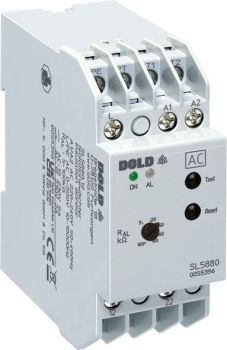
Dold 0059878 SL5880.12/200 DC24V insulation monitor 5-100k
| Lieske Part No. | 887676 |
|---|---|
| Mfg Part No | 0059878 |
| EAN-Code | 4030641598785 |
| Manufacturer | Dold |
| Here only | 278,29 EUR
331,17 EUR incl. VAT
|
Further information for Dold 0059878 SL5880.12/200 DC24V insulation monitor 5-100k
| Technical data | |
| Enclosure design | Switch cabinet |
| IMD type | AC |
| Nominal voltage IT system | AC 0 - 500 V |
| Response value | 5 - 500 kΩ |
| Response value type | Adjustable |
| Width | 35 mm |
| Type | SL 5880 |
| Earth fault indicator | |
| Variant | |
| Alarm value | 5 - 100 kOhm |
| Auxiliary voltage | DC 24 V |
| Contact equipping | 2 x 1 changeover contact |
| Prewarning value | 10 kOhm - 5 MOhm |
| Approvals and Markings | UKCA |
| Variant | Adjustable alarm and pre-warning value. Programmable outputs. De-energized on trip |
Applications
The insulation monitor is intended for pure alternating and rotating current networks in the frequency range of 10 to 10000 Hz. It serves a preventive fire and system protection function by detecting earth faults early. The variant SL5880.12/200 is specifically designed for applications requiring an additional warning threshold, for example in mobile power generation units or for monitoring de-energized consumers such as motor windings that must be activated in an emergency.
Functions and equipment in detail
The device features two 1-changeover contacts used for signal output in the event of an earth fault or warning. The function of the output relays is programmable, allowing selection between memory and hysteresis behavior. The setting of the trigger values is done via a potentiometer on the front of the device, with the alarm threshold adjustable between 5 and 100 kΩ and the warning threshold between 10 kΩ and 5 MΩ. Indication is provided by LEDs: a green LED indicates operational readiness, a red LED signals an earth fault (threshold undershoot), and a yellow LED lights up when the warning threshold is undershot.
Technology explained simply
The insulation monitor operates on the principle of rest current, where the output relays remain inactive in the event of a fault and stay in a resting state. This prevents unwanted switching operations during faults. The galvanic isolation between the measurement circuit, auxiliary voltage, and output contacts ensures safe and interference-free measurement. The auxiliary voltage of DC 24 V enables monitoring of systems that are de-energized at the moment, which is advantageous during maintenance work or emergency preparedness measures.
Compatibility and accessories
The device is specified according to IEC/EN 61557-8 and carries the UKCA mark. It is designed for use in IT systems and can be connected to external test and reset buttons to control the functions from outside. The connection terminals are designed for mounting in enclosures with mounting plate and cable duct.
Mounting and installation
Mounting is done in enclosures using DIN rail or screw mounting. The width is 35 mm, the depth is 98 mm. The connection terminals are arranged at the top, which facilitates wiring in enclosures.
Advantages in operation
The adjustable alarm and warning thresholds allow the device to be adapted to different requirements. The LED indicators enable quick visual inspection of the operating status. The programmability of relay functions (memory or hysteresis behavior) offers flexibility in fault handling. The galvanic isolation and rest current principle increase the safety and reliability of the device. The ability to monitor de-energized systems extends the range of applications in critical installations.

This is an offer of:
79279 Vörstetten
https://industry-electronics.com
Tel. 07666/88499-0
Fax. 07666/88499-111
Diesen Artikel finden Sie unter:
industry-electronics.com/artikel/887676

Lieske Elektronik e.K.
Reutener Str. 1079279 Vörstetten
https://industry-electronics.com
Tel. 07666/88499-0
Fax. 07666/88499-111
Diesen Artikel finden Sie unter:
industry-electronics.com/artikel/887676