
Dold 0059168 contactor AC230-480V 10A
Industrial Material > Industrial relays and contactors > Contactors
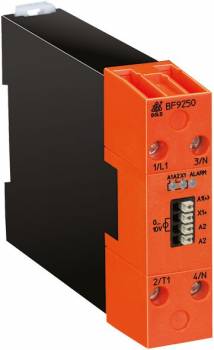
Dold 0059168 contactor AC230-480V 10A
| Lieske Part No. | 204136 |
|---|---|
| Mfg Part No | 0059168 |
| EAN-Code | 4030641591687 |
| Manufacturer | Dold |
| Here only | 218,71 EUR
260,26 EUR incl. VAT
|
Further information for Dold 0059168 contactor AC230-480V 10A
| Technical data | |
| Analog Input Control | 4 - 20 mA |
| Approvals | UL |
| Load current up to | 50 A |
| Load voltage up to | AC 480 V |
| Number of poles | 1-pole |
| Width | 22,5 mm, 45 mm, 90 mm |
| Type | BF 9250/0_2 |
| Temperature monitoring | |
| Variant | |
| Auxiliary voltage | AC/DC 24 V |
| Contact equipping | without signal contact |
| Control input | DC 0 - 10 V |
| Load current | AC 10 A |
| Load voltage | AC 230 - 480 V |
| Semiconductor output | 1-pole |
| Approvals and Markings | UL-listed C/US |
| Variant | Self optimising, to achieve as short as possible control periods, suitable for infrared lamps |
Applications
This contactor is specifically designed for controlling heating systems, particularly for applications with infrared lamps, where self-optimized pulse distribution with minimized cycle times is required. The zero-voltage switching function ensures disturbance-free switching and reduces electromagnetic interference. The varistor protection circuit protects the device against overvoltages, and the temperature protection function of the power semiconductors prevents overheating. The operating temperature ranges from 0 °C to 40 °C, with current reduction occurring above 40 °C (0.2 A/°C at 10 A load current).
Functions and Equipment in Detail
The device features an LED indicator for auxiliary voltage (green), output status (yellow), and alarms (red). In case of a synchronization error, a control input fault, or overtemperature of the power semiconductors, the LEDs illuminate accordingly. The overtemperature alert is latching and requires a brief interruption of the supply voltage to reset. Analog actuation is used, with a resolution of 5 % for this variant (BF9250.91/042). The pulse packet control enables precise load regulation, with pulses distributed self-optimally to ensure short cycle times.
Technology Explained Simply
Zero-voltage detection ensures that the contactor switches only at the zero crossing of the mains voltage, minimizing noise and interference in the network. Varistors protect the device against transient overvoltages caused by switching operations or network disturbances. The temperature protection function monitors the temperature of the power semiconductors and reduces the load current when the temperature reaches a critical level, preventing thermal overload. Current reduction above 40 °C occurs linearly to extend the device’s service life.
Compatibility and Accessories
The contactor is designed for resistive loads and is particularly suitable for heating applications, including infrared lamps. It can be combined with control devices providing an analog output (DC 0–10 V, DC 4–20 mA, or potentiometer 0–10 kΩ). The UL-listed C/US approvals make it suitable for use in North America. DIN rail mounting allows for easy installation in enclosures.
Mounting and Installation
The device can be snapped onto a DIN rail. Recommended clearances are 20 mm above and below, and 10 mm to the left and right, to ensure sufficient cooling at maximum load current and 100 % duty cycle. The connection terminals are clearly labeled: A1 (+) and A2 (–) for auxiliary voltage, X1 for the control input, L1/N for mains connections, and T1/N for the load output.
Operational Advantages
The contactor provides a noiseless and disturbance-free switching function, which is advantageous in sensitive production environments. Analog control enables precise temperature regulation, and self-optimized pulse distribution ensures rapid response to load changes. The LED indicators provide visual feedback on operating status and faults, simplifying maintenance and diagnostics. The UL approval and compliance with IEC/EN standards guarantee safe and reliable operation in industrial installations.

This is an offer of:
79279 Vörstetten
https://industry-electronics.com
Tel. 07666/88499-0
Fax. 07666/88499-111
Diesen Artikel finden Sie unter:
industry-electronics.com/artikel/204136

Lieske Elektronik e.K.
Reutener Str. 1079279 Vörstetten
https://industry-electronics.com
Tel. 07666/88499-0
Fax. 07666/88499-111
Diesen Artikel finden Sie unter:
industry-electronics.com/artikel/204136