
Dold 0058718 MK9055N.38/500 speed monitor AC230+DC24V
Industrial Material > Industrial relays and contactors > Switching units / measuring, control relay
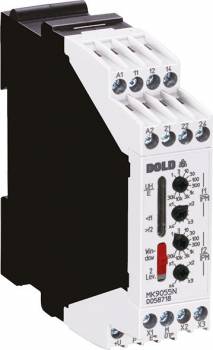
Dold 0058718 MK9055N.38/500 speed monitor AC230+DC24V
| Lieske Part No. | 1320391 |
|---|---|
| Mfg Part No | 0058718 |
| EAN-Code | 4030641587185 |
| Manufacturer | Dold |
| Here only | 263,32 EUR
313,35 EUR incl. VAT
|
Further information for Dold 0058718 MK9055N.38/500 speed monitor AC230+DC24V
| Technical data | |
| Classification | Drehzahlüberwachung |
| Enclosure design | Switch cabinet |
| Measuring range max. | 120000 IPM |
| Output contacts | 2 x 1 C/O contacts, 2 x 1 Wechsler |
| Width | 22,5 mm |
| Type | MK 9055N/5__ |
| Variant | |
| Auxiliary voltage | AC 230 V + DC 24 V |
| Contact equipping | 2 x 1 changeover contact |
| Hysteresis | 5 % fixed |
| Response value | 1 - 120000 IPM |
| Start up delay | 0 / 0,5 s |
| Approvals and Markings | UKCA |
| Variant | Universal input, for configuration of different sensors (PNP, NPN, 2-wire, contact, voltage). Monitoring of 2 speed levels |
Applications
The speed monitor is suitable for monitoring rotating machine parts, cyclic lifting movements, and general pulse sequences in material handling, transport, and production technology. It can also be used for pulse frequency monitoring with flow sensors or anemometers. The application is in industrial environments where the safety of machines and produced goods must be ensured through early detection of speed deviations.
Functions and equipment in detail
The device features two separate relay outputs, each with a changeover contact, designated for under-speed and over-speed monitoring. The start-up bypass time is adjustable to 0 or 0.5 seconds, allowing short-term speed drops during start-up to be ignored. The alarm delay time is also configurable to 0 or 0.5 seconds. Programming is done via terminals, with options such as alarm memory or auto-reset available. LED indicators signal the status of the auxiliary voltage, input signal, and relay outputs. When using a NAMUR sensor, an additional LED indicates wiring or sensor faults.
Technology explained simply
The technology of the speed monitor is based on evaluating pulse signals generated by an external sensor. The frequency of these pulses is converted into speed and compared with the set threshold values. If a threshold is exceeded or undershot, the corresponding relay output is activated. The 5 % hysteresis ensures that the device does not switch uncontrollably due to minor fluctuations around the threshold. The auxiliary voltage can be supplied via AC 230 V (via terminals A1-A2) or DC 24 V (via +U / 0V). The width is 22.5 mm, enabling compact mounting in standard enclosures.
Compatibility and accessories
The speed monitor is configurable for various sensor types, including PNP, NPN, 2-wire, contacts, and voltage signals. Use of NAMUR sensors is also possible, with integrated sensor and wiring monitoring for open circuit and short circuit. Devices in the MK 9055N series are available in a compact design with a width of 22.5 mm, while the MH 9055 series has a width of 45 mm. The MK 9055N/5__ variant offers 2 x 1 changeover contacts, while the MH 9055/5__ variant offers 2 x 2 changeover contacts or a wide-range auxiliary voltage (AC/DC 24–60 V or AC/DC 110–230 V).
Mounting and installation
Mounting is done in an enclosure, with the width of 22.5 mm allowing for compact placement. The connection terminals are clearly labeled: A1-A2 for auxiliary voltage, IN+/- for input signal, X1-X3 for programming, M as reference point, UA/IA for analog output (optional), and +U/0V for alternative DC 24 V supply. Settings are adjusted via programming terminals, with values for start-up bypass, alarm delay, and reset behavior configured directly via terminals.
Advantages in operation
The speed monitor provides reliable and precise speed monitoring, protecting machines and produced goods from damage due to stoppage or over-speed. Simple and clear device configuration via terminals enables quick commissioning. The universal input configuration reduces the need for additional adapters or converters. LED indicators enable quick fault diagnosis during operation. The combination of AC 230 V and DC 24 V auxiliary voltage in one device increases installation flexibility. Compliance with IEC/EN 60255-1 ensures electrical safety and reliability of the device.

This is an offer of:
79279 Vörstetten
https://industry-electronics.com
Tel. 07666/88499-0
Fax. 07666/88499-111
Diesen Artikel finden Sie unter:
industry-electronics.com/artikel/1320391

Lieske Elektronik e.K.
Reutener Str. 1079279 Vörstetten
https://industry-electronics.com
Tel. 07666/88499-0
Fax. 07666/88499-111
Diesen Artikel finden Sie unter:
industry-electronics.com/artikel/1320391