
Dold 0058168 GB9034 200A AC50/60Hz 400V motor brake unit
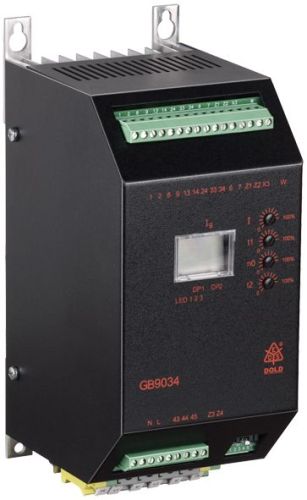
Dold 0058168 GB9034 200A AC50/60Hz 400V motor brake unit
| Lieske Part No. | 1001877 |
|---|---|
| Mfg Part No | 0058168 |
| EAN-Code | 4030641581688 |
| Manufacturer | Dold |
| Here only | 2.219,91 EUR
2.641,69 EUR incl. VAT
|
Further information for Dold 0058168 GB9034 200A AC50/60Hz 400V motor brake unit
| Technical data | |
| Braking current adjustable up to max. | 600 A |
| Braking time adjustable up to max. | 320 s |
| Width | 110 mm |
| Type | GB 9034 |
| Automatic standstill monitoring | |
| External brake contactor required | |
| Signalling output | |
| Temperature monitoring | |
| Variant | |
| Auxiliary voltage | Without |
| Braking current | 200 A |
| Nominal voltage | AC 400 V |
| Approvals and Markings | UKCA |
Applications
This braking device is designed for industrial applications where rapid and safe stopping of the motor is required. It is suitable for all asynchronous motors and is particularly used in systems where short coast-down times are necessary for safety or process optimization. The device variant with 200 A braking current is designed for motors with corresponding power and can be easily integrated into existing systems.
Functions and equipment in detail
The device features automatic standstill monitoring, which detects motor standstill and accordingly switches off the braking current. The braking time is adjustable up to a maximum of 320 seconds, with the user being able to choose between time-dependent and standstill-dependent braking. In standstill-dependent braking, a potential-free signaling contact indicates if the motor has not come to a stop within the maximum braking time. Additionally, temperature monitoring is integrated, which monitors heat development via a motor PTC sensor (optional).
Technology explained simply
DC braking is achieved via single-phase rectification, which converts alternating voltage into direct voltage to brake the motor via the stator winding. The braking current strength is adjustable up to 600 A, with the current variant having a rated value of 200 A. The supply voltage is connected to terminals L1 and L2, with the rated voltage being AC 400 V. An external brake contactor is required, as the device itself does not include an integrated brake contactor for this current strength. Control of the external brake contactor is performed via contact 1–2, which is timed so that the motor contactor has fully dropped out before the braking current flows.
Compatibility and accessories
The device is specified according to IEC/EN 60947-4-2 and carries the UKCA mark. It is designed for use in industrial environments and can be combined with optional features such as star-delta starting, thermistor motor protection, or a wide voltage range (200–690 V). The width is 110 mm, enabling compact mounting in enclosures. Control is performed via a start button, with the ready LED indicating that the supply voltage is present and the device is operational.
Mounting and installation
Mounting is done in an enclosure, with terminals L1–L2 connected to the supply voltage. The interlock contacts (8–9) ensure that the motor contactor can only be switched on when the brake contactor is switched off. The connection terminals are clearly labeled, with terminals 1–2 designated for the external brake contactor. The safety time between switching off the motor contactor and switching on the brake contactor is predefined in the device electronics to prevent damage from induced voltages.
Advantages in operation
Due to the wear- and maintenance-free design, the service life of the device is extended and maintenance effort is reduced. The shorter coast-down time increases the safety and economic efficiency of the system. Adjustable parameters such as braking current and braking time allow individual adaptation to the specific requirements of each application. The integrated standstill monitoring and signaling output ensure reliable monitoring of the braking process and enable quick fault detection.

This is an offer of:
79279 Vörstetten
https://industry-electronics.com
Tel. 07666/88499-0
Fax. 07666/88499-111
Diesen Artikel finden Sie unter:
industry-electronics.com/artikel/1001877

Lieske Elektronik e.K.
Reutener Str. 1079279 Vörstetten
https://industry-electronics.com
Tel. 07666/88499-0
Fax. 07666/88499-111
Diesen Artikel finden Sie unter:
industry-electronics.com/artikel/1001877