
Dold 0055530 input module BG5913.08/00MF0 DC24V
Industrial Material > Industrial relays and contactors > Industrial Relays
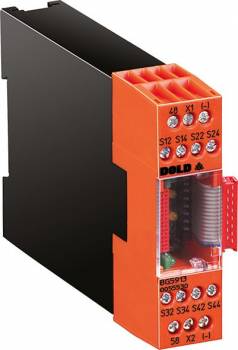
Dold 0055530 input module BG5913.08/00MF0 DC24V
| Lieske Part No. | 1312988 |
|---|---|
| Mfg Part No | 0055530 |
| EAN-Code | 4030641555306 |
| Manufacturer | Dold |
| Here only | 412,81 EUR
491,24 EUR incl. VAT
|
Further information for Dold 0055530 input module BG5913.08/00MF0 DC24V
| Technical data | |
| Application | Emergency stop, Light barrier, Safety gate, Two-hand |
| Cat. / PL acc. to EN ISO 13849-1 | 4/e |
| SIL CL acc. to IEC/EN 62061 | 3 |
| SIL acc. to IEC/EN 62061 | 3 |
| Safety integrity level according to EN 574 | lll A, lll C |
| Width | 22,5 mm |
| Type | BG 5913.08/_0___ |
| Variant | |
| Contact equipping | 8 inputs for control units |
| Nominal voltage | DC 24 V |
| Approvals and Markings | CSA C/US, TÜV |
Applications
This module is intended for use in machines and plants where safe shutdown is required. It is frequently used in machining centres, robotic cells, machine tools, injection moulding and packaging machines, as well as in complete production lines. The functions can be configured easily and without programming via rotary switches, simplifying commissioning and maintenance. The modular design allows flexible adaptation to different monitoring tasks and system expansion through additional modules.
Functions and Equipment in Detail
The input module features eight inputs for command devices, used to connect safety switches, pushbuttons or other sensors. The nominal voltage is DC 24 V, which represents a standard supply in industry. The outputs are configured as semiconductor outputs, with two outputs per module dedicated to status indication. These enable visual monitoring of the operating status via LEDs. An integrated wire break and short-circuit monitoring ensures reliability of input signals and indicates faults via LEDs.
Technology Explained Simply
The module is part of a software-free safety system, where functions are set not via programming but through mechanical switches (rotary switches). This reduces effort for configuration, maintenance and training. Safety functions are implemented via redundant circuits, ensuring high availability and reliability. The integrated diagnostic function via LEDs and semiconductor alarm outputs enables quick fault localization.
Compatibility and Accessories
The module is designed for use in the SAFEMASTER M system and can be combined with other modules of this system. It is compatible with output modules supporting redundant, safety-related contacts according to Category 4 and Performance Level e (EN ISO 13849-1) as well as SIL 3 (IEC/EN 62061). System components can be hierarchically grouped, enabling complex safety functions. An optional fieldbus connection allows transmission of system status to other bus participants, facilitating integration into existing automation systems.
Mounting and Installation
The module has a width of 22.5 mm and is designed for mounting in standard 35 mm control panels. Installation is performed by simply plugging it into the module board of the SAFEMASTER M system. The assignment of inputs to outputs is done via internal switches, eliminating the need for additional programming. Wiring is simple and reduces installation effort.
Advantages in Operation
The module offers a cost-efficient alternative to conventional or programmable safety components. Simple configuration without software and modular expandability reduce design and maintenance times. The integrated diagnostic function via LEDs and semiconductor outputs enables rapid fault detection. Certifications CSA C/US and TÜV confirm compliance with international safety standards. Safety levels Category 4, PL e according to EN ISO 13849-1, as well as SIL 3 according to IEC/EN 62061 and IEC/EN 61508, guarantee a high protection standard for applications in critical areas.

This is an offer of:
79279 Vörstetten
https://industry-electronics.com
Tel. 07666/88499-0
Fax. 07666/88499-111
Diesen Artikel finden Sie unter:
industry-electronics.com/artikel/1312988

Lieske Elektronik e.K.
Reutener Str. 1079279 Vörstetten
https://industry-electronics.com
Tel. 07666/88499-0
Fax. 07666/88499-111
Diesen Artikel finden Sie unter:
industry-electronics.com/artikel/1312988