
Dold 0054100 level relay MK9151N.122-450KAC230V0,2-20S
Industrial Material > Industrial relays and contactors > Switching units / measuring, control relay
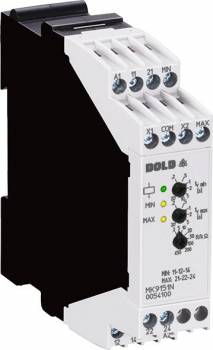
Dold 0054100 level relay MK9151N.122-450KAC230V0,2-20S
| Lieske Part No. | 583595 |
|---|---|
| Mfg Part No | 0054100 |
| EAN-Code | 4030641541002 |
| Manufacturer | Dold |
| Here only | 182,36 EUR
217,01 EUR incl. VAT
|
Further information for Dold 0054100 level relay MK9151N.122-450KAC230V0,2-20S
| Technical data | |
| Classification | Füllstandsüberwachung |
| Enclosure design | Distribution board |
| Measuring range max. | 450 kΩ |
| Output contacts | 2 x 1 C/O contacts |
| Width | 22,5 mm |
| Type | MK 9151N |
| Operate delay | |
| Variant | |
| Auxiliary voltage | AC 230 V |
| Contact equipping | 2 x 1 changeover contact |
| Response and release delay | 0,2 - 20 s |
| Response value | 2 - 450 kOhm |
| Terminal type | screw terminals fixed |
| Approvals and Markings | UKCA, CCC |
| Variant | Time delay, when level rises over and drops under setting value |
Applications
This relay is used in plants where precise fill level control is required, for example in process industry, water treatment, or chemical industry. It is suitable for monitoring liquid levels in tanks, containers, or pipelines. Additionally, it can be used for monitoring the mixing ratio of conductive liquids or for detecting limit temperatures using PTC resistors. The application also includes general resistance monitoring tasks, where a specific resistance value serves as a threshold.
Functions and Equipment in Detail
The device features three electrode connections (MIN, MAX, COM), which can be used for 2-point and 1-point level control. The reference electrode (COM) is typically mounted at the lowest point of the container and must always be connected to the COM terminal. The opposing electrodes for MIN and MAX are connected to the corresponding inputs. Programming is done via jumpers on terminals X1-COM and X2-COM, allowing selection between separate and common actuation of the output relays, as well as between operating and resting current principle. With separate actuation, the two output relays switch independently, and a separate delay time can be set for each level. With common actuation, both relays switch synchronously, enabling a 2-point hysteresis level control.
Technology Explained Simply
The operation is based on measuring the specific resistance of the liquid between the electrodes. When the liquid level reaches the set trigger value, the corresponding output relay is activated. The trigger delay prevents unwanted switching operations caused by short-term level changes, for example due to vibrations or splashes. The reset delay ensures that the relay only switches back after the set time has elapsed, once the level falls below the trigger value. The auxiliary voltage is AC 230 V, and the output contacts consist of two individual changeover contacts (one changeover contact per relay). The terminals are fixed screw terminals located at the top of the device, enabling easy installation in enclosures with mounting plate and cable duct.
Compatibility and Accessories
The relay is designed for auxiliary voltages of AC 24 to 400 V or DC 24 V, with the variant described here specifically designed for AC 230 V. It is equipped with LEDs indicating operational readiness (green LED) and the contact position of the output relays (yellow LEDs for MIN and MAX). The electrodes can be any commercially available products, and the container can serve as the reference electrode if made of conductive material. The connection terminals are designed for use with standard cables, and the width is 22.5 mm, allowing installation in standard installation distributors.
Mounting and Installation
The device is mounted in enclosures, with the top-mounted connection terminals enabling easy wiring. The depth is 98 mm, which must be considered when planning the enclosure depth. Mounting is done on a mounting plate, with cable ducts supporting the wiring. Programming is done via jumpers on terminals X1-COM and X2-COM, allowing selection of operating mode (operating or resting current principle) and actuation type (separate or common).
Advantages in Operation
The MK9151N level relay offers high flexibility through separate adjustment of trigger value and delay times for MIN and MAX levels. The LED indicators facilitate diagnosis and monitoring during operation. The robust design and compliance with standard IEC/EN 60255-1 ensure reliable operation in industrial environments. The combination of 2-point and 1-point control options, along with the choice between operating and resting current principle, significantly expands the range of applications. The device class is designed for level monitoring, with time delay on exceeding and falling below the liquid level supporting stable and disturbance-free operation. The UKCA and CCC certifications confirm compliance with applicable safety and quality requirements.

This is an offer of:
79279 Vörstetten
https://industry-electronics.com
Tel. 07666/88499-0
Fax. 07666/88499-111
Diesen Artikel finden Sie unter:
industry-electronics.com/artikel/583595

Lieske Elektronik e.K.
Reutener Str. 1079279 Vörstetten
https://industry-electronics.com
Tel. 07666/88499-0
Fax. 07666/88499-111
Diesen Artikel finden Sie unter:
industry-electronics.com/artikel/583595