
Dold 0054058 time relay MK9906N.82/500 response delay 0,05 s–300 h
Industrial Material > Industrial relays and contactors > Industrial Timers
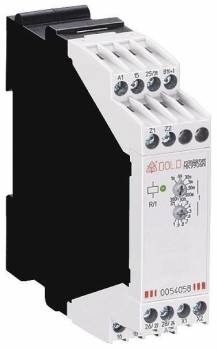
Dold 0054058 time relay MK9906N.82/500 response delay 0,05 s–300 h
| Lieske Part No. | 1312758 |
|---|---|
| Mfg Part No | 0054058 |
| EAN-Code | 4030641540586 |
| Manufacturer | Dold |
| Here only | 125,21 EUR
149,00 EUR incl. VAT
|
Further information for Dold 0054058 time relay MK9906N.82/500 response delay 0,05 s–300 h
| Technical data | |
| Approvals | UL |
| Enclosure design | Switch cabinet |
| Output contacts | 2 C/O contacts |
| Time function(s) | On-delay |
| Width | 22,5 mm |
| Type | MK 9906N |
| Connection facility for remote potentiometer | |
| Variant | |
| Contact equipping | 2 changeover contacts, one programmable as instantaneous contact |
| Nominal voltage | AC/DC 12 - 240 V |
| Terminal type | screw terminals fixed |
| Time range | 0,05 s - 300 h |
| Approvals and Markings | UKCA |
| Variant | 8 time ranges. With connection facility for a remote potentiometer to adjust the time |
Applications
This time relay is suitable for applications in industrial automation, particularly in systems requiring time-controlled operation. It is commonly used in machine controls, process monitoring systems, or in safety and protection circuits. The delayed-action function allows the contact to switch only after a pre-set time has elapsed once the relay is energized. This is useful for gradually activating loads or synchronizing switching operations.
Functions and Features in Detail
The device features 2 changeover contacts as output contacts, with one of these contacts configurable as an immediate contact via programming. This allows flexible adaptation to different switching logic requirements. The time delay is adjustable via a rotary switch across 8 different time ranges, from 0.05 seconds up to 300 hours. The adjustment aid enables quick and accurate setting, even for longer time intervals. The relay is energized via a voltage in the range of AC/DC 12 to 240 V, making it suitable for various mains voltage conditions.
Technology Explained Simply
The time relay operates on the principle of delayed-action switching, where the contact switches only after the set time has elapsed once the relay is energized. The time delay is implemented via an integrated timer, which is adjusted using the rotary switch. The connection terminals are fixed screw terminals, ensuring a secure and durable connection. The terminals are rated for conductor cross-sections up to 2.5 mm² solid or 1.5 mm² stranded wire with ferrule and plastic collar. The provision for a remote potentiometer allows for external, remotely controlled time adjustment, which can be advantageous in complex systems or during maintenance.
Compatibility and Accessories
The device is compatible with a remote potentiometer, which can be connected via a separate connection point. This enables external, remotely controlled adjustment of the delay time. The relay is energized via two-wire proximity switches, facilitating integration into existing control systems. The UL and UKCA certifications confirm compliance with applicable safety and quality standards. The device complies with standard EN 61812-1, which applies to time relays in industrial applications.
Mounting and Installation
The time relay is designed for mounting in enclosures and is connected via fixed screw terminals. Its width of 22.5 mm allows for compact placement in standard control panels. Mounting is typically done in a DIN-standard control box. The connection terminals are designed for solid or stranded conductors, with maximum cross-sections of 2.5 mm² (solid) or 1.5 mm² (stranded) as specified by the manufacturer.
Operational Advantages
The combination of 8 time ranges in a single device reduces inventory requirements, as one model can be used for a wide range of applications. The high accuracy of the time delay and the quick, precise adjustment of even long time intervals enhance control system reliability. LED indicators for operational readiness, contact position, and time progression support diagnostics and maintenance. Options such as remote potentiometer connection or plug-in terminal blocks (optional) increase flexibility during installation and maintenance. The UL and UKCA certifications ensure safety and proper operation in various markets.

This is an offer of:
79279 Vörstetten
https://industry-electronics.com
Tel. 07666/88499-0
Fax. 07666/88499-111
Diesen Artikel finden Sie unter:
industry-electronics.com/artikel/1312758

Lieske Elektronik e.K.
Reutener Str. 1079279 Vörstetten
https://industry-electronics.com
Tel. 07666/88499-0
Fax. 07666/88499-111
Diesen Artikel finden Sie unter:
industry-electronics.com/artikel/1312758