
Dold 0052934 BC7936N.38AC/DC24V+AC220-240V10S star-delta relay 100 ms
Industrial Material > Industrial relays and contactors > Industrial Relays
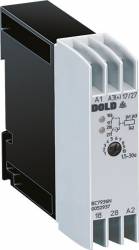
Dold 0052934 BC7936N.38AC/DC24V+AC220-240V10S star-delta relay 100 ms
| Lieske Part No. | 336614 |
|---|---|
| Mfg Part No | 0052934 |
| EAN-Code | 4030641529345 |
| Manufacturer | Dold |
| Here only | 84,59 EUR
100,66 EUR incl. VAT
|
Further information for Dold 0052934 BC7936N.38AC/DC24V+AC220-240V10S star-delta relay 100 ms
| Technical data | |
| Enclosure design | Switch cabinet |
| Output contacts | 2 NO contacts |
| Time function(s) | Star-Delta-Timer |
| Time range | 0,5 s - 100 s |
| Width | 22,5 mm |
| Type | BC 7936N |
| Variant | |
| Contact changeover time | 100 ms |
| Contact equipping | 1 NO contact fleeting on, 1 NO contact on delay |
| Nominal voltage | AC/DC 24 V + AC 220 - 240 V |
| Time range max. value | 10 s |
| Approvals and Markings | UKCA |
Applications
This relay is primarily used in systems for controlling three-phase motors, especially in drives requiring a soft start via star-delta switching. This is typical in pumps, fans, compressors, and other machinery where direct connection to full line voltage would result in high inrush currents. The stepless adjustability of the delay time allows application-specific adaptation of the start duration.
Functions and Equipment in Detail
The device features two output contacts: one make contact operating as fleeting on, and one make contact operating with delayed operation. This contact configuration enables control of two different switching operations within the star-delta control. The contact switching time is 100 ms, ensuring fast and precise switching between star and delta configurations. The repeatability is ≤ 0.5 % + 10 ms, ensuring high consistency in time control. Two LED indicators signal the state of the output relays: the upper LED lights up when contact 17-18 is closed, and the lower LED when contact 27-28 is closed.
Technology Explained Simply
The operating voltage is supplied via two voltage inputs: AC/DC 24 V (at terminals A3-A2) and AC 220–240 V (at terminals A1-A2). The voltage ranges are AC 0.8–1.1 U_N and DC 0.9–1.25 U_N, providing high tolerance to voltage fluctuations. The nominal frequency is 50/60 Hz. The drop-out voltage is at least 15 % of the nominal voltage, ensuring secure de-energization even during voltage dips. The device is designed for continuous operation and functions in a temperature range from -20 °C to +60 °C.
Compatibility and Accessories
The relay is designed for use with standard control panels and enclosures. The terminals are suitable for conductor cross-sections of 1 x 4 mm² (solid) or 1 x 2.5 mm² (stranded wire with ferrule and plastic sleeve) and 2 x 1.5 mm² (stranded wire with ferrule). The connection terminals comply with EN 50005. The enclosure protection rating is IP 40, and the terminals are IP 20, providing protection against touch and dust, but not against water. The enclosure materials consist of thermoplastic with V0 behavior according to UL Subject 94, indicating a high flame retardancy class.
Mounting and Installation
Mounting is done in enclosures using screw terminals. The tightening torques for the plus-minus terminal screws M 3.5 are 0.8 Nm. The terminals are designed as box terminals with wire protection, ensuring a secure and durable connection. The electrical and mechanical life expectancy is high: the electrical life is at least 500,000 switching cycles at 1 A and AC 230 V, and the mechanical life is 100 million switching cycles. The short-circuit withstand capability is defined with a maximum fuse rating of 4 A gG/gL according to IEC/EN 60947-5-1.
Operational Advantages
The stepless adjustability of the delay time and the high repeatability ensure precise and reproducible control. The LED indicators enable visual monitoring of the operating state. The dual-voltage design increases flexibility when integrating into existing systems. The robust construction and compliance with EMC standards (e.g. IEC/EN 61000-4-2 to -4-6) ensure reliable operation in industrial environments with electromagnetic interference. The operating altitude is limited to ≤ 2000 m, which is sufficient for most industrial applications. The vibration resistance and climatic resistance (20/060/04 according to IEC/EN 60068-1) ensure functionality under dynamic and climatic stresses.
Approvals and Markings
The device carries the UKCA approval, confirming compliance with British safety and environmental requirements. Radio frequency interference suppression meets Class B limits according to EN 55011, ensuring low emission of interference. The rated impulse withstand voltage is 4 kV at pollution degree 2 according to IEC 60664-1.

This is an offer of:
79279 Vörstetten
https://industry-electronics.com
Tel. 07666/88499-0
Fax. 07666/88499-111
Diesen Artikel finden Sie unter:
industry-electronics.com/artikel/336614

Lieske Elektronik e.K.
Reutener Str. 1079279 Vörstetten
https://industry-electronics.com
Tel. 07666/88499-0
Fax. 07666/88499-111
Diesen Artikel finden Sie unter:
industry-electronics.com/artikel/336614