
Dold 0052922 time relay delayed return AC110-240V
Industrial Material > Industrial relays and contactors > Industrial Timers
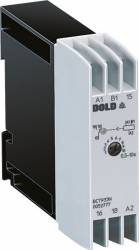
Dold 0052922 time relay delayed return AC110-240V
| Lieske Part No. | 1312796 |
|---|---|
| Mfg Part No | 0052922 |
| EAN-Code | 4030641529222 |
| Manufacturer | Dold |
| Here only | 78,18 EUR
93,03 EUR incl. VAT
|
Further information for Dold 0052922 time relay delayed return AC110-240V
| Technical data | |
| Enclosure design | Switch cabinet |
| Output contacts | 1 C/O contact |
| Time function(s) | Off-delay, with control signal |
| Width | 22,5 mm |
| Type | BC 7933N |
| Variant | |
| Contact equipping | 1 changeover contact |
| Nominal voltage | AC 110 - 240 V |
| Time range | 1,5 - 30 min |
| Variant | Release delay, with control signal |
Applications
This time relay is designed for applications requiring delayed switching-off after a control signal. Typical uses include controlling motors, pumps, lighting systems, or other electrical loads where immediate switching-off is not desired. The delayed release ensures that the output contact remains active for a set duration after the control signal ends. The operating voltage of AC 110 to 240 V makes the device suitable for a wide range of installations in Europe and other regions with corresponding mains voltage.
Functions and Equipment in Detail
The device features a changeover contact as output, rated for AC 250 V. The contact configuration allows control of loads with a thermal current up to 4 A. The contact materials are made of AgNi, ensuring high switching durability and low wear. The LED indicator shows the status of the output relay – the yellow LED lights up when the contact is activated. Control is via input B1, which operates at the rated voltage; a potential-free control contact is not required. The minimum switching-on time is 15 ms for alternating current, ensuring reliable actuation.
Technology Explained Simply
The delayed release is continuously adjustable and can be set between 1.5 and 30 minutes. The timing function is designed so that the output contact remains closed for the set duration after the control signal ends. The reset time after the delay period is less than 50 ms, enabling quick response to new control signals. Voltage influence values are below 1 %, and temperature influence is maximum 0.25 % per Kelvin, ensuring high accuracy even with temperature fluctuations. Repeatability is ≤ 0.5 % + 10 ms, sufficient for precise control tasks.
Compatibility and Accessories
The device is intended for use in enclosures and can be connected with standard terminals. Connection options include 2 x 1.5 mm² stranded wire with sleeve and plastic collar according to DIN 46228-1/-2/-3/-4, or 2 x 2.5 mm² stranded wire with sleeve according to DIN 46228-1/-2/-3. The operating voltage of AC 110 to 240 V allows use in various industrial environments. EMC requirements according to IEC/EN 61000-4-2 to -4-6 are met, ensuring immunity against electromagnetic interference. Overvoltage category III and pollution degree 2 (basic insulation) make the device suitable for industrial applications.
Mounting and Installation
Mounting is done in an enclosure, with the width of 22.5 mm allowing standard installation on DIN rails. The terminal connections are designed for the specified wire cross-sections, and the use of sleeves and plastic collars is recommended. The operating voltage must be continuously applied to A1-A2 to ensure proper relay function. For auxiliary voltages below AC 180 V, input B1 must not be operated until 150 ms after voltage application to ensure proper engagement of the output relay.
Advantages in Operation
The time relay offers high reliability with a mechanical life of 10⁸ switching operations and an electrical life of 1.5 x 10⁵ switching operations at 1 A and AC 230 V. The short reset time and high repeatability enable precise and fast control sequences. The integrated LED indicator simplifies diagnosis and maintenance, as the status of the output relay can be visually monitored. The operating temperature range of -20 to +60 °C and storage temperature of -25 to +70 °C make the device suitable for a wide range of operating conditions. The permissible switching frequency is 36,000 switching operations per hour, sufficient for intensive operating conditions.

This is an offer of:
79279 Vörstetten
https://industry-electronics.com
Tel. 07666/88499-0
Fax. 07666/88499-111
Diesen Artikel finden Sie unter:
industry-electronics.com/artikel/1312796

Lieske Elektronik e.K.
Reutener Str. 1079279 Vörstetten
https://industry-electronics.com
Tel. 07666/88499-0
Fax. 07666/88499-111
Diesen Artikel finden Sie unter:
industry-electronics.com/artikel/1312796