
Dold 0052913 time relay delayed return
Industrial Material > Industrial relays and contactors > Industrial Timers
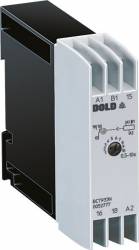
Dold 0052913 time relay delayed return
| Lieske Part No. | 493898 |
|---|---|
| Mfg Part No | 0052913 |
| EAN-Code | 4030641529130 |
| Manufacturer | Dold |
| Here only | 78,18 EUR
93,03 EUR incl. VAT
|
Further information for Dold 0052913 time relay delayed return
| Technical data | |
| Enclosure design | Switch cabinet |
| Output contacts | 1 C/O contact |
| Time function(s) | Off-delay, with control signal |
| Width | 22,5 mm |
| Type | BC 7933N |
| Variant | |
| Contact equipping | 1 changeover contact |
| Nominal voltage | AC 42-48 V / DC 48 V |
| Time range | 15 - 300 s |
| Variant | Release delay, with control signal |
Applications
This time relay is used in industrial control systems where delayed switching-off operations are required, for example in motor control, lighting systems, or safety functions. The delayed release ensures that the output contact remains active for a defined period after the control signal is switched off. This is useful for gently shutting down mechanical loads or ensuring that subsequent processes are completed before the next step begins.
Functions and Equipment in Detail
The device features a changeover contact as the output contact, consisting of a close contact (15–18) and an open contact (15–16). The contact position is indicated by a yellow LED, which lights up when the output relay is activated. The control input B1 can be operated directly with the rated voltage, eliminating the need for a potential-free control contact. The wiring connection options include 2 x 1.5 mm² stranded wire with sleeve and plastic collar according to DIN 46228-1/-2/-3/-4 or 2 x 2.5 mm² stranded wire with sleeve according to DIN 46228-1/-2/-3.
Technology Explained Simply
The delayed release is achieved through an electronic timing circuit, which maintains the output contact for the set duration after the control signal is switched off. The time can be continuously adjusted within the range of 15 to 300 seconds. The reset time after the delay period ends is less than 50 ms, enabling rapid reactivation. The repeat accuracy is ≤ 0.5 % + 10 ms, ensuring high precision during repeated switching operations. Voltage influence values are ≤ 1 %, and temperature influence values are ≤ 0.25 %/K, ensuring stability under varying operating conditions.
Compatibility and Accessories
The device is designed for operating voltages in the range of AC 42–48 V and DC 48 V. It can also be operated with an operating voltage of AC 110–240 V, provided that the rated voltage for control (B1) remains within the range of AC 42–48 V or DC 48 V. The contact configuration is limited to a changeover contact, with a rated operating voltage of AC 250 V. The thermal current rating (Ith) is 4 A. The switching capacity according to AC 15 is 3 A/AC 230 V for the close contact and 1 A/AC 230 V for the open contact.
Mounting and Installation
The time relay is mounted in enclosures and requires a continuously applied operating voltage at terminals A1–A2. For operating voltages below AC 180 V, the control input B1 must be energized only after at least 150 ms following the application of auxiliary voltage, to ensure proper engagement of the output relay. Mounting is done via terminals designed for the specified wire cross-sections.
Operational Advantages
The continuous adjustability of the delay time and high repeat accuracy enable precise control in industrial applications. The integrated LED indicator simplifies diagnosis and maintenance. The short reset time and high mechanical life (10⁸ switching operations) ensure reliable and low-maintenance operation. EMC tests according to IEC/EN 61000-4-2 to -4-6 guarantee robust performance in electromagnetically noisy environments. The device is designed for operating temperatures from -20 to +60 °C and relative humidity of 95 % at 40 °C, enabling broad applicability in industrial environments.

This is an offer of:
79279 Vörstetten
https://industry-electronics.com
Tel. 07666/88499-0
Fax. 07666/88499-111
Diesen Artikel finden Sie unter:
industry-electronics.com/artikel/493898

Lieske Elektronik e.K.
Reutener Str. 1079279 Vörstetten
https://industry-electronics.com
Tel. 07666/88499-0
Fax. 07666/88499-111
Diesen Artikel finden Sie unter:
industry-electronics.com/artikel/493898