
Dold 0052663 wipe relay BC7931N.71 AC/DC24V+AC230V
Industrial Material > Industrial relays and contactors > Industrial Relays
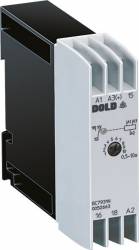
Dold 0052663 wipe relay BC7931N.71 AC/DC24V+AC230V
| Lieske Part No. | 162271 |
|---|---|
| Mfg Part No | 0052663 |
| EAN-Code | 4030641526634 |
| Manufacturer | Dold |
| Here only | 65,64 EUR
78,11 EUR incl. VAT
|
Further information for Dold 0052663 wipe relay BC7931N.71 AC/DC24V+AC230V
| Technical data | |
| Enclosure design | Switch cabinet |
| Output contacts | 1 C/O contact |
| Time function(s) | Fleeting on make |
| Width | 22,5 mm |
| Type | BC 7931N |
| Variant | |
| Contact equipping | 1 changeover contact |
| Nominal voltage | AC/DC 24 V + AC 230 V |
| Time range | 0,5 - 10 s |
| Variant | Fleeting action |
Applications
This timer relay is used in systems requiring a time-delayed switching function, for example in automation technology, pump control systems, lighting installations, or manufacturing technology. The on-delay timer function means that the contact remains closed for a pre-set time period after the operating voltage is applied, and then opens again. This enables controlled, time-based activation of loads.
Functions and Features in Detail
The device features 1 changeover contact as the output contact, designed for switching operations with a rated operating voltage of AC 250 V. The contact materials are made of AgNi, ensuring high switching durability and corrosion resistance. The LED indicator signals the contact position – it lights up when the output relay contact (15–18) is closed. The wire connection terminals are designed as box terminals and allow connection of stranded wires with cross-sections up to 2 x 2.5 mm² (with sleeve DIN 46228-1/-2/-3) or 2 x 1.5 mm² (with sleeve and plastic collar DIN 46228-1/-2/-3/-4). The wire stripping length is 10 mm, and the tightening torques for the terminal screws (M 3.5) are 0.8 Nm.
Technology Explained Simply
The on-delay timer function is implemented via an electronic timing circuit that triggers a defined time delay after the operating voltage is applied. The time can be continuously adjusted, with the setting scaled by a 1:20 ratio. The reset time is ≤ 100 ms, ensuring the device is quickly ready for the next operation after switching. The voltage influence is < 1 % across the entire voltage range, ensuring stable operation even with voltage fluctuations. The temperature dependence is less than 0.25 % per Kelvin, ensuring reliability at different ambient temperatures.
Compatibility and Accessories
The timer relay is designed for use in enclosures and is mounted on a DIN rail (IEC/EN 60715). It features a protection rating IP 40 (housing) and IP 20 (terminals), making it suitable for use in enclosed control systems. The rated frequency is 50/60 Hz, and the rated consumption is 4 VA (AC) or 0.4 W (DC). The release voltage is 15 % of the rated voltage, ensuring secure reset of the relay.
Mounting and Installation
Mounting is done by securing the device to a DIN rail inside the enclosure. Cable connections are made via the box terminals, ensuring compliance with specified cross-sections and tightening torques. The terminals are clearly labeled (A1, A2, A3, 15, 16, 18), ensuring unambiguous assignment of wires. The operating temperature ranges from -20 °C to +60 °C, and the storage temperature ranges from -25 °C to +70 °C. The maximum operating altitude is 2000 m above sea level.
Operational Advantages
The device features a high electrical life (1.5 x 10⁵ switching operations at 1 A/AC 230 V) and a mechanical life of 10⁸ switching operations. The permissible switching frequency is 36,000 switching operations per hour, suitable for high-load applications. The short-circuit resistance is ensured by a maximum fuse rating of 4 A gG/gL. EMC tests according to IEC/EN 61000-4-2 to -4-5 demonstrate high immunity to electromagnetic interference. The insulation test voltage is 2.5 kV (1 min), and the overvoltage category is III, ensuring safe insulation even under transient voltage surges.

This is an offer of:
79279 Vörstetten
https://industry-electronics.com
Tel. 07666/88499-0
Fax. 07666/88499-111
Diesen Artikel finden Sie unter:
industry-electronics.com/artikel/162271

Lieske Elektronik e.K.
Reutener Str. 1079279 Vörstetten
https://industry-electronics.com
Tel. 07666/88499-0
Fax. 07666/88499-111
Diesen Artikel finden Sie unter:
industry-electronics.com/artikel/162271