
Dold 0052640 time relay delayed pickup AC/DC24V+AC230V 0,15-3S
Industrial Material > Industrial relays and contactors > Industrial Timers
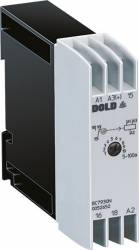
Dold 0052640 time relay delayed pickup AC/DC24V+AC230V 0,15-3S
| Lieske Part No. | 1583543 |
|---|---|
| Mfg Part No | 0052640 |
| EAN-Code | 4030641526405 |
| Manufacturer | Dold |
| Here only | 64,08 EUR
76,26 EUR incl. VAT
|
Further information for Dold 0052640 time relay delayed pickup AC/DC24V+AC230V 0,15-3S
| Technical data | |
| Enclosure design | Switch cabinet |
| Output contacts | 1 C/O contact |
| Time function(s) | On-delay |
| Width | 22,5 mm |
| Type | BC 7930N |
| Variant | |
| Contact equipping | 1 changeover contact |
| Nominal voltage | AC/DC 24 V + AC 230 V |
| Time range | 0,15 - 3 s |
Applications
The time relay is used in industrial control systems where delayed activation of switching operations is required. Typical applications include delaying motor start-up sequences, securing switching operations in production plants, or controlling lighting systems with time-based sequences. The delayed-on function means that the output contact only switches after the set delay time has elapsed, once the operating voltage is applied.
Functions and Features in Detail
The device features an LED indicator that lights up when the output relay is activated, i.e., when contact 15-18 is closed. This enables visual monitoring of the operating status. The time delay is continuously adjustable within the range of 0.15 to 3 seconds, with a repeatability accuracy of ≤ 0.5 % + 10 ms. The reset time is ≤ 100 ms, allowing for rapid reset after switching off the operating voltage. Voltage influence values are ≤ 1 %, and temperature influence is ≤ 0.25 %/K, ensuring high stability under varying operating conditions.
Technical Explanation
The relay operates according to standard EN 61812-1, which applies to time relays. The operating voltage is supplied via two separate inputs (A1/A2 for 230 V and A3/A2 for 24 V), enabling flexible integration into existing circuits. The time delay is implemented via an internal timing circuit controlled by a continuously adjustable potentiometer-like mechanism. The output contacts are configured as changeover contacts, allowing them to be used as either make or break contacts. The mechanical life is 10^8 switching operations, and the electrical life at 1 A and AC 230 V is 1.5 × 10^5 switching operations.
Compatibility and Accessories
The device is designed for mounting on DIN rail according to IEC/EN 60715. The terminal clamps allow connection of 1 x 4 mm² solid wire, 1 x 2.5 mm² stranded wire with ferrule and plastic collar, or 2 x 1.5 mm² stranded wire with ferrule DIN 46228-1/-2/-3/-4. The wire stripping length is 10 mm. The maximum permissible switching frequency is 36,000 switching operations per hour. Short-circuit protection is ensured by a maximum fuse rating of 4 A gG/gL.
Mounting and Installation
Mounting is performed using quick fastening on a DIN rail. The terminals are equipped with M 3.5 plus-minus screws, to be tightened with a torque of 0.8 Nm. The terminal block provides secure wire protection. The device dimensions are 22.5 mm (width) × 84 mm (height) × 97 mm (depth). The net weight is 80 g. The operating temperature range is from -20 °C to +60 °C, and the storage temperature range is from -25 °C to +70 °C. The relative humidity is up to 95 % at 40 °C. The operating altitude is limited to ≤ 2000 m.
Operational Advantages
The time relay offers high repeatability accuracy and low dependence on voltage and temperature fluctuations. The LED indicator enables easy status monitoring. The dual-voltage configuration allows flexible integration into existing circuits. The robust construction made of thermoplastic with V0 flammability rating according to UL Subject 94 ensures high vibration and climate resistance. The enclosure protection rating is IP 40, and the terminals are rated IP 20, suitable for use in enclosed enclosures. EMC tests according to IEC/EN 61000-4-2 to -4-5 ensure good immunity against electromagnetic interference.

This is an offer of:
79279 Vörstetten
https://industry-electronics.com
Tel. 07666/88499-0
Fax. 07666/88499-111
Diesen Artikel finden Sie unter:
industry-electronics.com/artikel/1583543

Lieske Elektronik e.K.
Reutener Str. 1079279 Vörstetten
https://industry-electronics.com
Tel. 07666/88499-0
Fax. 07666/88499-111
Diesen Artikel finden Sie unter:
industry-electronics.com/artikel/1583543