
Dold 0051662 BD9080.12/001 phase monitor 3AC400V
Industrial Material > Industrial relays and contactors > Switching units / measuring, control relay
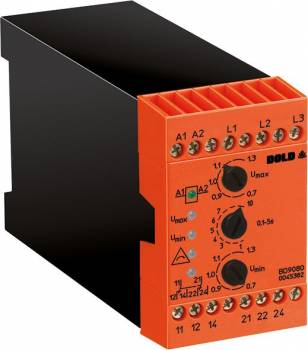
Dold 0051662 BD9080.12/001 phase monitor 3AC400V
| Lieske Part No. | 1313016 |
|---|---|
| Mfg Part No | 0051662 |
| EAN-Code | 4030641516628 |
| Manufacturer | Dold |
| Here only | 435,95 EUR
518,78 EUR incl. VAT
|
Further information for Dold 0051662 BD9080.12/001 phase monitor 3AC400V
| Technical data | |
| 1- / 3-phase | 3 |
| Enclosure design | Switch cabinet |
| Measuring range max. | 750 V |
| Output contacts | 2 C/O contacts |
| Standard measuring range | 3 AC 400 V |
| Width | 45 mm |
| Type | BD 9080 |
| Operate delay | |
| Variant | |
| Auxiliary voltage | AC/DC 24 - 80 V |
| Contact equipping | 2 changeover contacts |
| Nominal voltage | 3AC 400 V |
| Release delay | 0,1 - 5 s |
| Approvals and Markings | CCC |
| Variant | Energized on trip |
Applications
The phase monitor is intended for industrial applications where the reliability of power supply is critical. It is used in systems with electric drives, pumps, compressors, or other machinery that depends on stable three-phase power supply. Early detection of voltage fluctuations, phase failure, or incorrect phase sequence enables preventive maintenance and prevents damage to expensive machinery. Monitoring is performed regardless of whether the network is operated with or without a neutral conductor.
Functions and equipment in detail
The device monitors voltage in the range of 0.7 to 1.3 times the nominal voltage (3AC 400 V), with the range restricted to 0.8 to 1.1 times when using auxiliary voltage from the monitored network. The pickup delay is adjustable between 0.1 and 5 seconds, allowing adaptation to different requirements. The reset delay is also 0.1 to 5 seconds. Asymmetry detection occurs at deviations of ±8 to ±20 % of the pickup voltage, with the fault angle at approximately 120° ±15°. The repeatability is ≤ ±0.5 % of the nominal voltage.
Technology explained clearly
Measurement is performed via arithmetic averaging of multiple half-waves of the rectified phase voltages L1/L2 and L2/L3, with L3 serving as the reference voltage. The current consumption is approximately 0.5 mA per phase L1 and L2, and 0.8 mA for L3. The output contacts consist of two changeover contacts rated for switching operations according to AC 15 (2 A/AC 230 V) and DC 13 (1 A/DC 24 V). The electrical life is approximately 250,000 switching operations at 1 A/AC 230 V, and the mechanical life is at least 50 million switching operations.
Compatibility and accessories
The device is specified according to IEC/EN 60255-1 and meets requirements for monitoring devices in industrial installations. CCC certification is indicated. The maximum measuring voltage is 750 V, with other voltages available upon request. The operating temperature range is -20 °C to +60 °C, and the storage temperature range is also -20 °C to +60 °C. The operating altitude is limited to ≤ 2000 m. The creepage and clearance distances correspond to pollution degree 2, with a rated impulse withstand voltage of 6 kV (auxiliary voltage/measurement input, auxiliary voltage/contacts, measurement input/contacts) and 4 kV (contact/contact) according to IEC 60664-1.
Mounting and installation
The phase monitor is mounted in enclosures and is designed for continuous operation. The connection terminals are provided for phase voltages L1, L2, L3, as well as for auxiliary voltage A1/A2. The output contacts (11–14 and 21–24) are used for signal transmission to external devices. Installation is carried out according to the technical data and instructions in the datasheet, with maximum short-circuit withstand ensured by a fuse with 4 A gG/gL.
Advantages in operation
The integrated LED indicator for auxiliary voltage, overvoltage, undervoltage, asymmetry/phase sequence/power failure, and contact position allows visual recognition of the device status. The adjustable pickup delay enables adaptation to the specific requirements of the installation. Early fault detection reduces downtime and supports preventive maintenance. The high mechanical and electrical life ensures long operational life with minimal maintenance effort.

This is an offer of:
79279 Vörstetten
https://industry-electronics.com
Tel. 07666/88499-0
Fax. 07666/88499-111
Diesen Artikel finden Sie unter:
industry-electronics.com/artikel/1313016

Lieske Elektronik e.K.
Reutener Str. 1079279 Vörstetten
https://industry-electronics.com
Tel. 07666/88499-0
Fax. 07666/88499-111
Diesen Artikel finden Sie unter:
industry-electronics.com/artikel/1313016