
Dold 0050518 contactor BF9250.01/001 DC24V AC25A
Industrial Material > Industrial relays and contactors > Contactors
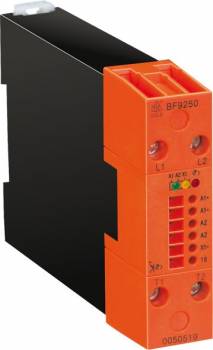
Dold 0050518 contactor BF9250.01/001 DC24V AC25A
| Lieske Part No. | 633829 |
|---|---|
| Mfg Part No | 0050518 |
| EAN-Code | 4030641505189 |
| Manufacturer | Dold |
| Here only | 224,05 EUR
266,62 EUR incl. VAT
|
Further information for Dold 0050518 contactor BF9250.01/001 DC24V AC25A
| Technical data | |
| Approvals | UL |
| Load current up to | 50 A |
| Load voltage up to | AC 480 V |
| Number of poles | 1-pole, 2-pole, 3-pole |
| On/Off Input Control | AC/DC, DC |
| Width | 22,5 mm, 45 mm, 90 mm |
| Type | BF 9250 |
| Signalling output | |
| Temperature monitoring | |
| Variant | |
| Auxiliary voltage | AC/DC 24 V |
| Contact equipping | with signal contact |
| Load current | AC 25 A |
| Load voltage | AC 24 - 480 V |
| Semiconductor output | 1-pole |
| Approvals and Markings | UL-listed C/US |
| Variant | Switching at zero crossing. Control input X1 with low current consumption. Monitoring output for the temperature protection |
Semiconductor contactor is the technical term for an electronic switching device that uses semiconductors (such as thyristors or triacs) instead of mechanical contacts to switch loads. This technology enables noiseless switching without mechanical wear. The BF9250.01/001 switches at zero voltage, meaning the circuit is opened or closed whenever the voltage passes through zero. This reduces electrical interference and extends the lifespan of the loads, especially with inductive loads such as motors.
Zero-voltage switching is a central function that synchronizes switching operations with the sinusoidal waveform of alternating voltage. This minimizes the generation of sparks and electrical overvoltages. Switching is performed via the control input X1, which operates with low current consumption and can therefore be directly controlled by a PLC (Programmable Logic Controller). This is particularly advantageous in automated systems where a direct interface to control devices is required.
Temperature monitoring is an integrated protection system that protects the power semiconductors from overheating. When a critical temperature is reached, an alarm output is activated, indicated by a red LED (J>). This enables early response to malfunctions or overloads. The monitoring is latching, meaning it remains active until the voltage at A1/A2 is briefly interrupted, allowing reset. This mechanism protects the device and connected loads from damage.
Alarm output is an integrated contact that is activated when the temperature monitoring triggers. It can be integrated into safety or monitoring systems to trigger, for example, an alarm message or shutdown. The combination of temperature monitoring and alarm output increases the safety and maintainability of the system.
Approvals and markings include UL listing C/US, confirming approval for use in the USA and Canada. Compliance with standards IEC/EN 60947-4-2 and IEC/EN 60947-4-3 ensures electrical safety and reliability of the device. Protection against transient overvoltages caused by switching operations or network disturbances is provided by varistors.
Compatibility and accessories include use in single- and multi-phase installations. The width of 22.5 mm allows mounting in standard DIN rail distribution boxes. The device is part of a product family that also includes 2-pole and 3-pole variants as well as wider widths (45 mm, 90 mm). Control via X1 makes it compatible with PLC systems. The load voltage up to 480 V and load current up to 50 A (in other variants) demonstrate the flexibility of the product series.
Mounting and installation is done by clipping onto a DIN rail, enabling quick and secure fixation in enclosures. Terminal markings (A1, A2, X1, T1, etc.) are standardized and facilitate wiring. LED indicators (green for operating voltage, yellow for X1 control, red for temperature alarm) support diagnostics during operation.
Operational advantages include noiseless switching, high semiconductor lifespan, integrated temperature protection, and direct PLC control. Zero-voltage switching reduces electrical interference and protects connected loads. UL listing and compliance with IEC standards guarantee suitability for safety-critical applications.
The device is suitable for use in industrial installations, building technology, and automation systems where reliable, low-maintenance, and disturbance-free switching of loads is required. The combination of electronic switching, temperature protection, and PLC-compatible control makes the BF9250.01/001 a robust and flexible component in modern control systems.

This is an offer of:
79279 Vörstetten
https://industry-electronics.com
Tel. 07666/88499-0
Fax. 07666/88499-111
Diesen Artikel finden Sie unter:
industry-electronics.com/artikel/633829

Lieske Elektronik e.K.
Reutener Str. 1079279 Vörstetten
https://industry-electronics.com
Tel. 07666/88499-0
Fax. 07666/88499-111
Diesen Artikel finden Sie unter:
industry-electronics.com/artikel/633829