
Dold 0049322 IL9077.12/011 3AC400V 0,1-20S under-voltage over-voltage relay 3ph
Industrial Material > Industrial relays and contactors > Switching units / measuring, control relay
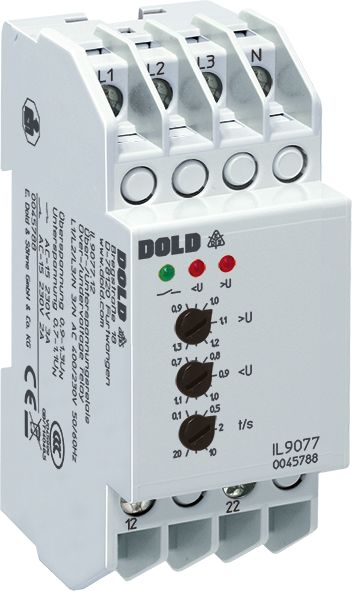
Dold 0049322 IL9077.12/011 3AC400V 0,1-20S under-voltage over-voltage relay 3ph
| Lieske Part No. | 1312739 |
|---|---|
| Mfg Part No | 0049322 |
| EAN-Code | 4030641493226 |
| Manufacturer | Dold |
| Here only | 276,25 EUR
328,74 EUR incl. VAT
|
Further information for Dold 0049322 IL9077.12/011 3AC400V 0,1-20S under-voltage over-voltage relay 3ph
| Technical data | |
| 1- / 3-phase | 1, 3 |
| Auxiliary voltage | Without |
| Enclosure design | Distribution board |
| Measuring range max. | 500 V |
| Output contacts | 2 C/O contacts |
| Standard measuring range | 3/N AC 400/230 V |
| Width | 35 mm |
| Type | IL 9077 |
| Operate delay | |
| Variant | |
| Contact equipping | 2 changeover contacts |
| Nominal voltage | 3AC 400 V |
| Time delay | 0,1 - 20 s |
| Approvals and Markings | CCC |
| Variant | Without neutral connection. De-energized on trip. With asymmetry detection |
Applications
This relay is used in industrial and commercial installations where reliable network monitoring is required. It is particularly suitable for systems connected to the public power grid, as well as for self-generation systems such as photovoltaic installations or generators. Monitoring is based on overvoltage, undervoltage, and phase failure. The function is independent of phase sequence, simplifying installation. The variant without neutral conductor connection measures phase voltages L1 and L2 against L3, making it suitable for systems without an N connection.
Functions and Equipment in Detail
The device features 2 changeover contacts as output contacts, which de-energize in case of a fault. The pickup values for overvoltage (0.9 to 1.3 times rated voltage) and undervoltage (0.7 to 1.1 times rated voltage) are independently adjustable, allowing flexible adaptation to different network conditions. Network fault diagnosis is indicated by multiple LEDs: a green LED indicates normal operation, while two red LEDs indicate the fault cause („<U“ for undervoltage, „>U“ for overvoltage). Upon returning to normal operation, a hysteresis of approximately 4 % of the set value prevents unnecessary switching operations.
Technology Explained Simply
The relay monitors voltage in a three-phase network and reacts if at least one phase exceeds the set threshold for overvoltage or undervoltage. The time delay of 0.1 to 20 seconds prevents reactions to short-term disturbances. Asymmetry detection is activated in this variant: if voltage asymmetry in the network exceeds approximately 5 to 10 %, even though all phases are within the permissible range, the relay de-energizes and the LED changes from green to red. This enables detection of disturbances caused by back-feeding or other network faults.
Compatibility and Accessories
The device is designed for single- and three-phase networks and can operate without auxiliary voltage. It is available in I-form, featuring a depth of 59 mm and bottom-mounted connection terminals for installation and industrial distributors in accordance with DIN 43880. The width is 35 mm. The measurement range limit is 500 V, with the standard measurement range being 3/N AC 400/230 V. CCC certification is included, and the device complies with the standard IEC/EN 60255-1.
Mounting and Installation
Mounting is carried out in installation distributors in accordance with DIN 43880. The connection terminals are located at the bottom, enabling easy integration into existing switchgear. The width of 35 mm fits standard modular constructions. Adjustment of pickup values and time delay is performed using rotary controls on the device.
Operational Advantages
The independent adjustability of pickup values for overvoltage and undervoltage, as well as the adjustable time delay, allows precise adaptation to specific requirements. The LED display provides quick visual fault diagnosis. The standby current principle ensures that the relay de-energizes in case of a fault, which is the desired response in many applications. Asymmetry detection extends functionality to also recognize voltage imbalances not caused by overvoltage or undervoltage alone.

This is an offer of:
79279 Vörstetten
https://industry-electronics.com
Tel. 07666/88499-0
Fax. 07666/88499-111
Diesen Artikel finden Sie unter:
industry-electronics.com/artikel/1312739

Lieske Elektronik e.K.
Reutener Str. 1079279 Vörstetten
https://industry-electronics.com
Tel. 07666/88499-0
Fax. 07666/88499-111
Diesen Artikel finden Sie unter:
industry-electronics.com/artikel/1312739