
Dold 0049292 IK9171.11/200 undervoltage relay 3/N AC400/230V
Industrial Material > Industrial relays and contactors > Contactors
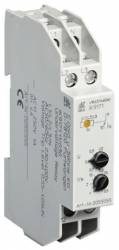
Dold 0049292 IK9171.11/200 undervoltage relay 3/N AC400/230V
| Lieske Part No. | 311094 |
|---|---|
| Mfg Part No | 0049292 |
| EAN-Code | 4030641492922 |
| Manufacturer | Dold |
| Here only | 106,00 EUR
126,14 EUR incl. VAT
|
Further information for Dold 0049292 IK9171.11/200 undervoltage relay 3/N AC400/230V
| Technical data | |
| 1- / 3-phase | 1, 3 |
| Auxiliary voltage | Without |
| Enclosure design | Distribution board |
| Nominal voltage max. | 3/N AC 500 / 290 V |
| Output contacts | 1 C/O contact |
| Width | 17,5 mm |
| Type | IK 9171 |
| Operate delay | |
| Variant | |
| Contact equipping | 1 changeover contact |
| Nominal voltage | 3/N AC 400 / 230 V |
| Response value | 0,85 Un |
| Time delay | without |
| Approvals and Markings | UKCA |
| Variant | With N. NC circuit operation. Without time delay. Fixed response value |
Applications
This relay is used in industrial and commercial installations where continuous power supply is critical. It monitors three-phase networks with neutral conductor connection (3/N AC 400/230 V) and can also be connected single-phase by connecting terminals L1, L2, and L3. Applications include monitoring power supplies in production plants, lighting systems, emergency power supplies, and other critical consumers that must be switched off during voltage dips. Compliance with the standard IEC/EN 60255-1 ensures electrical safety and reliability.
Functions and Equipment in Detail
The device detects undervoltages below 0.85 Un (rated voltage) and responds with a 1-changeover contact. The response delay is activated, meaning the device does not react immediately to short-term voltage dips but includes a brief stabilization period. The LED indicator signals the state of the output relay – illuminated yellow when contact 11-14 is closed. Phase sequence is arbitrary, allowing flexible installation. The device operates without auxiliary voltage, simplifying installation and ensuring independence from additional power sources.
Technology Explained Simply
Measurement is performed via the arithmetic mean of the three phases against the neutral conductor (N). For variants without neutral conductor connection, L1 and L3 are measured against L2 (IK/SK 9171). The rated voltage is 3/N AC 400/230 V, with a maximum rated voltage up to 3/N AC 500/290 V. The frequency range is between 45 and 65 Hz. The device is designed for continuous overload capacity of 1.15 Un. The hysteresis is approximately 4 %, preventing the relay from switching uncontrollably during slight voltage fluctuations.
Compatibility and Accessories
The relay is designed for use in installation distributors and can be combined with other devices from the series IK 9171, SK 9171, IL 9171, and SL 9171. Various variants are available with different response thresholds, time delays, and contact configurations; the variant described here is without time delay and features a fixed response threshold. The width of 17.5 mm allows mounting in standard distributor modules.
Mounting and Installation
Mounting is performed in installation distributors with terminals located at the bottom. The depth is 59 mm. The terminals are designed for direct connection to cables. In single-phase applications, terminals L1, L2, and L3 must be connected together. Installation is done without auxiliary voltage, simplifying wiring.
Operational Advantages
The relay provides reliable network monitoring without additional power supply. The LED indicator allows for quick status checking. Compliance with standards DIN VDE 0100-710 and DIN VDE 0108 ensures conformity with safety requirements. The housing design is compact and fits standard distributors, facilitating integration into existing installations. The standby current principle technology ensures safe signal transmission in the event of a fault, without activating the relay.

This is an offer of:
79279 Vörstetten
https://industry-electronics.com
Tel. 07666/88499-0
Fax. 07666/88499-111
Diesen Artikel finden Sie unter:
industry-electronics.com/artikel/311094

Lieske Elektronik e.K.
Reutener Str. 1079279 Vörstetten
https://industry-electronics.com
Tel. 07666/88499-0
Fax. 07666/88499-111
Diesen Artikel finden Sie unter:
industry-electronics.com/artikel/311094