
Dold 0049189 IL5991 AC50/60HZ 230V 1S surge protection extension
Industrial Material > Industrial relays and contactors > Electronic modules
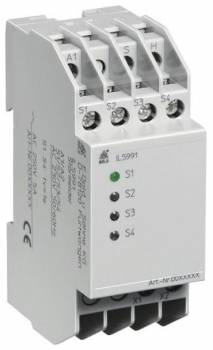
Dold 0049189 IL5991 AC50/60HZ 230V 1S surge protection extension
| Lieske Part No. | 1583556 |
|---|---|
| Mfg Part No | 0049189 |
| EAN-Code | 4030641491895 |
| Manufacturer | Dold |
| Here only | 163,26 EUR
194,28 EUR incl. VAT
|
Further information for Dold 0049189 IL5991 AC50/60HZ 230V 1S surge protection extension
| Technical data | |
| Alarm inputs | 4 |
| Alarm inputs extendable up to | 160 |
| Enclosure design | Distribution board |
| Operating principle | De-energized on trip, Energized on trip |
| Optical signal | LED |
| Width | 35 mm |
| Type | IL 5991 |
| Optional buzzer | |
| Variant | |
| Contact equipping | 2 x 1 NO contact |
| Nominal voltage | AC 230 V |
| Operate delay | 1 s |
Applications include monitoring of machines, plants, buildings, and technical systems where central alarm reporting is required in case of faults. The device is particularly suitable for industrial environments requiring a reliable and expandable fault alarm system. The response delay is 1 second, which suppresses short-term disturbances or impulses to avoid false alarms. The delay is adjustable and can be set to 3 or 10 seconds depending on the application.
Functions and equipment in detail include four fault alarm inputs, which can be switched between active current principle (output relay is activated in case of fault) and rest current principle (output relay is not activated in case of fault) via bridges X1-X2. This allows flexible adaptation to different monitoring scenarios. Each input features an LED for optical indication, displaying the status of the respective fault. The alarm is transmitted via two normally open contacts (2 x 1 NO), each designated for collective alarm and horn. Acknowledgement is performed via a front-mounted acknowledgement button QH, which can also be used for external alarm devices.
Technology explained simply shows that the device operates at a rated voltage of AC 230 V and has a rated consumption of 8 VA. Inputs S1 to S4 and the supply voltage A1-A2 must be connected to the same phase to ensure correct operation. Bus lines H and S carry low voltage and must not be subjected to foreign voltages. For inductive or capacitive interference from high-current lines, the use of shielded cables is recommended, with the shield connected to PE. The contact rating is designed for a thermal current of 5 A, and the switching capacity is 1 A / AC 230 V according to AC 15. The electrical life expectancy is at least 150,000 switching operations at 1 A and AC 230 V.
Compatibility and accessories include use as an expansion device for fault alarm relays IL 5990 and SL 5990. It is compatible with the accessory alarm device IK/SK 8832, which can be connected via the acknowledgement button QH. Expansion is achieved via bus lines H and S, enabling central control and display of faults. The devices are designed for mounting on DIN rail (DIN 60715), allowing quick and secure installation in enclosures.
Mounting and installation is carried out in standard installation distributors with a mounting depth of 61 mm. The connection terminals are located at the bottom, enabling easy wiring. Conductor cross-sections are 2 x 2.5 mm² solid or 2 x 1.5 mm² stranded with ferrules according to DIN 46228. The tightening torque is 0.8 Nm. The devices are designed for operating temperatures from -20 °C to +60 °C and can be used up to an operating altitude of 2000 m. The housing protection rating is IP 40, and the terminals are IP 20.
Operational advantages include high expandability, clear optical indication via LEDs, flexible adjustment of response delay, and easy integration into existing fault alarm systems. The use of two normally open contacts enables clear separation between collective alarm and horn signal. The mechanical life expectancy is at least 30 million switching operations, ensuring high reliability over a long period. The EMC requirements according to IEC/EN 61000-4-2 to -4-5 are met, ensuring immunity to electromagnetic interference. Radio frequency interference suppression complies with emission limit class B according to EN 55011.

This is an offer of:
79279 Vörstetten
https://industry-electronics.com
Tel. 07666/88499-0
Fax. 07666/88499-111
Diesen Artikel finden Sie unter:
industry-electronics.com/artikel/1583556

Lieske Elektronik e.K.
Reutener Str. 1079279 Vörstetten
https://industry-electronics.com
Tel. 07666/88499-0
Fax. 07666/88499-111
Diesen Artikel finden Sie unter:
industry-electronics.com/artikel/1583556