
Dold 0046593 fuse monitor IL9075.01/001 220-240V
Industrial Material > Industrial relays and contactors > Switching units / measuring, control relay
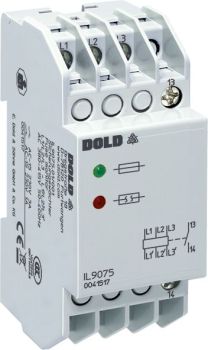
Dold 0046593 fuse monitor IL9075.01/001 220-240V
| Lieske Part No. | 1312825 |
|---|---|
| Mfg Part No | 0046593 |
| EAN-Code | 4030641465933 |
| Manufacturer | Dold |
| Here only | 128,73 EUR
153,19 EUR incl. VAT
|
Further information for Dold 0046593 fuse monitor IL9075.01/001 220-240V
| Technical data | |
| 1- / 3-phase | 3 |
| Enclosure design | Distribution board |
| Measuring range max. | 440 V |
| Output contacts | 1 NO contact, 2 C/O contacts |
| Standard measuring range | 3 AC 380 - 415 V |
| Width | 35 mm |
| Type | IL 9075 |
| Variant | |
| Contact equipping | 1 NO contact |
| Nominal voltage | AC 220 - 240 V 50 - 400 Hz |
| Approvals and Markings | CCC |
| Variant | De-energized on trip. Automatic reset |
Applications
The fuse monitor is designed for monitoring fuses in three-phase networks up to 3 AC 690 V. It is suitable for all common fuse types and sizes and can be used regardless of the network's rotation direction. Typical applications include automatic disconnection and lockout of three-phase motors in the event of failure of one or more phase fuses, ensuring operational safety and system availability.
Functions and Features in Detail
The device features an output contact in the form of a normally open (1 NO) contact, which can be used to control auxiliary functions such as alarm systems or disconnection mechanisms. The operating voltage is AC 220–240 V at a frequency of 50–400 Hz. The measurement ranges are set for 3 AC 380–415 V (standard range) and up to 440 V maximum. Indication is provided via two LEDs: a green LED indicates intact fuses, while a red LED signals a fuse failure. Programming is done via terminals X1–X2 (for memory function and remote reset) and X3–X5 (for load current or zero-current principle). The cable length for programming terminals X3–X5 must not exceed 3 m.
Technology Explained Simply
The fuse monitor monitors the power supply before and after the fuses. In the event of a fuse failure, the device detects the absence of current flow and triggers the appropriate response. The internal resistance of the measurement paths is in the megohm range (over 2000 Ohm/V), ensuring compliance with touch voltage regulations, even if a fuse is defective or missing. Detection is also possible in unbalanced networks, under harmonic load, or with regenerative motors, increasing reliability in complex installations.
Compatibility and Accessories
The device is designed for use in installation distribution systems and conforms to form factor I with a depth of 59 mm and terminals located at the bottom. The width is 35 mm, allowing mounting in standard distribution boxes according to DIN 43880. It is compatible with various fuse types and sizes and can be used in three-phase networks up to 3 AC 690 V.
Mounting and Installation
Mounting is carried out in installation or industrial distribution boxes according to DIN 43880. The terminals are located at the bottom of the device, enabling easy integration into existing control systems. Cable connections are made via terminals L1, L2, L3 (before the fuses) and L1', L2', L3' (after the fuses). Programming of functions (memory function, remote reset, load current/zero-current principle) is done via terminals X1–X5. The maximum cable length for programming terminals is 3 m.
Operational Advantages
Early detection of fuse failures, even when loads are switched off, increases system availability. Reliable detection even in unbalanced or harmonically loaded networks, as well as with regenerative motors, ensures stable operation. The shorter response time compared to motor protection switches allows for faster reaction to fault conditions. The clear LED indication simplifies diagnosis and maintenance, enabling more efficient preventive measures.

This is an offer of:
79279 Vörstetten
https://industry-electronics.com
Tel. 07666/88499-0
Fax. 07666/88499-111
Diesen Artikel finden Sie unter:
industry-electronics.com/artikel/1312825

Lieske Elektronik e.K.
Reutener Str. 1079279 Vörstetten
https://industry-electronics.com
Tel. 07666/88499-0
Fax. 07666/88499-111
Diesen Artikel finden Sie unter:
industry-electronics.com/artikel/1312825