
Dold 0045382 phase monitor BD9080.123AC400VUHAC230V
Industrial Material > Industrial relays and contactors > Switching units / measuring, control relay
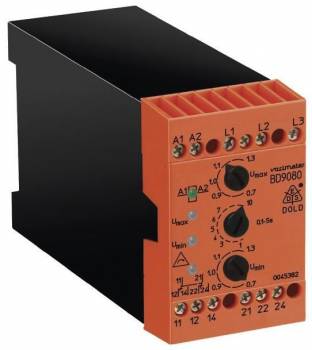
Dold 0045382 phase monitor BD9080.123AC400VUHAC230V
| Lieske Part No. | 857378 |
|---|---|
| Mfg Part No | 0045382 |
| EAN-Code | 4030641453824 |
| Manufacturer | Dold |
| Here only | 399,56 EUR
475,48 EUR incl. VAT
|
Further information for Dold 0045382 phase monitor BD9080.123AC400VUHAC230V
| Technical data | |
| 1- / 3-phase | 3 |
| Enclosure design | Switch cabinet |
| Measuring range max. | 750 V |
| Output contacts | 2 C/O contacts |
| Standard measuring range | 3 AC 400 V |
| Width | 45 mm |
| Type | BD 9080 |
| Operate delay | |
| Variant | |
| Auxiliary voltage | AC 230 V |
| Contact equipping | 2 changeover contacts |
| Nominal voltage | 3AC 400 V |
| Release delay | 0,1 - 5 s |
| Approvals and Markings | CCC |
| Variant | De-Energized on trip |
Applications
The phase monitor is suitable for use in industrial plants, such as machine controls, pumps, fans, or production systems, where reliable power supply is critical. It is mounted in enclosures and monitors three-phase networks for under- and overvoltage, asymmetry, phase failure, and incorrect phase sequence. Early detection of disturbances enables preventive maintenance and prevents damage to connected devices. The application is in systems requiring continuous operational readiness, such as in manufacturing industry or energy supply sectors.
Functions and Equipment in Detail
The device features two changeover contacts as output contacts, used for signaling disturbances. The contact position is indicated by an LED, as well as the auxiliary voltage (A1/A2), overvoltage (U max.), undervoltage (U min.), and fault conditions such as asymmetry, incorrect phase sequence, or power failure. The LED indicators allow for quick visual diagnosis of the operating status. The response delay is adjustable via a rotary control, allowing the device's reaction time to be adapted to the specific requirements of the installation. The reset delay is also 0.1 to 5 seconds, ensuring stable signaling even during short-term voltage fluctuations.
Technology Explained Simply
The phase monitor measures the voltage values of the three phases (L1, L2, L3) and compares them with the set threshold values. The adjustment ranges lie between 0.7 and 1.3 times the nominal voltage, with the range limited to 0.8 to 1.1 times when using auxiliary voltage from the monitored network. Monitoring is performed via arithmetic mean calculation from multiple half-waves of the rectified phase voltages. Asymmetry detection occurs at deviations of ±8 to ±20 % from the response value, with the fault angle at approximately 120° ± 15°. The current consumption is approximately 0.5 mA per phase L1 and L2, and 0.8 mA for L3 at nominal voltage. The hysteresis is up to 5 % of the response value, preventing the device from switching uncontrollably due to minor fluctuations around the threshold.
Compatibility and Accessories
The device is designed for three-phase networks and can be operated with or without a neutral conductor. The auxiliary voltage can be drawn from the monitored network, simplifying installation. The switching capacity is rated for AC 15, with 2 A / AC 230 V for closing contacts and 1 A / AC 230 V for opening contacts. For direct current (DC 13), the switching capacity is 1 A / DC 24 V. The maximum short-circuit withstand requires a fuse with 4 A gG / gL. The device is designed for continuous operation and can be used at operating temperatures from -20 to +60 °C. The creepage and clearance distances correspond to pollution degree 2 with a rated impulse withstand voltage of 6 kV.
Mounting and Installation
The phase monitor is mounted in enclosures and requires a mounting width of 45 mm. The connection terminals are provided for phase voltages L1, L2, L3, as well as for auxiliary voltage A1/A2. The output contacts (11, 12, 14 and 21, 22, 24) are designed for connection to external signaling or switching devices. Mounting is done in an enclosure, with ambient temperature during operation allowed between -20 and +60 °C. The maximum operating altitude is 2000 m above sea level.
Advantages in Operation
By detecting voltage fluctuations, phase failure, or incorrect phase sequence early, the phase monitor enables preventive maintenance and prevents damage to connected devices. The LED indicators provide quick visual fault diagnosis. The adjustable response delay reduces false alarms during short-term disturbances. The device is designed for continuous operation and offers high operational reliability in industrial plants. The mechanical life is at least 50 million switching operations, and the electrical life at 1 A / AC 230 V is 250,000 switching operations. The switching frequency can reach up to 20 switching operations per second. The CCC certification is relevant for use in certain markets.

This is an offer of:
79279 Vörstetten
https://industry-electronics.com
Tel. 07666/88499-0
Fax. 07666/88499-111
Diesen Artikel finden Sie unter:
industry-electronics.com/artikel/857378

Lieske Elektronik e.K.
Reutener Str. 1079279 Vörstetten
https://industry-electronics.com
Tel. 07666/88499-0
Fax. 07666/88499-111
Diesen Artikel finden Sie unter:
industry-electronics.com/artikel/857378