
Dold 0044506 MK9151.11 2-450K-OHM DC24V level relay
Industrial Material > Industrial relays and contactors > Switching units / measuring, control relay
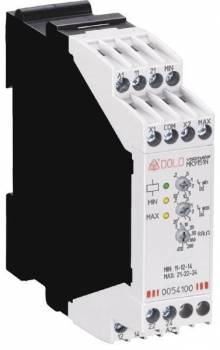
Dold 0044506 MK9151.11 2-450K-OHM DC24V level relay
| Lieske Part No. | 1312554 |
|---|---|
| Mfg Part No | 0044506 |
| EAN-Code | 4030641445065 |
| Manufacturer | Dold |
| Here only | 169,19 EUR
201,34 EUR incl. VAT
|
Further information for Dold 0044506 MK9151.11 2-450K-OHM DC24V level relay
| Technical data | |
| Classification | Füllstandsüberwachung |
| Enclosure design | Switch cabinet |
| Measuring range max. | 450 kΩ |
| Output contacts | 1 C/O contact |
| Width | 22,5 mm |
| Type | MK 9151 |
| Operate delay | |
| Variant | |
| Auxiliary voltage | DC 24 V |
| Contact equipping | 1 changeover contact |
| Response value | 2 - 450 kOhm |
| Variant | Time delay, when level rises over and drops under setting value |
Level monitoring is the primary application of this relay. It enables monitoring of maximum and minimum fill levels, with the setpoint adjusted via a logarithmically scaled dial. The distinction between liquid and foam is possible due to the wide adjustment range. Applications range from simple 1-point control, where only one limit level (e.g. maximum level) is monitored, to 2-point control, where the level is maintained between a minimum and maximum value. In both cases, the reference electrode is connected at the lowest point of the tank and connected to terminal COM.
Functions and equipment in detail include the ability to program the device for either the operating current principle (without bridge) or the resting current principle (with bridge X1-X2 or X1-COM). The response and reset delay are adjustable from 0.2 to 20 seconds, allowing precise adaptation to the specific application. Galvanic isolation of the measurement circuit from the mains ensures high immunity to interference. Two LEDs indicate the operating status: a green LED lights up when the operating voltage is applied, and a yellow LED indicates activation of the output relay.
Technology explained simply is based on measuring the electrical resistance between the electrodes in the tank. The maximum cable length to the electrodes is 3000 meters, with the actual length depending on the set resistance range. For a measurement range of 2 to 450 kΩ, the maximum cable length is 3000 meters at a resistance of 5 kΩ. The measurement voltage is generated internally (approx. AC 10 V) and the measurement current is approximately AC 1.5 mA. The output power is approximately 1 W at DC 24 V. The device is specified according to IEC/EN 60255-1 and meets the requirements for electrical equipment for measurement and monitoring tasks.
Compatibility and accessories include use with all commercially available electrodes. The terminal blocks are designed for connecting the reference electrode (COM), the MIN and MAX electrodes, as well as the control input (X1) and output (X2). The changeover contacts (11, 12, 14) allow integration into existing control systems. Devices are also available in variants with tamper-proof transparent cover or secure isolation according to IEC/EN 61140 and IEC/EN 60947-1, meeting additional safety requirements.
Mounting and installation is carried out in enclosures. The width of 22.5 mm allows compact mounting in standard control panels. The electrodes are installed at the appropriate points in the tank according to the application, with the reference electrode positioned at the lowest point. Cable connections are made via the designated terminal blocks. The setpoint and delay times are adjusted directly on the device using the scale.
Advantages in operation include high immunity to interference, galvanic isolation, and flexible programmability. The adjustable delay prevents false alarms caused by short-term level fluctuations. Clear indication via LEDs simplifies diagnosis during operation. The device is designed for use in industrial environments and is suitable for applications such as monitoring mixing ratios of conductive liquids or detecting limit temperatures with PTC resistors.

This is an offer of:
79279 Vörstetten
https://industry-electronics.com
Tel. 07666/88499-0
Fax. 07666/88499-111
Diesen Artikel finden Sie unter:
industry-electronics.com/artikel/1312554

Lieske Elektronik e.K.
Reutener Str. 1079279 Vörstetten
https://industry-electronics.com
Tel. 07666/88499-0
Fax. 07666/88499-111
Diesen Artikel finden Sie unter:
industry-electronics.com/artikel/1312554