
Dold 0041519 wire break relay AI 940 3AC50/60HZ 400V
Industrial Material > Industrial relays and contactors > Safety relay
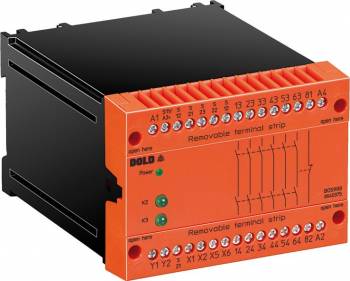
Dold 0041519 wire break relay AI 940 3AC50/60HZ 400V
| Lieske Part No. | 407169 |
|---|---|
| Mfg Part No | 0041519 |
| EAN-Code | 4030641415198 |
| Manufacturer | Dold |
| Here only | 548,94 EUR
653,24 EUR incl. VAT
|
Further information for Dold 0041519 wire break relay AI 940 3AC50/60HZ 400V
| Technical data | |
| 1- / 3-phase | 3 |
| Auxiliary voltage | Without |
| Enclosure design | Switch cabinet |
| Measuring range | AC 0,5 - 16 A |
| Output contacts | 1 C/O contact |
| Width | 45 mm |
| Type | AI 940 |
| Variant | |
| Contact equipping | 1 changeover contact |
| Nominal voltage | 3AC 400 V 50/60 Hz |
Applications
This relay is designed for industrial applications where power supply reliability is critical, such as in systems with motors, pumps, or conveyor belts. It is used to trigger an alarm or activate a protective switch in case of phase loss or interruption in the circuit. Monitoring is performed in the range of 0.5 to 16 A, with the measurement range valid for continuous currents up to 16 A. The rated voltage is 3AC 400 V at 50/60 Hz, making it suitable for most industrial networks.
Functions and Equipment in Detail
The device features a changeover contact (11-12-14) as output contact, which switches when a current drop below 0.5 A is detected in any phase. The contact reset time is approximately 50 ms, as is the switching delay. The contact rating is designed for an electrical life of 500,000 switching operations at 3 A and AC 230 V, according to IEC/EN 60947-5-1. The mechanical life exceeds 30 million switching operations. The switching capacity according to AC 15 is 5 A at AC 230 V. Maximum short-circuit withstand is ensured by a 6 A gG/gL fuse.
Technology Explained Simply
The relay monitors the current in each of the three phases (L1, L2, L3) and reacts when the current in any phase drops below 0.5 A. This may occur due to a wire break, contact loss, or open conductor. Detection is achieved via an inductive measurement path that measures current flow. The internal resistances are less than 6 mΩ per current path, ensuring minimal impact on the network current. The operating temperature ranges from -20 °C to +60 °C, and the storage temperature from -25 °C to +75 °C. Relative humidity is up to 93 % at 40 °C. The operating altitude is limited to a maximum of 2000 m above sea level.
Compatibility and Accessories
The relay is designed for mounting on a DIN rail (IEC/EN 60715) and is suitable for enclosures. The terminals are rated for conductor cross-sections of 2 x 2.5 mm² solid or 2 x 1.5 mm² stranded wire with ferrules (DIN 46228/-1/-2/-3/-4). The tightening torques are 0.8 Nm. For currents exceeding 16 A, the use of current transformers is recommended, with the primary side connected to the secondary side on one side. The device dimensions are 45 mm (width) x 77 mm (height) x 127 mm (depth). The protection rating is IP 40 for the housing and IP 20 for the terminals, according to IEC/EN 60529. The rated impulse voltage is 4 kV at pollution degree 2. The device complies with IEC/EN 60255-1 and is designed for continuous operation.
Mounting and Installation
Mounting is done on a DIN rail inside the enclosure. The connection terminals are designed for solid or stranded conductors. The terminals are equipped with self-lifting connection washers to ensure a secure connection. The tightening torque of 0.8 Nm must be observed to ensure a firm connection. Connections are made to terminals L1, L2, L3 (input) and L1', L2', L3' (output). The changeover contact (11-12-14) is connected to the control device or warning indicator. The device fuse (e.g. F1AG) is optional but recommended to ensure short-circuit withstand.
Advantages in Operation
The relay provides reliable wire break detection without requiring additional auxiliary voltage, simplifying installation. The low internal resistance values ensure minimal impact on network current. The high mechanical and electrical life ensures long-term operation. The IP 40 protection rating makes it suitable for industrial environments. EMC tests according to IEC/EN 61000-4-2 to -4-5 and radio interference suppression according to Class B limit (EN 55011) ensure electromagnetic compatibility. Vibration resistance (amplitude 0.35 mm, frequency 10–55 Hz) and climatic resistance (20/060/04) guarantee functionality under industrial conditions.

This is an offer of:
79279 Vörstetten
https://industry-electronics.com
Tel. 07666/88499-0
Fax. 07666/88499-111
Diesen Artikel finden Sie unter:
industry-electronics.com/artikel/407169

Lieske Elektronik e.K.
Reutener Str. 1079279 Vörstetten
https://industry-electronics.com
Tel. 07666/88499-0
Fax. 07666/88499-111
Diesen Artikel finden Sie unter:
industry-electronics.com/artikel/407169