
Dold 0033930 EC7610.22 time relay delayed pickup 230V
Industrial Material > Industrial relays and contactors > Industrial Timers
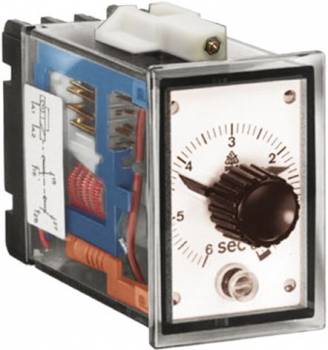
Dold 0033930 EC7610.22 time relay delayed pickup 230V
| Lieske Part No. | 1583542 |
|---|---|
| Mfg Part No | 0033930 |
| EAN-Code | 4030641339302 |
| Manufacturer | Dold |
| Here only | 344,85 EUR
410,37 EUR incl. VAT
|
Further information for Dold 0033930 EC7610.22 time relay delayed pickup 230V
| Technical data | |
| Enclosure design | Front panel mounting |
| Output contacts | 1 NC contact, 1 NO contact |
| Time function(s) | On-delay |
| Width | 48 mm |
| Type | EC 7610 |
| Variant | |
| Contact equipping | 1 NO contact, 1 NO contact delayed, 1 NC contact |
| Nominal voltage | AC 230 V |
| Time range | 2 - 60 min |
Applications
This device is designed for industrial control tasks requiring precise, time-controlled activation of loads. Typical applications include control of pumps, fans, lighting systems, or other electrical consumers where immediate switching is not desired. The on-delay function ensures that the output contacts only switch after the set delay time has elapsed, enabling controlled commissioning of system components.
Functions and Features in Detail
The time relay features contact configuration with one delayed-closer, one delayed-opener, and one instantaneous closer. The instantaneous contacts switch immediately when input voltage is applied, while the delayed contacts switch only after the set time has elapsed. Repeatability is ≤ ± 0.5 % of the scale end value, with an accuracy of ≤ ± 1 % applicable for the range up to 6 seconds. The reset time is < 150 ms, enabling rapid reset after power-off.
Technical Explanation
The time control is purely mechanical, ensuring high reliability and low maintenance requirements. The delay time is adjusted via a continuously variable rotary switch mounted directly on the front panel. The red pointer time indication allows visual monitoring of the switching process. The contacts are made of AgNi with a gold plating of 0.2 μm, ensuring high contact stability and corrosion resistance. The rated operating voltage of the contacts is AC 250 V, and the device is designed for continuous operation.
Compatibility and Accessories
The device is designed for use in enclosures and control systems supporting front panel mounting with a width of 48 mm. It is compatible with other devices from the MINTIMER series by Dold, such as models AA 7610 and EF 7610, which feature different widths and contact configurations. The rated power consumption is 5 VA, and the voltage range coverage is 0.8 to 1.1 times the rated voltage. The frequency range coverage is ± 5 % of the rated frequency.
Mounting and Installation
Mounting is performed via front panel installation in standard control panels. The front surface measures 48 mm in width and 72 mm in height. Electrical connections are made via terminals A1-A2 for input voltage and contact pairs 15-16, 27-28, and 31-32 for output contacts. The switching capacity according to AC 15 is 3 A at AC 230 V, with an electrical life of at least 100,000 switching cycles at 3 A and AC 230 V. The mechanical life exceeds 30 million switching cycles or 15,000 operating hours.
Operational Advantages
The time relay offers a wide adjustment range of 2 to 60 minutes, simple and precise adjustment via the rotary control, and high repeatability. The purely mechanical time control ensures robust and low-maintenance operation. The time progression indicator enables visual monitoring of the switching process. The device is designed for industrial environments, with an operating temperature range of -20 °C to +55 °C and a storage temperature range of -20 °C to +65 °C. The operating altitude is limited to a maximum of 2000 m above sea level. EMC requirements are met according to IEC/EN 61000-4-2 to -4-6, including immunity to electrostatic discharge, high-frequency radiation, and fast transients. Radio frequency interference suppression complies with Class B limits according to EN 55011.

This is an offer of:
79279 Vörstetten
https://industry-electronics.com
Tel. 07666/88499-0
Fax. 07666/88499-111
Diesen Artikel finden Sie unter:
industry-electronics.com/artikel/1583542

Lieske Elektronik e.K.
Reutener Str. 1079279 Vörstetten
https://industry-electronics.com
Tel. 07666/88499-0
Fax. 07666/88499-111
Diesen Artikel finden Sie unter:
industry-electronics.com/artikel/1583542