
Dold 0030731 BA9055 speed monitor AC230V
Industrial Material > Industrial relays and contactors > Switching units / measuring, control relay
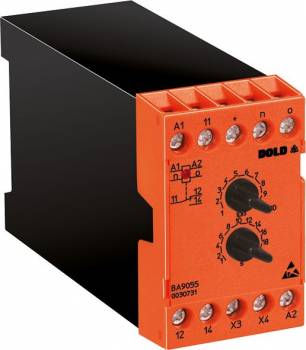
Dold 0030731 BA9055 speed monitor AC230V
| Lieske Part No. | 1313026 |
|---|---|
| Mfg Part No | 0030731 |
| EAN-Code | 4030641307318 |
| Manufacturer | Dold |
| Here only | 309,70 EUR
368,54 EUR incl. VAT
|
Further information for Dold 0030731 BA9055 speed monitor AC230V
| Technical data | |
| Classification | Drehzahlüberwachung |
| Enclosure design | Switch cabinet |
| Measuring range max. | 10000 IPM |
| Output contacts | 1 C/O contact |
| Width | 45 mm |
| Type | BA 9055 |
| Operate delay | |
| Variant | |
| Auxiliary voltage | AC 230 V |
| Contact equipping | 1 changeover contact |
| Setting range | 10 - 100 IPM |
| Start up delay | 1 - 20 s |
| Approvals and Markings | UKCA |
| Variant | With start up delay time. Standstill and underspeed monitoring in closed circuit operation. Overspeed monitoring in open circuit operation |
Applications
The speed monitor BA9055 is particularly suitable for installations with conveyor belts, conveyor systems, or in production environments with multiple interdependent drives. It is used where failure to maintain the specified speed could cause damage to machines or products. Monitoring is performed using the no-load current principle for standstill and under-speed, and the load current principle for over-speed, with functions activated according to application configuration.
Functions and Equipment in Detail
The device features an adjustable start-up bypass time of 1 to 20 seconds, which is activated by default. This function ensures that the output relay remains energized during the start-up phase for the set duration, preventing false alarms during machine start-up. The start-up bypass is implemented by default via a bridge between terminals X3 and X4, which can be removed if required. The adjustable range is between 10 and 100 pulses per minute (IPM), with a maximum measurement range up to 10,000 IPM. The hysteresis is 2 % of the set threshold value, ensuring stable switching behavior during minor speed fluctuations.
Technology Explained Simply
Speed monitors operate on the principle of frequency comparison. A proximity switch converts mechanical rotation into electrical pulses, which are then converted into a frequency. This frequency is compared with an internal reference signal. If the frequency falls below (under-speed) or exceeds (over-speed) the set value, the output relay is switched accordingly. The switching delay is very short, as the device does not have an integrated time delay. The power supply for the proximity switch is integrated within the device and provides a DC voltage of 24 V with a maximum current of 40 mA. The input is designed for pnp sensors.
Compatibility and Accessories
The speed monitor BA9055 is designed for use with proximity switches featuring a pnp output. The auxiliary voltage is AC 230 V, with a voltage tolerance between 0.8 and 1.1 times the nominal voltage. The output contacts consist of a changeover contact (1 C/O contact), suitable for controlling auxiliary relays, indicator lights, or other switching devices. The device class corresponds to the standard IEC/EN 60255-1, applicable to electrical equipment in measurement and control technology. The UKCA approval is indicated, enabling use in the United Kingdom.
Mounting and Installation
The device is designed for enclosure mounting and has a width of 45 mm, making it suitable for standard control panels. The connection terminals are clearly labeled: A1 and A2 for auxiliary voltage, X3 and X4 for the start-up bypass programming terminals, and 11, 12, 14 for the output changeover contact. An LED indicates the status of the auxiliary voltage, while a second LED shows the switching state of the output relay. Adjustment is performed via a rotary knob on the device, allowing setting of the threshold value within the range of 10 to 100 IPM.
Operational Advantages
The simple and clear device adjustment enables quick commissioning. The integrated start-up bypass prevents false alarms during machine start-up. The robust construction and compliance with the IEC/EN 60255-1 standard ensure reliable performance in industrial environments. The combination of standstill, under-speed, and over-speed monitoring in a single device reduces the number of required components and simplifies circuit diagram planning. The output contacts are designed for use in industrial control systems and provide clear indication of the operating status.

This is an offer of:
79279 Vörstetten
https://industry-electronics.com
Tel. 07666/88499-0
Fax. 07666/88499-111
Diesen Artikel finden Sie unter:
industry-electronics.com/artikel/1313026

Lieske Elektronik e.K.
Reutener Str. 1079279 Vörstetten
https://industry-electronics.com
Tel. 07666/88499-0
Fax. 07666/88499-111
Diesen Artikel finden Sie unter:
industry-electronics.com/artikel/1313026