
APC AP8958 PDU 0HE 7x C13 1x C19
19 Inch-Technology > Accessories/Equipment > Energy Management
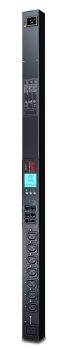
APC AP8958 PDU 0HE 7x C13 1x C19
| Lieske Part No. | 987470 |
|---|---|
| Mfg Part No | AP8958 |
| EAN-Code | 0731304277101 |
| Manufacturer | APC |
| Here only | 2.333,20 EUR
2.776,51 EUR incl. VAT
|
Further information for APC AP8958 PDU 0HE 7x C13 1x C19
| Design | |
| PDU types | Metered, Switched |
| Rack capacity | 0U |
| Mounting | Vertical |
| Logistics data | |
| Total carbon footprint (kg of CO2e) | 1302.31 |
| Management features | |
| Monitoring | Current, Power, Voltage |
| Outlet control | Lock-out, Recycle, Turn off, Turn on |
| Ports & interfaces | |
| AC outlets quantity | 8 AC outlet(s) |
| AC outlet types | C13 coupler, C19 coupler |
| Power | |
| Nominal input voltage | 230 V |
| Maximum current | 16 A |
| Load capacity | 3680 VA |
| Maximum input current per phase | 16 A |
| Maximum total current draw per phase | 16 A |
| Maximum power | 3680 W |
| Weight & dimensions | |
| Width | 56 mm |
| Depth | 46 mm |
| Height | 988 mm |
| Weight | 3.23 kg |
Applications
The PDU is designed for use in data centers, server rooms, and other IT environments where precise control and monitoring of power supply are required. It helps prevent issues such as unauthorized use of power outlets, power surges, overloads, and system crashes. Remote control of outputs allows reboot procedures to be performed and power supply to critical systems to be prioritized.
Functions and Equipment in Detail
The PDU offers comprehensive control of power supply. Each of the eight outputs can be individually switched on, switched off, cycled, or reset. Output control allows access to individual outputs to be locked, preventing unauthorized use. Adjustable delay times for switching on and off enable a defined sequence for powering on and off connected devices. This reduces power surges that could lead to overloads. The power supply is continuously monitored, measuring current, power, and voltage. User-defined alarms warn of potential overloads before failures occur.
Technology Explained Simply
The PDU is designed as a measuring device and captures real-time data on power consumption. Monitoring is performed both locally via a digital display and remotely via network protocols. Power measurement enables precise load distribution and helps extend the operational life of critical systems through prioritization. The unit is designed for a maximum total current draw of 16 A per phase, ensuring safe use in standardized IT environments. Vertical mounting and compact design (height 988 mm, width 56 mm, depth 46 mm) allow flexible placement in the rack.
Compatibility and Accessories
The PDU is equipped with C13 and C19 connectors, which are standard for most servers, network devices, and other IT equipment. Control is performed via secure web, SNMP, or Telnet interfaces. Integration with APC management platforms such as InfraStruxure Central, Capacity Manager, and Change Manager is possible, supporting centralized management of IT infrastructure. A port for temperature and humidity sensors is also available to capture additional environmental data.
Mounting and Installation
The PDU is designed for vertical mounting in 19-inch racks. Mounting requires no additional tools; the unit is simply inserted and secured in the rack. Installation requires no special prerequisites other than a suitable network connection and a 230 V power supply. Configuration is performed via network interfaces, with settings adjustable through web interface, SNMP, or Telnet.
Advantages in Operation
The PDU enables efficient load distribution and reduces the risk of power surges and overloads. Remote control of outputs supports maintenance and reboot procedures without requiring physical access to devices. Real-time monitoring of power parameters helps detect and prevent potential issues early. Integration with existing management systems facilitates centralized control and monitoring of IT infrastructure. The robust construction and compact form factor ensure a reliable and space-saving solution in rack systems.

This is an offer of:
79279 Vörstetten
https://industry-electronics.com
Tel. 07666/88499-0
Fax. 07666/88499-111
Diesen Artikel finden Sie unter:
industry-electronics.com/artikel/987470

Lieske Elektronik e.K.
Reutener Str. 1079279 Vörstetten
https://industry-electronics.com
Tel. 07666/88499-0
Fax. 07666/88499-111
Diesen Artikel finden Sie unter:
industry-electronics.com/artikel/987470