
Allied Telesis AT-QSFPLR4 CPNT 40G QSFP+ LR4 SMF
Networks > Router > IP router
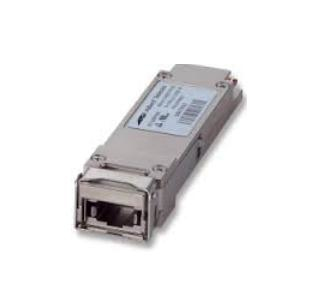
Allied Telesis AT-QSFPLR4 CPNT 40G QSFP+ LR4 SMF
| Lieske Part No. | 121678 |
|---|---|
| Mfg Part No | AT-QSFPLR4 |
| EAN-Code | 0767035206172 |
| Manufacturer | Allied Telesis |
| Here only | 3.264,66 EUR
3.884,95 EUR incl. VAT
|
Further information for Allied Telesis AT-QSFPLR4 CPNT 40G QSFP+ LR4 SMF
| Certificates | |
| Compliance certificates | RoHS |
| Features | |
| Product colour | Grey |
| Hot-swap | |
| Logistics data | |
| Harmonized System (HS) code | 85369010 |
| Operational conditions | |
| Operating temperature (T-T) | 0 - 70 °C |
| Storage temperature (T-T) | -20 - 85 °C |
| Operating relative humidity (H-H) | 0 - 85% |
| Other features | |
| RX sensitivity | -11.5 dB |
| Performance | |
| SFP transceiver type | Fiber optic |
| Maximum data transfer rate | 11200 Mbit/s |
| Interface type | QSFP |
| Fiber optic connector | LC |
| SFP transceiver standard | LR4 |
| Maximum transfer distance | 10000 m |
| Tx power (min) | -7 dBmW |
| Tx power (max) | 2.3 dBmW |
| Networking standards | IEEE 802.3ba |
| Single-mode fiber (SMF) supported | |
| Ethernet LAN | |
| Power | |
| Power consumption (typical) | 3.5 W |
Applications
The AT-QSFPLR4 is designed for use in datacom and telecom environments where high bandwidth and long transmission distances are required. It is suitable for switch and router connections, data aggregation, backplane applications, and systems with high-density port configurations. Typical use cases include data centers, backbone networks, or connecting network components over long distances. The 4 CWDM lanes (Coarse Wavelength Division Multiplexing) allow simultaneous use of four wavelength channels, achieving a total data rate of 40 Gbit/s.
Functions and Features in Detail
The module is hot-swappable, meaning it can be replaced without interrupting network operation. This is particularly advantageous during maintenance or when expanding existing networks. The Digital Diagnostic Monitoring (DDM) enables real-time monitoring of parameters such as transmit power, receive sensitivity, temperature, and voltage, simplifying network administration. The receive sensitivity is -11.5 dBm, ensuring reliable signal transmission even at low signal strength. The transmit power ranges from -7 dBm to 2.3 dBm, which is within the specifications for LR4 modules.
Technology Explained Simply
The AT-QSFPLR4 uses QSFP technology, a compact form factor connector developed for high port density in modern network devices. The 40-Gigabit-Ethernet connection is achieved through four individual wavelength channels (1271 nm, 1291 nm, 1311 nm, 1331 nm), multiplexed via a CWDM MUX/DEMUX design. This enables efficient fiber utilization and high data rates. The single-mode fiber ensures low attenuation and high reach, making it ideal for long distances in backbone applications. The LC connector is a standard in fiber optics and ensures a secure and precise connection.
Compatibility and Accessories
The module is MSA-compliant and conforms to industry standards SFF-8436 and IEEE 802.3ba, enabling interoperability with other devices supporting these specifications. It is therefore suitable not only for Allied Telesis devices but also for other manufacturers adhering to the standard. As accessories, the manufacturer’s catalog offers QSFP+ cables (e.g., AT-QSFP1CU, AT-QSFP3CU) and breakout cables (e.g., AT-QSFP-4SFP10G-3CU) that enable connection to four individual 10-Gigabit ports. MTP cables (e.g., AT-MTP12-1, AT-MTP12-5) are also available to connect to MTP connectors.
Installation and Mounting
Installation is performed by simply inserting the module into the corresponding QSFP slot of a compatible network device. Due to the hot-swap feature, replacement can be done without powering down the device. The fiber connection is made via the integrated LC connector, which is directly plugged into an LC socket. Installation requires no special tools or additional components. Operating conditions include an operating temperature of 0 to 70 °C and a storage temperature of -20 to 85 °C, with relative humidity during operation up to 85 %.
Operational Advantages
The AT-QSFPLR4 offers a high bandwidth of 11.2 Gbit/s per channel (total 40 Gbit/s), sufficient for modern network requirements. The low power consumption of 3.5 W in standard operation reduces energy costs and thermal load. The hot-swap feature enables flexible network design and minimizes downtime. RoHS compliance ensures environmentally friendly manufacturing. Digital diagnostics support network monitoring and simplify troubleshooting. The long-reach capability up to 10 km makes the module particularly suitable for backbone and campus networks.

This is an offer of:
79279 Vörstetten
https://industry-electronics.com
Tel. 07666/88499-0
Fax. 07666/88499-111
Diesen Artikel finden Sie unter:
industry-electronics.com/artikel/121678

Lieske Elektronik e.K.
Reutener Str. 1079279 Vörstetten
https://industry-electronics.com
Tel. 07666/88499-0
Fax. 07666/88499-111
Diesen Artikel finden Sie unter:
industry-electronics.com/artikel/121678