
Allied Telesis AT-MMC2000/LC-960 Media Converter 1000BASE-SX
Networks > Industrial Networking > Media Converters
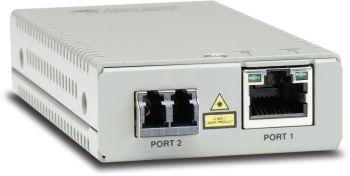
Allied Telesis AT-MMC2000/LC-960 Media Converter 1000BASE-SX
| Lieske Part No. | 1542391 |
|---|---|
| Mfg Part No | AT-MMC2000/LC-960 |
| EAN-Code | 0767035218670 |
| Manufacturer | Allied Telesis |
| Here only | 305,61 EUR
363,68 EUR incl. VAT
|
Further information for Allied Telesis AT-MMC2000/LC-960 Media Converter 1000BASE-SX
| Certificates | |
| Safety | FCC Class A, EN55022 Class A, CISPR 22 Class A, C-TICK, VCCI |
| Certification | CE, EN55024, EN61000-3-2, EN61000-3-3 |
| Features | |
| LED indicators | Activity, Link |
| Product colour | Grey |
| Internal | |
| Logistics data | |
| Harmonized System (HS) code | 85176990 |
| Network | |
| Maximum data transfer rate | 1000 Mbit/s |
| Converter input interface | 10Base-T, 100Base-T, 1000Base-T |
| Converter output interface | 1000Base-SX |
| Networking standards | IEEE 802.1Q |
| Ethernet interface type | Gigabit Ethernet |
| Ethernet LAN data rates | 10,100,1000 Mbit/s |
| Fiber ethernet cabling technology | 1000BASE‑SX |
| Duplex system | Full |
| Jumbo frames support | |
| VLAN support | |
| Operational conditions | |
| Operating temperature (T-T) | 0 - 50 °C |
| Storage temperature (T-T) | -30 - 70 °C |
| Operating relative humidity (H-H) | 5 - 95% |
| Storage relative humidity (H-H) | 5 - 95% |
| Operating altitude | 0 - 3048 m |
| Packaging content | |
| User guide | |
| Manual | |
| Quick installation guide | |
| Performance | |
| Maximum transfer distance | 2000 m |
| Wavelength | 1310 nm |
| Fiber mode structure | Multi-mode |
| Fiber cable diameters supported (core/cladding) | 50/125,62.5/125 µm |
| Tx power (min) | -20 dBmW |
| Tx power (max) | -14 dBmW |
| Rx power (min) | -32 dBmW |
| Ports & interfaces | |
| Connectivity technology | Wired |
| Ethernet LAN (RJ-45) ports | 1 |
| Fiber ports quantity | 2 |
| Fiber optic connector | LC |
| DC-in jack | |
| Power | |
| Input voltage | 12 V |
| Input current | 0.14 A |
| Power consumption (typical) | 1.7 W |
| Power over Ethernet (PoE) | |
| Weight & dimensions | |
| Width | 54.9 mm |
| Depth | 101.6 mm |
| Height | 21.8 mm |
| Weight | 170 g |
Applications
The converter is suitable for industrial applications where stable and reliable data transmission over long distances is required. Typical use cases include networking of machines in production facilities, connecting network segments in large halls, or integrating monitoring systems connected to the central network via fibre cables. Support for VLANs in accordance with IEEE 802.1Q enables structured network organisation, improving network security and management.
Functions and Features in Detail
The device features an Ethernet LAN port (RJ-45) on the input side, which receives 10/100/1000Base-T signals. On the output side, two fibre ports with LC connectors are integrated, designed for transmission over multi-mode fibre cables. Supported fibre diameters are 50/125 µm and 62.5/125 µm. The wavelength is 1310 nm, typical for 1000Base-SX technology. The transmit power ranges from -20 dBmW (min) to -14 dBmW (max), while the receive sensitivity is up to -32 dBmW. These values ensure reliable signal transmission over the entire range.
Technology Explained Simply
The converter operates in full-duplex mode, meaning data can be transmitted simultaneously in both directions without impairing transmission. Support for jumbo frames allows transmission of larger data packets, increasing network efficiency, especially in applications with high data traffic. LED indicators for activity and link status enable quick visual inspection of the operating state. Power supply is via a DC connector at 12 V with a current consumption of 0.14 A, with a total power consumption of 1.7 W in standard operation.
Compatibility and Accessories
The converter is compatible with standard Ethernet networks and supports common Ethernet data transfer rates of 10, 100, and 1000 Mbit/s. Use of multi-mode fibre cables with LC connectors is required to achieve full functionality. The devices are designed for use in environments with an operating temperature of 0 to 50 °C and relative humidity of 5 to 95 %. Storage is possible at temperatures from -30 to 70 °C and the same humidity level. The maximum operating altitude is 3048 m, suitable for use in high mountain regions.
Mounting and Installation
The device is not built-in but is designed as a standalone module. Installation is performed via integrated connectors: RJ-45 for the copper cable and LC connectors for the fibre cable. Power supply is via the DC connector. The delivery includes user manual, operating instructions, and quick installation guide, supporting setup and configuration. The compact design with dimensions 54.9 mm (width) × 101.6 mm (depth) × 21.8 mm (height) and a weight of 170 g allows flexible placement, e.g. in enclosures or on walls.
Operational Advantages
Using the Allied Telesis AT-MMC2000/LC-960 enables cost-efficient extension of existing networks without requiring a complete reconfiguration. The combination of copper and fibre cables offers flexibility in network design. Support for VLANs and jumbo frames improves network performance and security. The PoE function reduces the need for additional power supply units, simplifying installation and reducing maintenance costs. The robust construction and certification according to FCC Class A, EN55022 Class A, CISPR 22 Class A, C-TICK, VCCI as well as CE, EN55024, EN61000-3-2, EN61000-3-3 ensure compliance with applicable electromagnetic compatibility and safety standards.

This is an offer of:
79279 Vörstetten
https://industry-electronics.com
Tel. 07666/88499-0
Fax. 07666/88499-111
Diesen Artikel finden Sie unter:
industry-electronics.com/artikel/1542391

Lieske Elektronik e.K.
Reutener Str. 1079279 Vörstetten
https://industry-electronics.com
Tel. 07666/88499-0
Fax. 07666/88499-111
Diesen Artikel finden Sie unter:
industry-electronics.com/artikel/1542391