
Weidmüller 9019220000 wire end sleeve 6 mm²
Installation > Terminals > Sleeves, blank - isolated
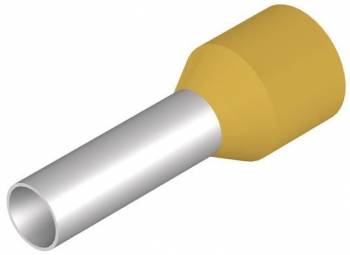
Weidmüller 9019220000 wire end sleeve 6 mm²
| Lieske Part No. | 166083 |
|---|---|
| Mfg Part No | 9019220000 |
| EAN-Code | 4008190151607 |
| Manufacturer | Weidmüller |
| Here only | 12,82 EUR
15,26 EUR incl. VAT
|
Further information for Weidmüller 9019220000 wire end sleeve 6 mm²
| General | |
| Conductor cross section | 6 mm² |
| Material | Copper, galvanically tinned |
| Application | flexible conductors |
Wire end ferrule
The ferrule is designed as a wire end ferrule, meaning it is mounted at the end of a cable to enclose the exposed conductors. It is intended for flexible conductors that are frequently moved or stressed during operation, such as in machine building, drive technology, or industrial electrical installation technology. The galvanic tinning ensures good corrosion resistance and improves electrical conductivity, enhancing the reliability of the connection.
Technology explained simply
The wire end ferrule is made of copper, galvanically coated with tin. This coating prevents oxide formation on the surface, which could impair electrical conductivity. The ferrule is applied by crimping — that is, mechanically deforming it using a crimping tool — onto the cable. During crimping, the ferrule is deformed to tightly enclose the conductors and create a metallic connection. The tinning supports contact quality and extends the connection’s service life.
Compatibility and accessories
The ferrule is designed for conductor cross-sections of 6 mm² and is suitable for flexible cables. The designation “20D” refers to the ferrule’s length, which is 12 mm. These dimensions are standard for industrial applications. The ferrule can be processed using appropriate crimping tools designed for a 6 mm² cross-section.
Installation and mounting
Installation is performed by crimping with a suitable tool. The cable is first stripped so that the exposed conductors match the length of the ferrule. The ferrule is then slipped over the conductors and deformed using the crimping tool. It is essential to ensure the ferrule is fully deformed to guarantee a secure and durable connection. Processing requires no additional materials such as solder or adhesive.
Operational advantages
The galvanic tinning of the copper ferrule provides high corrosion resistance, extending the connection’s service life. The mechanical stability achieved through crimping ensures reliable electrical conductivity even under dynamic loads. The ferrule is easy to process and requires no additional materials or special tools beyond the crimping tool. The connection is durable and resistant to mechanical stress.
Applications
The wire end ferrule is used in industrial installations, machine building, drive technology, and electrical installation. It is particularly suitable for applications where flexible conductors are mechanically stressed, such as in moving parts, switchgear, or control systems. The galvanic tinning also makes it suitable for environments with increased corrosion risk, for example, in damp or chemically aggressive areas.
Functions and features in detail
The ferrule is made of copper and galvanically tinned, improving electrical conductivity and corrosion resistance. Its shape is cylindrical with a length of 12 mm, suitable for conductor cross-sections of 6 mm². Processing is done by crimping, during which the ferrule fully encloses the conductors. The connection is durable and mechanically stable, making it suitable for industrial applications.

This is an offer of:
79279 Vörstetten
https://industry-electronics.com
Tel. 07666/88499-0
Fax. 07666/88499-111
Diesen Artikel finden Sie unter:
industry-electronics.com/artikel/166083

Lieske Elektronik e.K.
Reutener Str. 1079279 Vörstetten
https://industry-electronics.com
Tel. 07666/88499-0
Fax. 07666/88499-111
Diesen Artikel finden Sie unter:
industry-electronics.com/artikel/166083