
Weidmüller 3016680000 SDT 2.5 3C Terminal Block
Industrial Material > Connection technology > Terminals
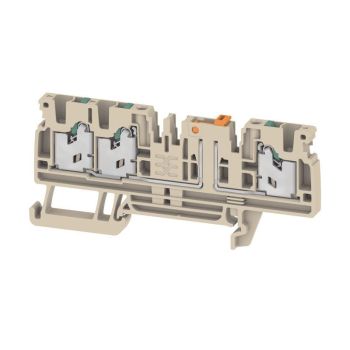
Weidmüller 3016680000 SDT 2.5 3C Terminal Block
| Lieske Part No. | 612060 |
|---|---|
| Mfg Part No | 3016680000 |
| EAN-Code | 4099986926530 |
| Manufacturer | Weidmüller |
| Here only | 3,55 EUR
4,22 EUR incl. VAT
|
Further information for Weidmüller 3016680000 SDT 2.5 3C Terminal Block
| General | |
| Product type | Barrier strip |
| Function | Isolating electrical circuits |
| Number of poles | 3 |
| Maximum conductor cross-section | 2,5 mm² |
| Construction type | Barrier strip |
Applications
The SDT 2.5 3C is designed for use in industrial electrical installations where targeted disconnection of conductors is required. It is commonly used in enclosures, control systems, and distribution units, where safe isolation of individual conductors is necessary during maintenance work or when performing electrical measurements. The terminal is designed for use in circuits with a nominal cross-section of 2.5 mm², making it suitable for a wide range of standard applications in electrical engineering.
Functions and Features in Detail
The terminal features a 3-pole design, enabling three individual conductor connections. The disconnect function is implemented via an integrated mechanism that allows the connection between two conductors to be selectively interrupted. This is especially useful when a conductor needs to be isolated during measurement or testing to eliminate error sources or ensure personnel safety. The terminal is designed as a terminal block, meaning it can be mounted in a row with other terminals to enable compact and organized wiring.
Technology Explained Simply
The designation SDT 2.5 3C describes the product family (SDT = Safety and Diagnostic Disconnect Terminal), the maximum conductor cross-section (2.5 mm²), and the number of poles (3C = 3-pole). The terminal is designed for use with cables up to 2.5 mm², which is a standard size in industrial electrical engineering. The disconnect function is achieved via a mechanical lock that interrupts the electrical connection between two conductors without affecting the entire circuit. The terminal is designed for use in enclosures and distribution units, where clear and safe disconnection of circuits is required.
Compatibility and Accessories
To extend functionality and improve identification, various accessories are available. These include cross-connectors such as the ZQV 2.5N/3 BK, which enables electrical connection between multiple terminals, as well as terminal markers in various sizes and colors, such as the WS 10/5 MC NE GE or DEK 5/5 MC NE RT. These markers allow for clear identification of individual conductors and simplify maintenance and diagnostics. Additionally, component connectors such as the BEST or BEST/D are available, enabling easy mounting and connection of components. The terminal is also compatible with fuse holders such as the SIHA 3/G20/LD 10-36V, facilitating integration into existing circuits.
Mounting and Installation
The SDT 2.5 3C is mounted in enclosures or distribution units, where it can be arranged in a row with other terminals. Installation is typically done via screw fastening or by inserting into a corresponding terminal block field. The terminal is designed for use with cables up to 2.5 mm², with connections made via screw or clamp connections. The disconnect function is activated by operating an integrated mechanism, which interrupts the electrical connection between two conductors.
Operational Advantages
The terminal provides safe and targeted disconnection of circuits, enhancing safety during maintenance and measurement tasks. The 3-pole design allows simultaneous handling of multiple conductors, increasing installation efficiency. Compatibility with various accessories such as markers and cross-connectors extends functionality and simplifies identification and maintenance of the system. The terminal is designed for industrial environments and delivers reliable performance under typical operating conditions.

This is an offer of:
79279 Vörstetten
https://industry-electronics.com
Tel. 07666/88499-0
Fax. 07666/88499-111
Diesen Artikel finden Sie unter:
industry-electronics.com/artikel/612060

Lieske Elektronik e.K.
Reutener Str. 1079279 Vörstetten
https://industry-electronics.com
Tel. 07666/88499-0
Fax. 07666/88499-111
Diesen Artikel finden Sie unter:
industry-electronics.com/artikel/612060