
Weidmüller 3016670000 SDT 2.5 2C Terminal Block
Industrial Material > Connection technology > Terminals
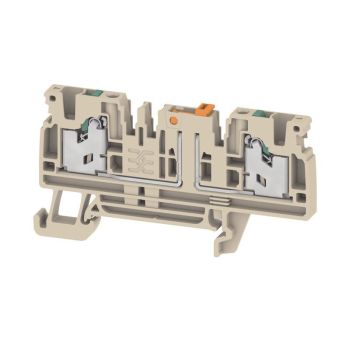
Weidmüller 3016670000 SDT 2.5 2C Terminal Block
| Lieske Part No. | 608213 |
|---|---|
| Mfg Part No | 3016670000 |
| EAN-Code | 4099986926523 |
| Manufacturer | Weidmüller |
| Here only | 3,16 EUR
3,76 EUR incl. VAT
|
Further information for Weidmüller 3016670000 SDT 2.5 2C Terminal Block
| General | |
| Function | separation of circuits |
| Application | tests, measurements |
| Mounting method | SNAP |
| Cross section | 2,5 mm² |
| Number of connection points | 2 C |
Applications
The SDT 2.5 2C is used in industrial electrical engineering where safe and rapid disconnection of circuits is essential. Typical applications include maintenance, servicing, and diagnostics of control and switching systems. The terminal is particularly suitable for installations where frequent testing or measurements are performed, as it enables repeatable and secure disconnection. It is mounted in enclosures, control systems, and distributors where multiple conductors are connected in a row.
Functions and Features in Detail
The terminal is designed as a test-disconnect terminal block, meaning it is specifically designed for use in measurement and testing procedures. The disconnection function is achieved via a mechanical lock that interrupts the electrical contact between the connected conductors. The terminal features two connection points, each intended for one conductor. The designation 2C indicates dual contact, with disconnection occurring between the two contacts. The terminal is designed for maximum current load suitable for industrial applications.
Technology Explained Simply
The SDT 2.5 2C operates on the principle of a terminal block, where multiple terminals are arranged in a row and provide a common screw or push-in connection. The disconnection function is implemented via an integrated locking mechanism that interrupts the electrical contact between the two connected conductors. This mechanism can be manually operated to perform the disconnection. The terminal is designed for a conductor cross-section of 2.5 mm², which is a standard size in industrial electrical engineering. The designation SNAP indicates quick mounting, where the terminal is inserted into a corresponding strip.
Compatibility and Accessories
The terminal can be combined with various accessories that support functionality and identification. These include cross-connectors such as the ZQV 2.5N/3 BK or ZQV 2.5N/9 BL, which enable electrical connections between multiple terminals. For identification, markers such as the WS 8/5 MC NE GE or DEK 5/5 MC NE BL are available, enabling clear identification of connections. Additionally, component connectors such as the BEST or BEST/D are available, ensuring secure connections to other components. Combining with fuse holders such as the SIHA 3/G20/LD 10-36V enables integrated protection functions in the circuit.
Mounting and Installation
Mounting is done into a standard terminal block strip, where the terminal is inserted into the strip using a SNAP mechanism. The connecting conductors are inserted into the terminal openings and secured using the integrated screw or push-in connection. Disconnection is performed by operating the integrated lock, interrupting the electrical contact. The terminal is intended for use in enclosures and distributors, with mounting in a row to ensure a structured and clear arrangement of conductors.
Operational Advantages
The SDT 2.5 2C provides a safe and reliable disconnection of circuits, essential for performing tests and measurements. The quick mounting via the SNAP mechanism reduces installation time. Compatibility with various accessories such as markers and cross-connectors allows flexible and individual adaptation to specific requirements. The terminal is designed for industrial use and offers high mechanical stability as well as secure electrical disconnection.

This is an offer of:
79279 Vörstetten
https://industry-electronics.com
Tel. 07666/88499-0
Fax. 07666/88499-111
Diesen Artikel finden Sie unter:
industry-electronics.com/artikel/608213

Lieske Elektronik e.K.
Reutener Str. 1079279 Vörstetten
https://industry-electronics.com
Tel. 07666/88499-0
Fax. 07666/88499-111
Diesen Artikel finden Sie unter:
industry-electronics.com/artikel/608213