
Weidmüller 1952130000 PTDS 4 FieldPower connector 5p
Industrial Material > Automation > Industrial bus systems
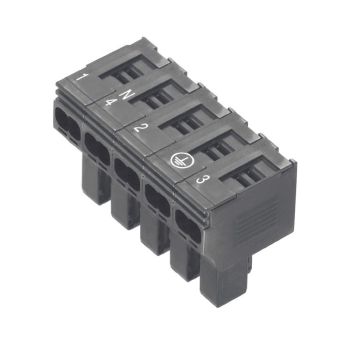
Weidmüller 1952130000 PTDS 4 FieldPower connector 5p
| Lieske Part No. | 499004 |
|---|---|
| Mfg Part No | 1952130000 |
| EAN-Code | 4032248632084 |
| Manufacturer | Weidmüller |
| Here only | 134,90 EUR
160,53 EUR incl. VAT
|
Further information for Weidmüller 1952130000 PTDS 4 FieldPower connector 5p
| General | |
| Cable cross-section | 0.5 to 4 mm² |
| Number of poles | 5 |
| Accessories | stripping tools AM 25, AM 16; locking hooks ZVR ZP2.5; terminal marking WS 12/6 MC NE WS; screwdriver SDS 0.5x3.0x80 |
Applications
The PTDS 4 connector is suitable for use in industrial automation technology, particularly in installations with field power supply. It is frequently used in machine building, manufacturing plants, and packaging technology, where reliable power supply to various modules is required. The connection is made using push-in technology, which accelerates installation and ensures secure contact. The application is in environments where quick and repeatable connections are required, without the need for additional tools for connection.
Functions and Equipment in Detail
The connector features push-in connection technology, enabling simple and fast cable connection. Cable cross-sections range from 0.5 mm² to 4 mm², covering a wide variety of cable types. The connector is designed for 5 poles, allowing multiple connections in a single connector. Contacting is achieved through a mechanical locking mechanism, ensuring a secure and durable connection. The connection technology is designed to be performed without tools, reducing installation time and minimizing error susceptibility.
Technology Explained Simply
The push-in technology allows the cable to be simply inserted into the contact, activating a mechanical locking mechanism. This technology ensures that the cable cannot be accidentally released, even under mechanical stress. Contacting is achieved through a metallic connection, ensuring low contact resistance and high electrical conductivity. The construction is designed to provide high mechanical stability, which is crucial for use in industrial environments. The connector is designed for use in field power supplies, where continuous power supply is required.
Compatibility and Accessories
The PTDS 4 connector can be combined with various accessories to optimize installation and operation. These include stripping tools such as AM 25 and AM 16, suitable for PVC round cables and enabling precise cable stripping. Additionally, the locking hook ZVR ZP2.5 is available, supporting secure fastening of the connector to cables or lines. For marking terminals, the WS 12/6 MC NE WS terminal marking MultiCard can be used, enabling clear labeling of connections. A screwdriver SDS 0.5x3.0x80 is also available as an accessory, used during installation of additional fastening elements or during maintenance.
Installation and Mounting
Mounting of the connector is tool-free, as the push-in technology allows easy insertion of the cable into the contact. Locking occurs automatically once the cable is fully inserted. Installation requires no additional tools, reducing installation time. The connection is immediately functional once the cable is inserted and locked. Mounting typically occurs on cables or lines located near electrical modules. The connection is designed to remain stable even during frequent installation and removal.
Advantages in Operation
The PTDS 4 connector offers high reliability and fast installation during operation. The push-in technology reduces installation time and minimizes error susceptibility. The mechanical locking ensures that the connection remains stable even under mechanical stress. Use in field power supplies enables continuous power supply to connected modules. Compatibility with various accessories expands application possibilities and simplifies maintenance and component replacement. The construction is designed to meet the requirements of industrial automation technology, without requiring additional tools or special mounting procedures.

This is an offer of:
79279 Vörstetten
https://industry-electronics.com
Tel. 07666/88499-0
Fax. 07666/88499-111
Diesen Artikel finden Sie unter:
industry-electronics.com/artikel/499004

Lieske Elektronik e.K.
Reutener Str. 1079279 Vörstetten
https://industry-electronics.com
Tel. 07666/88499-0
Fax. 07666/88499-111
Diesen Artikel finden Sie unter:
industry-electronics.com/artikel/499004