
Weidmüller 1697540000 ZQV 2.5/50 Cross Connector
Industrial Material > Connection technology > Terminals
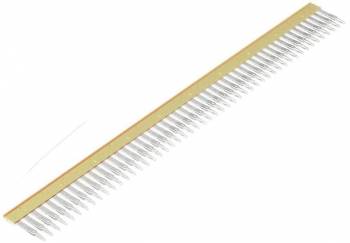
Weidmüller 1697540000 ZQV 2.5/50 Cross Connector
| Lieske Part No. | 200658 |
|---|---|
| Mfg Part No | 1697540000 |
| EAN-Code | 4008190883256 |
| Manufacturer | Weidmüller |
| Here only | 18,67 EUR
22,22 EUR incl. VAT
|
Further information for Weidmüller 1697540000 ZQV 2.5/50 Cross Connector
| General | |
| Application | Power distribution, signal transmission |
| Compatibility | DIN rail terminal blocks |
| Nominal cross section | 2,5 mm² |
| Maximum number of connectable terminals | 50 |
Applications
The ZQV 2.5/50 is used in industrial electrical installations where uniform potential distribution is required. Typical applications include connecting multiple terminals in a row to ensure, for example, a common earth potential or a common supply voltage. It is suitable for systems requiring high contact reliability and mechanical stability, such as in manufacturing automation, machine building, or building automation. The connector is used exclusively in combination with through-type terminal blocks that feature the appropriate contact surface for the cross connector.
Functions and Features in Detail
The cross connector enables the electrical connection of multiple terminals in a row, creating a common potential. It is inserted into the contact openings of the terminal blocks, ensuring direct electrical contact between individual terminals. The design ensures a stable connection that remains intact even under mechanical stress or vibrations. The connection is made via metallic contact surfaces, achieving low transition resistance and high conductivity. The number of connectable terminals is limited by the length of the cross connector and the arrangement of the terminals.
Technology Explained Simply
The ZQV 2.5/50 operates on the principle of direct metallic contact. It is inserted into the contact openings of the terminal blocks, connecting the electrical contacts of individual terminals. This creates a common potential across multiple terminals. The designation 2.5/50 refers to the nominal cross-section size of the terminals (2.5 mm²) and the maximum number of connectable terminals (50). The design ensures high mechanical stability and reliable electrical conductivity. The connection does not depend on additional connection elements such as screws or solder joints, but is achieved solely through the contact surfaces.
Compatibility and Accessories
The cross connector is designed exclusively for through-type terminal blocks that have the appropriate contact surface for the connector. It is not suitable for other terminal types, such as end terminals or terminals without through-connection. It is used in combination with terminal blocks supporting a nominal cross-section of 2.5 mm². There are no specific accessories that must be combined with this connector; its function is achieved solely through mechanical insertion into the terminals.
Installation and Mounting
Mounting is done by simply inserting the cross connector into the contact openings of the terminal blocks. No additional fastening or tools are required. The connection is established by the mechanical fit between the connector and the terminals. Installation typically occurs during the mounting of the terminal block row, with the cross connector inserted into the contact openings after the terminals are installed. Correct positioning is crucial to ensure a reliable electrical connection.
Operational Advantages
The ZQV 2.5/50 provides a simple and reliable method for potential distribution in terminal block systems. The direct metallic connection ensures low transition resistance and high conductivity. Mounting is quick and requires no additional tools. The connection is mechanically stable and resistant to vibrations and mechanical loads. Its use in industrial applications ensures high operational safety and reduces the risk of contact errors or potential shifts.

This is an offer of:
79279 Vörstetten
https://industry-electronics.com
Tel. 07666/88499-0
Fax. 07666/88499-111
Diesen Artikel finden Sie unter:
industry-electronics.com/artikel/200658

Lieske Elektronik e.K.
Reutener Str. 1079279 Vörstetten
https://industry-electronics.com
Tel. 07666/88499-0
Fax. 07666/88499-111
Diesen Artikel finden Sie unter:
industry-electronics.com/artikel/200658