
WAGO 2857-569 1PH-P-Transducer
Industrial Material > Industrial relays and contactors > Switching units / measuring, control relay
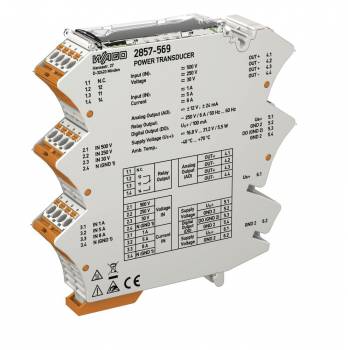
WAGO 2857-569 1PH-P-Transducer
| Lieske Part No. | 1953966 |
|---|---|
| Mfg Part No | 2857-569 |
| EAN-Code | 4055143907323 |
| Manufacturer | WAGO |
| Here only | 446,50 EUR
531,33 EUR incl. VAT
|
Further information for WAGO 2857-569 1PH-P-Transducer
| General | |
| Product type | 1-phase power transducer |
| Input signals | current and voltage signal |
| Output signals | current and voltage signal |
| Configuration | via software |
| Supply voltage | 24 V DC |
| Digital output | |
Applications
The power transducer 2857-569 is designed for use in industrial control and monitoring systems, particularly in installations where precise measurement of electrical power is required. This includes, for example, machine controls, energy consumption measurements in production facilities, or monitoring systems for electrical loads. The ability to process both current and voltage signals makes it flexible for use in various network configurations, especially in single-phase systems.
Functions and Equipment in Detail
The device features a current and voltage input that captures the electrical signals from the monitored network. These signals are processed internally to calculate the electrical power. The output is provided via current and voltage outputs, suitable for driving controllers, displays, or other control components. The integrated digital output enables the transmission of digital signals, for example, for alarms or status messages. Configuration is done via software, allowing the user to adjust measurement parameters individually. The supply voltage of DC 24 V is a standard value in automation technology and ensures reliable power supply.
Technology Explained Simply
A power transducer like the 2857-569 measures the electrical power flowing in a circuit by simultaneously capturing voltage and current. Internal circuits calculate the power, which is then transmitted via analog outputs (current and voltage signals) or a digital output. Software configuration allows adjustment of the measurement range, scaling, and other parameters to meet the requirements of the specific application. The supply voltage of DC 24 V is a common voltage in industrial electronics and is often provided via control systems or external power supplies.
Compatibility and Accessories
Various accessories are available for this device to facilitate installation and labeling. These include multilabeling systems from the WMB series in various versions, such as blank or printed labels with horizontal prints for number ranges 1–10, 11–20, 21–30, 31–40, 41–50, and 1–50. Additional accessories include labeling strips, bridging combs, potential taps in various cross-sections (2.5–6 mm² and 10–16 mm²) with or without fuses, as well as tools such as an actuation tool and screwless end terminals. Communication cables for USB connection (lengths 2.5 m and 5 m) are also available to enable software configuration.
Mounting and Installation
Mounting is done on standard DIN rails (TS 35), enabling easy integration into existing enclosures. Connections are made via terminals designed for wiring. Labeling of the terminals can be done using the available multilabeling systems to ensure clear identification of signals. Software configuration requires a computer with a USB port and the corresponding communication cable to perform the settings.
Advantages in Operation
The power transducer 2857-569 provides precise and reliable measurement of electrical power in single-phase systems. The combination of analog and digital outputs allows flexible integration into existing control and monitoring systems. Software configuration offers flexibility in adapting to specific requirements, while the supply voltage of DC 24 V represents a standard solution in automation technology. The use of accessories such as labeling systems and tools simplifies installation and maintenance.

This is an offer of:
79279 Vörstetten
https://industry-electronics.com
Tel. 07666/88499-0
Fax. 07666/88499-111
Diesen Artikel finden Sie unter:
industry-electronics.com/artikel/1953966

Lieske Elektronik e.K.
Reutener Str. 1079279 Vörstetten
https://industry-electronics.com
Tel. 07666/88499-0
Fax. 07666/88499-111
Diesen Artikel finden Sie unter:
industry-electronics.com/artikel/1953966